


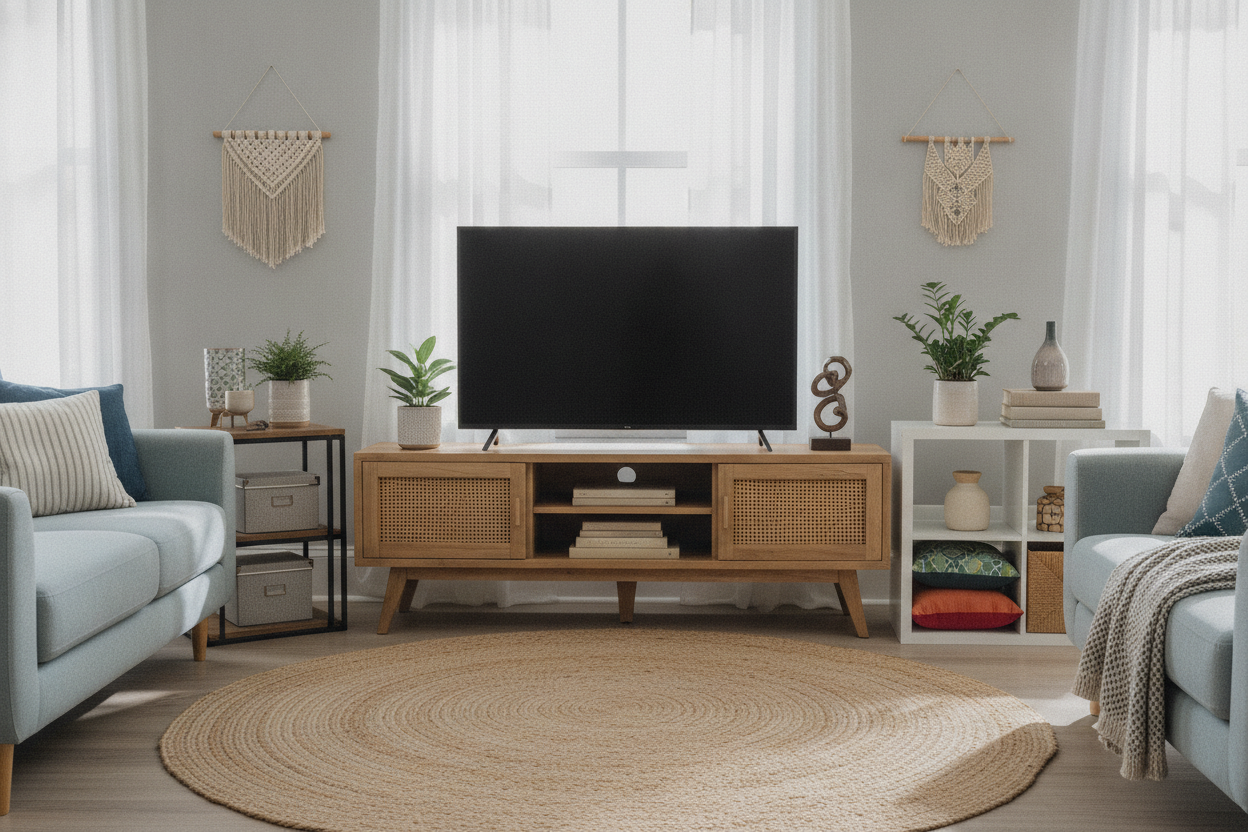
I have lived in six apartments in ten years. That is a lot of security deposits, a lot of U-Haul boxes, and a truly embarrassing number of broken cam locks. Every time I moved, I would stare at my sagging inexpensive media console and tell myself I would finally buy the $1,200 solid walnut version once I settled in. But life happens, and usually, that money goes toward a new rug or a plumber.
The truth is, most of us are stuck in the cycle of buying the best cheap tv stands we can find, hoping this one won't be the one that collapses under the weight of a soundbar. I have owned the 'disposable' furniture. I have seen the paper-thin laminate peel off like a bad sunburn. But I have also found a few gems that have survived three moves and still look like they cost a month's rent.
- Check the center: If it is longer than 40 inches and doesn't have a center support leg, it will sag within six months.
- Material matters: Look for 'MDF' over 'Hollow Core' or 'Particleboard' if you want any structural integrity.
- Weight limits: If the listing doesn't specify a weight capacity for the top shelf, keep scrolling.
- Hardware swaps: Replacing plastic knobs with heavy brass or matte black steel instantly changes the vibe.
The Particleboard Problem (And Why I Kept Buying Junk)
For years, I was the queen of the $89 budget tv stand. I’d see a photo online of a sleek, mid-century modern unit, ignore the 'assembly required' warning, and spend four hours on a Tuesday night fighting with an Allen wrench. By Wednesday morning, I’d have a piece of furniture made essentially of compressed sawdust and hope. The problem isn't just that it's cheap; it's that it's structurally doomed from the start.
Most entry-level units use paper laminate. It looks like wood for about three weeks until you set a sweating water glass on it. Once that moisture hits the particleboard underneath, the wood swells and the 'finish' bubbles up. I once had a console where the middle shelf literally bowed into a U-shape because I dared to put a few coffee table books on it. It looked sad, it felt flimsy, and when it came time to move, the screws simply ripped out of the pulp as soon as we lifted it. I was basically paying a 'crap furniture tax' every two years because I refused to look at the actual specs of what I was buying.
What to Look For When You Can't Afford Solid Wood
You do not need a four-figure budget to get something decent, but you do need to be a bit of a nerd about the details. After spending three nights reading countless Wirecutter TV stand reviews, I realized I was looking at the wrong things. I was looking at the style; I should have been looking at the weight capacity and the leg construction.
The best cheap tv stand is almost always going to be made of MDF (Medium Density Fiberboard). It is heavier and denser than standard particleboard, meaning it holds screws better. When searching for the best budget tv stand, I now look specifically for a fifth leg in the dead center. This prevents the 'smile' effect where the top shelf sags under the TV. If a unit is 50 inches wide and only has four legs at the corners, it is a hard pass for me.
Also, pay attention to the cam locks—those little round metal bits you turn with a screwdriver. If they are made of cheap pot metal, they will snap. I always look for best affordable tv stands that use steel hardware. If you are shopping for a cheap and best tv stand, check the reviews specifically for 'sturdiness' and 'weight.' If a unit is rated for 100 lbs and your TV is 40 lbs, you are in the safe zone. If it's rated for 50 lbs, you are living on the edge.
3 Cheap Upgrades That Fake a Custom Build
If you have already bought one of the best cheap tv stands and it looks a little 'dorm room,' don't panic. You can fix it for under $30. The first thing I do with any budget piece is toss the included hardware. Most inexpensive consoles come with light, hollow plastic knobs that feel terrible to touch. Spending $15 on heavy, solid metal pulls from a hardware store makes the entire unit feel substantial every time you open a cabinet door.
Secondly, address the raw edges. Cheap furniture often has exposed 'raw' edges on the back or inside the shelves. You can buy iron-on edge banding for about $10 that matches the wood grain. It covers those ugly brown strips of particleboard and makes the piece look like it was finished by a professional. It takes ten minutes and an old clothes iron, but the difference is massive.
Finally, you have to deal with the wires. Nothing makes a console look cheaper than a tangled mess of black cords hanging out the back. A stand for TV that hides every cable is usually just a regular stand with some clever management. I use adhesive cable clips and a power strip mounted to the back of the unit itself. If you can see the wall behind the console but no wires, people will assume you spent way more than you actually did. It is the easiest way to make a best cheap tv stand look like a high-end designer find.
My Current Setup (And Why It Survived My Last Move)
My current media center is a $180 find that I have had for three years. It is not an heirloom, but it is a survivor. Why? Because it has a steel frame. When you are looking for cheap and best tv stands, metal frames are the ultimate cheat code. The wood bits might be inexpensive laminate, but the structure is held together by bolts and steel, not just glue and wooden dowels. It survived a cross-town move in the back of a pickup truck without a single wobble.
Finding a cheap and best tv stand is about compromise. I don't mind if the back panel is thin cardboard, as long as the legs are solid and the top shelf is reinforced. My current setup anchors my living room without looking like I'm still living in my first post-college studio. It feels grown-up because I took the time to swap the handles and hide the wires. You don't need a massive bank account to have a nice home; you just need to know which corners are okay to cut and which ones will make your TV end up on the floor.
FAQ
How much should I spend on a budget TV stand?
For a 50-to-60-inch TV, the sweet spot is usually between $150 and $250. Anything under $100 is likely made of 'hollow core' material (basically cardboard honeycomb), which won't survive a single move. At the $200 mark, you start seeing better MDF and metal reinforcement.
Can I paint a cheap laminate media console?
Yes, but you can't just slap paint on it. You need a high-quality 'bonding primer' first. Laminate is non-porous, so regular paint will peel off in sheets. Sand it lightly, prime it, and then use a cabinet-grade paint for a finish that actually stays put.
What is the most important feature for a TV stand?
Weight capacity and depth. Many modern 'inexpensive' stands are very shallow (12-14 inches). If you have a TV with a wide 'V' shaped stand, make sure the legs won't hang off the edge. Always aim for a stand that is at least 3-4 inches deeper than your TV's base.

Laisser un commentaire
Ce site est protégé par hCaptcha, et la Politique de confidentialité et les Conditions de service de hCaptcha s’appliquent.