


I was three hours deep into a Reddit rabbit hole, staring at a 65-inch OLED that still sat on its cardboard box because I couldn't decide where to put it. I wanted something that wouldn't collapse under the weight of a soundbar but also didn't look like it belonged in a dorm room. Naturally, I typed best tv stand wirecutter into Google, expecting a quick answer that would solve my life.
- Tech reviews prioritize ports and airflow over living room aesthetics.
- Always choose a stand at least 6-10 inches wider than your TV's actual width.
- Slatted wood doors are the secret to hiding tech while keeping remotes functional.
- Avoid 'tech-bro' recommendations that look like industrial server racks.
Why I Started My Search With Product Review Sites
Buying furniture online is a special kind of hell. You're trying to judge the structural integrity of a 100-pound object based on three photos and a bunch of reviews from people who just moved into their first apartment. I wanted a shortcut. When I searched for a wirecutter tv stand, I was looking for someone to tell me, 'Buy this one, it won't wobble, and the assembly won't make you want to file for divorce.'
We trust these sites because they do the legwork. They measure the heat dissipation and the weight capacity. But as I scrolled through the top picks, I realized something was missing. The recommendations felt sterile. They were perfect for a basement media room where the lights are always off, but they felt completely out of place in a living room with linen curtains and a Persian rug.
The Problem With Tech-Focused Furniture Reviews
The fundamental issue is priorities. A tech reviewer wants to know if your receiver will overheat and if there's enough room for a massive center-channel speaker. Those are valid concerns, but they shouldn't be the only concerns. If you follow the best tv stand recommended by tech bros, you often end up with something that looks like it was salvaged from a RadioShack backroom.
I’ve seen too many 'top-rated' stands made of cheap, glossy black glass or metal poles that scream 2004. They focus so much on cable management 'solutions'—usually just plastic clips that break after a month—that they forget the piece needs to actually look like a piece of furniture. Your living room shouldn't look like an IT department.
What I Bought Instead (Function Meets Actual Style)
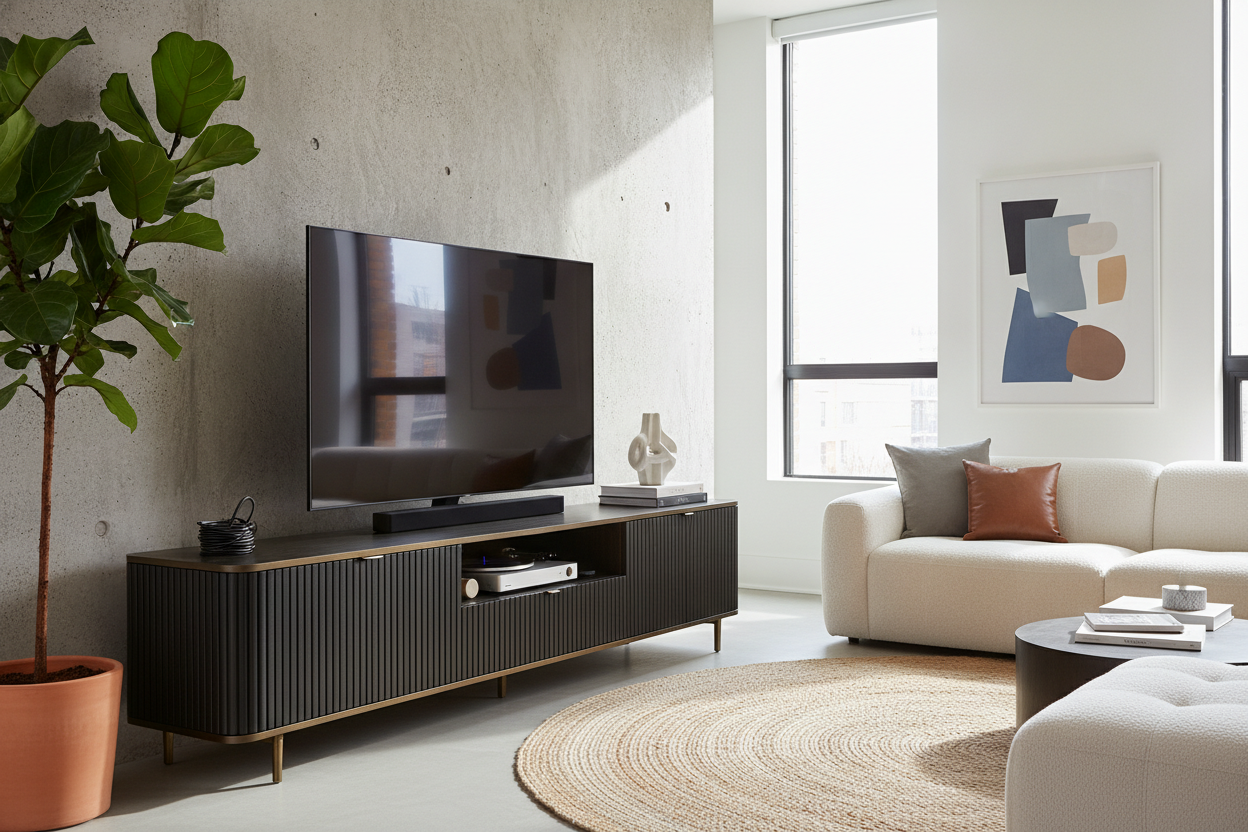
I eventually stopped looking at tech specs and started looking at architecture. I needed a piece that felt warm and residential. I settled on a mid-century modern TV stand with slatted doors. This was the 'aha' moment for me. The slatted front is a design trick that solves the technical problem: it allows infrared signals from my remote to hit the devices inside and lets air circulate so my Xbox doesn't melt.
It’s made of actual wood veneer, not that paper-thin laminate that peels if you spill a drop of water. It has a presence. When the TV is off, it looks like a beautiful sideboard. When the TV is on, it does its job without drawing attention to a mess of tangled black wires. It’s the compromise I didn't think existed when I was looking at those industrial metal racks.
3 Things to Look for That Review Sites Forget
First, let's talk about the 'overhang' rule. If your TV is 55 inches wide and your stand is 55 inches wide, it looks terrible. You want at least 4 to 6 inches of breathing room on either side to 'anchor' the screen. Second, check the height. Most people buy stands that are too tall, forcing them to crane their necks. Your eyes should be level with the middle of the screen when you're sitting on your sofa.
Third, consider the 'hidden' versus 'shown' ratio. I like a storage credenza with sliding glass doors for things I actually want to see, like a vintage record player or a stack of art books. Everything else—the router, the power strip, the messy controllers—needs to be behind a solid or slatted door. Tech sites often suggest open shelving for airflow, but that’s just an invitation for visual clutter.
Final Verdict: Should You Trust the Internet's Favorite Picks?
Don't get me wrong, I still check the reviews to make sure a piece isn't a total lemon. But I've learned that a 'best of' list is just a starting point, not a final answer. You have to live with this furniture every single day. If a stand has perfect cable management but makes your living room feel like a cubicle, it's not the right stand.
Trust your gut on the aesthetics. Look for real materials, proper proportions, and smart ways to hide the tech without sacrificing the vibe of your home. If you're ready to stop settling for 'utilitarian' and start looking for something you'll actually love, go ahead and browse beautifully designed TV stands that put design first.
How wide should my TV stand be?
Ideally, the stand should be at least 6 to 10 inches wider than the actual width of your TV. This prevents the 'lollipop' look where the TV seems to be teetering on a base that's too small.
Do I really need a stand with holes for cables?
Yes, but don't let that be the deciding factor. You can easily drill a neat 2-inch hole in the back of almost any wood cabinet with a $10 hole saw bit from the hardware store. Don't pass up a beautiful vintage piece just because it lacks built-in holes.
Is solid wood always better than MDF?
Not necessarily for a TV stand. High-quality MDF with a real wood veneer is often more stable and less prone to warping under the heat of electronics than solid wood. Just stay away from the cheap particle board that feels like compressed sawdust.

Laisser un commentaire
Ce site est protégé par hCaptcha, et la Politique de confidentialité et les Conditions de service de hCaptcha s’appliquent.