


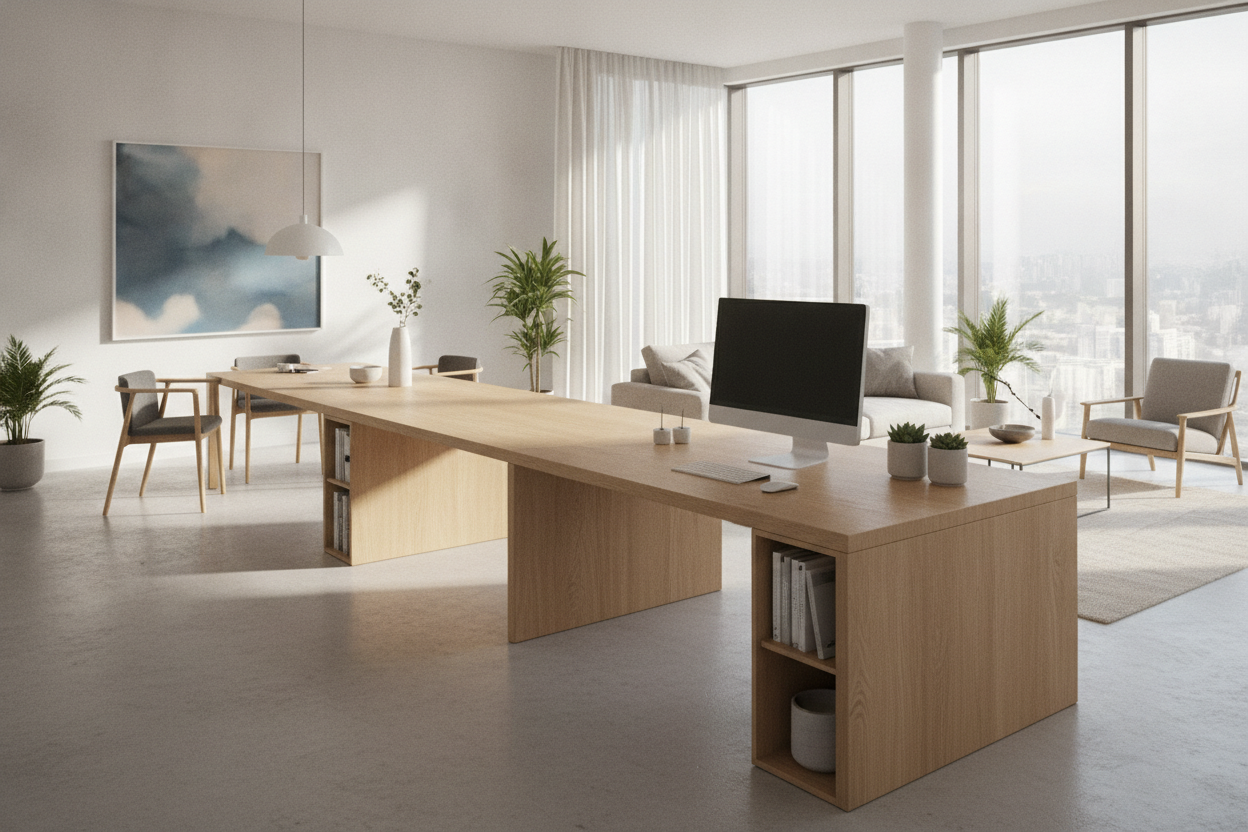
I spent three weeks measuring my floor with blue painter's tape, trying to squeeze a 48-inch desk and a 30-inch cafe table into a corner that clearly only wanted one of them. I ended up with a room that felt like an obstacle course where I was constantly stubbing my toe on a stray metal leg. I spent years trying to justify having both a table and desk in a space roughly the size of a walk-in closet, convinced that 'zoning' my life was the only way to stay sane while working from home.
The reality was much grimmer. My desk was too small for my dual-monitor setup, and my dining table was so tiny I couldn't even host a two-person dinner without moving the salt shaker to the floor. I was living in a cluttered mess of 'right-sized' furniture that didn't actually function. Finally, I admitted defeat, hauled both pieces to the curb, and bought one massive, 72-inch solid wood dining table to do it all.
Quick Takeaways
- Standard 'small space' desks are often too shallow (under 24 inches) for ergonomic comfort.
- A single large table provides more usable surface area than two small pieces with the same total footprint.
- Leg placement is the most critical factor; avoid trestle bases if you want to slide a desk chair in easily.
- A high-quality leather desk mat is the best way to protect a dining surface from laptop heat and mouse scratches.
The Delusion of 'Zones' in a Tiny Apartment
Every interior design blog tells you to create 'zones' for different activities. They say you need a dedicated workspace to signal to your brain that it's time to focus, and a separate dining area to unwind. That's lovely advice if you live in a sprawling suburban colonial. In a 450-square-foot studio, 'zones' are just a polite word for 'clutter.' When you try to force multiple zones into one room, you end up with a forest of furniture legs and zero walking space.
I realized that my brain didn't care about the zones; it cared about the cramped feeling of a tiny desk. I was constantly hitting my elbows on the edges of my 'space-saving' furniture. By trying to follow the rules, I was making my home feel smaller and my work feel more stressful. The moment I cleared out the small pieces, the room breathed. One large, intentional piece of furniture looks like a design choice; three small pieces look like a storage unit.
Why My Separate Table and Desk Setup Failed Miserably
My first attempt at a WFH setup involved a 40-inch desk and a 28-inch round bistro table. On paper, it fit. In practice, it was a nightmare. The desk was so shallow that my monitors were practically touching my face, leading to massive eye strain. Because it was a 'budget' desk made of thin particle board, it shook every time I typed more than twenty words a minute. It felt temporary and cheap, which is exactly how it made my work feel. I Gave Up My Aesthetic Table for a Power Desk (And Don't Regret It) during a previous attempt to fix this, but I eventually realized the desk itself was still crowding my eating space.
Then there was the dining table. It was so light that if I cut a steak too vigorously, my water glass would wobble. I couldn't use it for projects, I couldn't use it for puzzles, and I certainly couldn't use it for work when I got bored of my desk. I had two pieces of furniture, and I hated using both of them. The leg-to-surface-area ratio was also ridiculous. Between the four legs of the desk and the pedestal of the table, I was losing a huge amount of floor space to furniture supports. Switching to a single table & desk hybrid eliminated half the legs and gave me back three square feet of actual floor.
What Makes a Good Table for Desk Use? (No Wobbles Allowed)
When you start looking for a table for desk use, you have to ignore the 'office' section and head straight for the dining room. But you can't just buy any table. Most dining tables are 29 to 30 inches high, which is standard for a desk, but the depth is where people mess up. You want at least 30 inches of depth. Anything less and you'll feel like your monitor is looming over you. I Gave Up on Traditional Desks and Bought a Massive Desk Table because I needed that extra depth to keep my wrists in a neutral position while typing.
Material matters more than you think. Avoid glass—it's cold, it shows every fingerprint, and it's a nightmare for optical mice. Go for solid wood or a high-pressure laminate. I opted for a kiln-dried oak table with a 1.5-inch thick top. It's heavy enough that it doesn't budge when I'm scrubbing a stain or typing an angry email. Also, look at the legs. Corner legs are your friend. Trestle bases or X-frames look cool, but they always seem to be exactly where your knees want to go when you're sitting in an office chair.
The Secret to the Perfect Table & Desk Hybrid
The biggest hurdle to the one-table lifestyle is the 'office' look creeping into your 'home' look. You don't want to eat dinner staring at a tangled nest of black plastic cables. The fix is simple: adhesive cable management clips tucked along the back edge of the table leg. I run all my power cords down one leg, hidden from view. When 5:00 PM hits, I unplug my laptop, tuck the charging cable into a small hook under the tabletop, and the desk disappears.
To protect the wood, I use a large, 36-inch leather desk mat. It defines the workspace during the day and provides a soft surface for my keyboard. At night, I can either leave it (it looks like a high-end blotter) or roll it up in five seconds to set the table for a real meal. As for the chair, I ditched the mesh 'corporate' look for a high-back upholstered dining chair with lumbar support. It’s comfortable enough for an eight-hour shift but doesn't look like it belongs in a cubicle.
What About the Bedroom? (When You Actually Need Two Spaces)
I know what you're thinking: 'I live with a partner who also works from home. We can't share one table.' That's fair. If you absolutely need a second spot, don't try to cram another desk into the living room. Move the secondary workspace to the bedroom, but make it work for its keep. Instead of a clunky metal desk, look for a piece that can double as a vanity or a dressing area. It keeps the 'office' vibe out of your sleeping space.
A piece like the Modern Vanity Desk With Mirror 5 Drawers Shelves And Matching Stool Makeup Dressing Table is a smart move here. It gives you drawers to hide your mouse and notepad at the end of the day, and the mirror makes the room feel larger rather than more cluttered. It’s about finding furniture that has a life outside of your 9-to-5. If it only does one thing, it’s probably taking up too much space.
FAQ
Can I use a regular dining chair as a desk chair?
You can, but look for one with a firm seat and some back support. Avoid 'slumped' mid-century styles if you're sitting there for hours. If you need more height, a simple seat cushion can fix the ergonomics without ruining the aesthetic.
How do I stop my monitors from looking ugly on a dining table?
Use a monitor arm that clamps to the back of the table. It clears up all the space under the screen, making the table look less like a desk and more like a clean surface. Plus, it's better for your neck.
Does a large table make a small room look smaller?
Counter-intuitively, no. One large, clean piece of furniture often makes a room feel more expansive than four or five small, spindly pieces that break up the visual flow of the floor.

Laisser un commentaire
Ce site est protégé par hCaptcha, et la Politique de confidentialité et les Conditions de service de hCaptcha s’appliquent.