


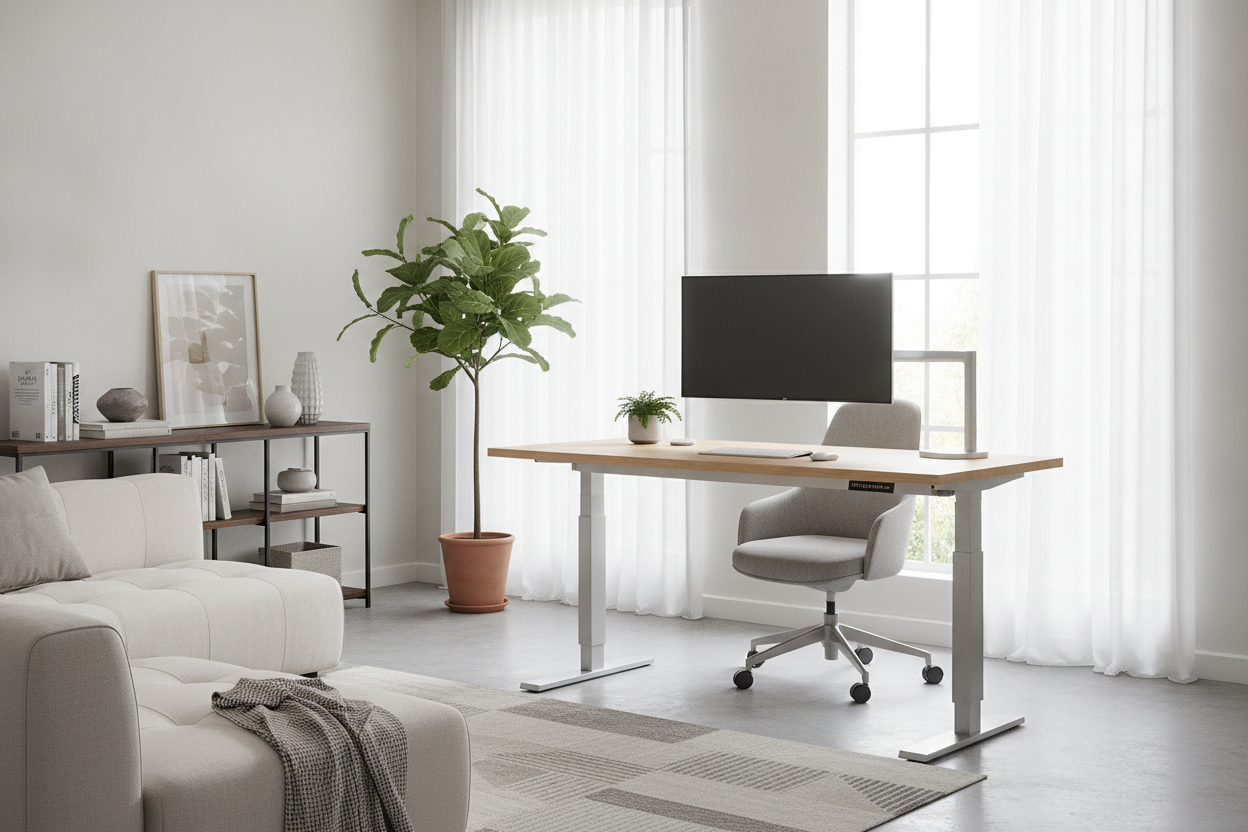
I remember the first standing desk I ever bought. It was a $150 'special' from a big-box store that promised a healthier lifestyle but actually just gave me a vibrating monitor and a persistent headache. I spent best adjustable height desks hours researching, only to find that most reviews ignore the one thing that actually matters: the wobble. If your desk makes your monitor dance every time you hit the 'Enter' key, you are going to hate using it within a week.
- Stability is king; if it shakes at standing height, it is a failed piece of furniture.
- Memory presets are non-negotiable for long-term use.
- Dual motors are quieter, faster, and handle heavy gear better than single motors.
- Cable management requires a plan before you start the assembly.
The 'Two-Week Standing Honeymoon' Phase
We have all seen it happen. You get the new desk, you stand for six hours on Monday, and by Friday your calves are screaming. By the second week, you realize that holding a manual 'Up' button for 30 seconds while the motor whines like a dying blender is just annoying enough to stop doing it. This is where most people give up. They buy based on whether an adjustable standing height desk actually look good in their office, but they forget that mechanics are the heartbeat of the thing.
If the transition from sitting to standing isn't seamless, you will eventually leave the desk at its lowest setting and never touch the buttons again. I have seen countless friends drop $400 on a desk only to treat it like a static table because the adjustment process felt like a chore. You need a motor that moves at least 1.5 inches per second. Anything slower feels like watching paint dry while you are trying to stay in the zone during a meeting.
I once owned a manual crank desk. I think I used the crank exactly three times before deciding my lower back pain was preferable to the arm workout required to raise a 60-inch tabletop. Do not do that to yourself. If you are going to invest in a standing desk, the goal is to remove every possible barrier to movement.
Why I Finally Hunted Down the Best Adjustable Height Desks
The 2 PM brain fog used to be my greatest enemy. I thought it was my lunch, or maybe I just needed more caffeine, but the reality was the physical stagnation of sitting at a standard writing computer desk for eight hours. When you are locked in one position, your blood flow slows down and your energy tanks. I realized I needed a tool that forced me to change my posture without interrupting my thoughts.
A high-quality desk isn't just a surface; it's a productivity hack. When I finally upgraded to a frame that moved with a single tap, my afternoon slumps nearly vanished. I found that standing for even 15 minutes every hour kept my brain sharp. But to get there, I had to stop looking at 'budget' options that were essentially just particle board on toothpicks.
The 'Lean Test' and Why Cheap Frames Fail
Here is the truth: almost every desk is stable when it is 28 inches off the ground. The real test of the best adjustable height standing desk happens when you raise it to 45 inches or higher. This is where cheap frames fall apart. Most 'affordable' desks use single-stage legs with thin 1.5mm steel walls. When those legs extend, there is very little overlap between the segments, creating a pivot point that causes the 'wobble' effect.
If you have a dual-monitor setup or a heavy desktop PC, you need a 71 w height adjustable standing desk with a heavy-duty frame. I personally look for three-stage legs and a base made of at least 2.5mm or 3mm steel. A heavy base acts as an anchor. I perform what I call the 'Lean Test' on every desk I review—if I can't lean my elbows on the front edge to read an email without my screen shivering like it's in a cold draft, the desk is garbage.
Wobble isn't just annoying; it's a distraction. You shouldn't have to type lightly to keep your workspace still. Look for desks that weigh a lot. In the world of furniture, weight is often a proxy for quality. If the shipping box weighs less than 70 pounds, that frame is likely too light to be stable at standing height.
Memory Presets Are Not a Luxury (They're Mandatory)
I will die on this hill: do not buy a standing desk that only has 'Up' and 'Down' buttons. If you have to manually eyeball the height every time you move, you will never get it right. Your body is sensitive to even a half-inch difference in keyboard height. Over time, that slight misalignment leads to wrist strain or shoulder tension.
An electric lift system with memory presets allows you to save your exact ergonomic heights. You hit '1' for sitting and '2' for standing. This allows you to walk away, grab a glass of water, and return to a perfectly adjusted workspace. It removes the friction. When the barrier to standing is reduced to a single button press, you actually do it.
I also recommend looking for a controller with a 'soft start/stop' feature. Cheaper motors tend to jerk when they begin moving, which can tip over a top-heavy coffee mug or shift your monitors. A premium motor accelerates smoothly and slows down gently, keeping your expensive gear exactly where you left it.
How to Program Your Perfect Ergonomic Sweet Spots
Finding your 'sweet spot' is a science, not a guess. Your elbows should be at a 90-degree angle with your shoulders relaxed, and the top third of your monitor should be at eye level. I spent way too long scrolling through the best adjustable standing desk Reddit threads to realize I had been standing about two inches too high for months, which was causing my neck to cramp.
Once you find that millimeter-perfect height, lock it in. I suggest setting a third preset for 'perching'—using a tall stool that lets you half-sit, half-stand. It is the perfect middle ground for those days when your feet are tired but your back needs a break from a standard chair. Create a routine: stand during every internal meeting, and sit for deep-focus work. If you don't build the habit into your calendar, the desk is just a fancy ornament.
Are dual motors really worth the extra money?
Yes, absolutely. Dual motors distribute the load evenly across both legs, which means the desk moves faster and can lift significantly more weight. They also tend to be much quieter, which matters if you are adjusting your height during a Zoom call.
How do I handle all the cables when the desk moves?
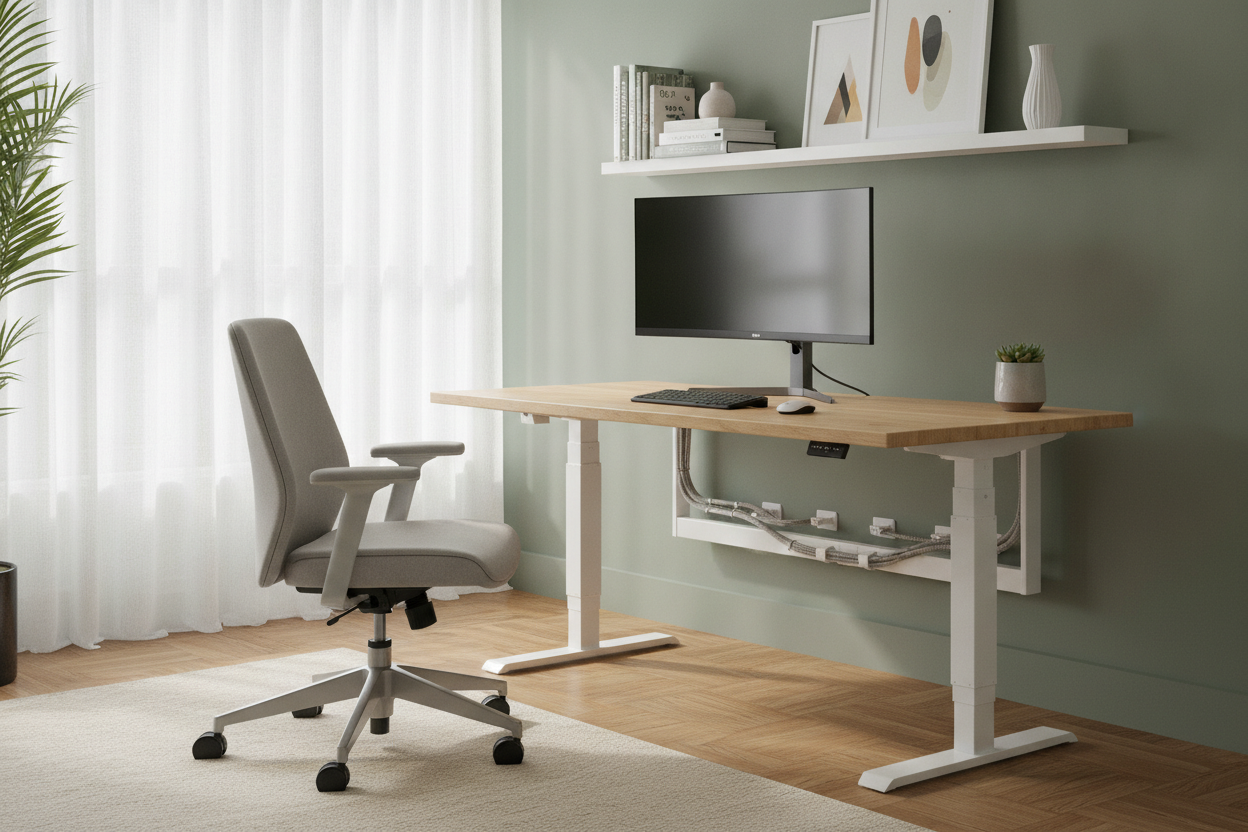
You need a cable management tray that mounts to the underside of the desk. Plug everything—monitors, laptop, speakers—into a single power strip inside that tray. That way, only one main power cord has to travel from the desk to the wall outlet. Just make sure that main cord has enough slack to reach the desk's maximum height without pulling.
Do I need a standing mat?
Standing on a hard floor in socks will kill your heels in less than an hour. A high-density foam standing mat is the secret to actually enjoying a standing desk. It encourages micro-movements in your feet that keep your blood flowing and prevent your legs from feeling like lead pipes by 5 PM.

Laisser un commentaire
Ce site est protégé par hCaptcha, et la Politique de confidentialité et les Conditions de service de hCaptcha s’appliquent.