
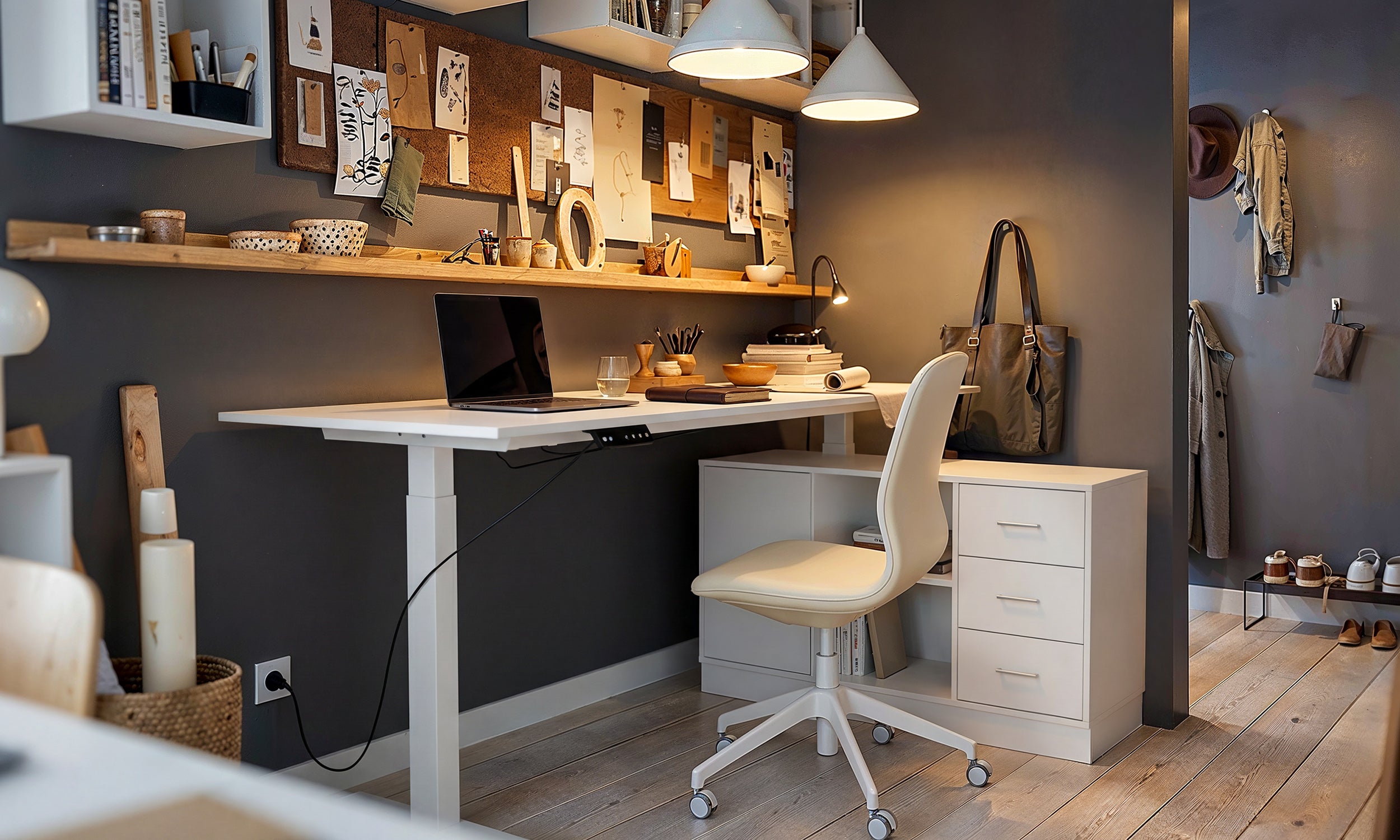
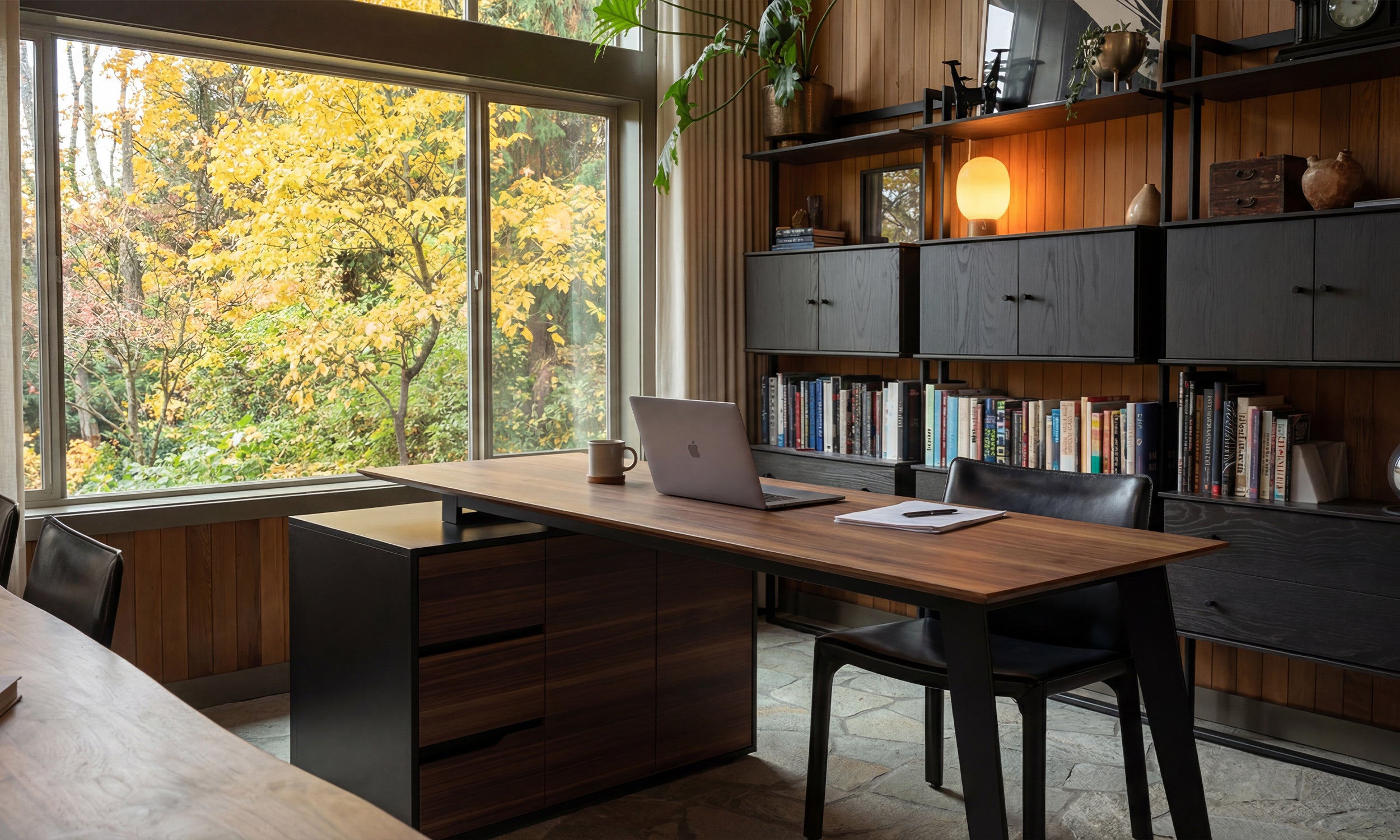

Most standing desks look like office equipment because of what you can see: bare steel legs, a crossbar, a thin laminate top, a control box under the edge and loose cables. A standing desk that isn't ugly fixes those five things: a wood or wood-look top with some visual weight, legs that match the top or disappear into panels and cabinets, cables routed out of sight, a small keypad tucked under the front edge, and storage that looks like cabinetry.
Below: what to check in a listing, how to hide cords safely, how to style the desk, when a fixed desk is the better buy, and four sit-stand desks from the FUFU&GAGA standing desk collection that look more like furniture than office gear.
Key takeaways
- The frame is the problem. Wood-clad columns, panel ends or cabinet bases hide the steel.
- Match the base to the top (or to the wall) so the frame recedes.
- Hide the moving parts: cable management, a discreet keypad and a power strip off the floor.
- Looks never replace fit. Check height range and capacity before the finish.
Why most standing desks look like office equipment
A sit-stand desk, as the Canadian Centre for Occupational Health and Safety (CCOHS) puts it, lets you "alternate between sitting and standing by being able to lower or raise the work (desk) platform" (CCOHS, sit/stand desks). Most are built frame first: two telescoping steel columns, wide T-shaped feet, a crossbar and a top screwed on afterward, often in black, white or gray steel whatever the top looks like.
So the steel shows at every height, the control box is a plastic block under the edge, and cords hang in a loop behind. Even a nice top sits on what looks like call-center equipment. The fix is a desk designed so the lifting parts are covered, matched or hidden.
What makes a standing desk look like furniture?
Use this table to read a listing and its photos.
| Office-equipment cue | Furniture fix | What to check in the listing |
|---|---|---|
| Bare steel legs and crossbar | Wood-clad columns, panel ends or cabinet bases | Base material and base colour |
| Thin, shiny top | Wood-grain or matte top with a clean edge | Top material and finish (thickness is rarely listed) |
| Frame colour that clashes | Base the same colour as the top | Desktop colour vs base colour |
| Plastic control box | Small keypad under the front edge | Controller type and memory presets |
| Cable waterfall | Cable management, power strip off the floor | "Cable management" in the spec |
| Clip-on trays and baskets | Drawers and doors that look like cabinetry | Drawers, cabinets, drawer capacity |
The top: material, edge and thickness
The top is the largest surface you see. A wood-grain finish such as walnut reads as furniture; a solid white or black top reads as modern if the edges are crisp. A top with visual weight, such as a thicker front edge or an apron, looks more like a writing table than a panel on legs. Be realistic about materials: all four picks below use MDF-based tops with a laminated or wood-look surface rather than solid hardwood. None of their listings gives desktop thickness, so judge it from the side view in the photos.
The frame: colour and leg shape
Make the base the same colour as the top, or the wall, so it recedes: a white desk against a white wall almost disappears, and a walnut top on matching wood-look columns reads as one piece. A black frame under a light top pulls the eye to the legs. Slim, tapered or C-shaped legs look lighter than thick square columns on T-feet; better still are legs you don't read as legs, such as wood-clad pedestals, flat panel ends or cabinets that carry the top. A short section of inner column usually shows when the desk rises, so check the photos at standing height too.
The controller and cables
The tidy keypads are small, mounted under the front edge to one side, in black or the top's colour; big boxes that stick out past the edge catch sleeves. Memory presets let a simple keypad do the job in one press. For cables, look for "cable management" in the spec (a tray, channel or clips under the top); a closed base or a built-in power strip helps too.
Storage that looks like cabinetry
Drawers and doors with flush or handle-free fronts look like a sideboard, not an accessory. A cabinet on the floor stays put while the top moves above it; drawers under the top move with it. Our standing desk with drawers guide covers drawer types, knee clearance and drawer weight.
Colour options
Pick the finish by the room: white or light wood in a bright, small room; walnut or black with dark wood, leather or deep paint. If the photos only show one colour, ask for photos of the finish you plan to buy.

How to hide the cords on a standing desk
Every cable to the desktop needs slack for the full lift: top height minus lowest height. On the three picks below that list both heights, that is 14.6 inches (44.1 minus 29.5), 15.3 inches (44.9 minus 29.6) and 18.5 inches (46.6 minus 28.1). Bundle the slack in one loop and check it can't catch on a cabinet, sill or chair.
- Run cords up one leg into a tray, held with clips or a sleeve in the frame colour.
- Get the power strip off the floor: mount it under the top or use a desk with one built in, so one cord goes to the wall.
- Don't hide cords under a rug. The U.S. Consumer Product Safety Commission (CPSC) says: "Never cover any part of an extension cord with rugs or other objects while it is in use," because heat cannot escape. It also says not to overload cords and to look for a certification label from an independent testing lab such as UL (CPSC).
- Treat extension cords as temporary. CPSC's safety sheet says to use them "only when necessary and only on a temporary basis" and to replace cracked or worn cords (CPSC, extension cords and power strips). If the desk is far from an outlet, an electrician can add one.
CCOHS adds that cables, electrical access and storage should not make adjusting the desk difficult. For a desk that floats in the room with its back on show, see our desk in the middle of the room guide.
Is a good-looking standing desk stable at standing height?
Any sit-stand desk moves more at standing height, because the columns are extended. Furniture-style design can help: panel ends, wood-clad pedestals and cabinet bases give a broad stance, while a very slim leg with no crossbar may sway more as you type. Keep the load well under the listed capacity, level the feet, keep heavy items near the legs, and raise the empty desk on arrival to check it before you load it. None of our picks lists a stability rating, so don't assume one. Our adjustable height desk guide covers what to compare between frames.
Will the height range fit you?
CCOHS says the standing platform should be at approximately your standing elbow height. The University of British Columbia's ergonomics team recommends a range from 22.6 inches or lower to 48.7 inches or higher to fit people from about 5 feet to 6 feet 4 inches; with a desk that only goes down to 25 inches, people 5 feet 4 inches or shorter need a footrest or keyboard tray, and a desk that doesn't go below 29 inches is above elbow height for nearly all users (UBC Ergonomics, height adjustable desks).
The picks below go down to 28.1 to 29.6 inches (one listing gives no lowest height) and up to 44.1 to 46.6 inches. Most people will sit with the chair raised and a footrest, and very tall users should check their standing elbow height against the top setting. Our standing desk setup guide walks through the measurements and presets.
How to style a standing desk so it looks like it belongs
Treat it like a console table or writing desk, not a workstation.
- Rug. A low-pile rug under desk and chair defines the zone; make it big enough that the chair stays on it, and keep cords on top of it.
- Lamp. Swap a clip-on LED for a ceramic, brass or wood table lamp. OSHA says lamps should have shades that direct light away from your line of sight and should not reflect on the screen, and that the screen should face at right angles to windows (OSHA, workstation environment). Leave cord slack for the lift.
- Chair. An upholstered or wood-framed chair looks more residential than a mesh task chair, as long as it adjusts to your sitting height.
- Textures. A leather or felt desk pad, a pen tray, a plant and a few books; keep the front edge clear so nothing slides as the desk moves.
- The wall behind. Art, a mirror or a shelf turns the desk into a vignette; see our desk wall ideas guide. In a room without daylight, our windowless office guide covers lighting.
When a fixed desk and a desktop converter is the better choice
If you already own a desk you love, need to match period furniture, or will stand only now and then, a fixed desk that looks like furniture plus a desktop converter (a riser that sits on the desk and lifts keyboard and screen) may suit you better. The desk keeps its legs and drawers, and the converter can come off when guests visit.
The trade-offs: the converter is visible while it is in place, it takes up work surface, and the screen must rise with the keyboard. Cornell University's ergonomics group warns that if you raise the work height you need to raise the screen too, or you get neck flexion (Cornell, sitting and standing). If you will switch positions several times a day, a full sit-stand desk is simpler. For writing desks, secretaries and other designs that hide the office, see our desk that looks like furniture guide.
Buying checklist
- Lowest height at or below your seated elbow height, or a plan for a footrest.
- Top height at or above your standing elbow height.
- Base colour that matches the top or the wall.
- Legs clad, panelled, tapered or hidden by storage, checked in photos at standing height.
- A small keypad under the front edge, ideally with memory presets.
- "Cable management" in the spec, and cord slack equal to the travel.
- Capacity well above the weight of your equipment.
- A footprint that leaves chair space behind the desk.
Our picks: four standing desks that look like furniture
Each has a wood or wood-look top, a base that matches it, and a clad base or cabinet storage. Figures are from the listings; all four arrive flat-packed and need assembly.
63" Modern Walnut Standing Desk with Electric Height Adjustment
The most furniture-like desk here. Top and base are both brown walnut-look, and in the photos the legs are wood-clad pedestals with stepped feet, so at sitting height it reads as a writing table. The 63 x 31.5-inch top rises from 29.6 to 44.9 inches at a steady 20 mm per second on a steel lifting frame, with a 4-preset memory controller and built-in cable management. Capacity is 110 lb.
Best for: a living room, bedroom or bay window where the desk is on show.
Skip it if: you need drawers (none are listed) or run a heavy multi-monitor setup: 110 lb is the lowest capacity here.
71" Modern Minimalist Standing Desk with File Drawer and Storage Cabinet
Clean and handle-free: in the photos, one end is a flat panel and the other a floor-standing cabinet with a drawer and double doors, so no steel legs show, and the top lifts above the cabinet. The 70.9 x 31.5-inch top moves from 29.5 to 44.1 inches with a programmable memory controller, holds 150 lb and has built-in cable management. It comes in white, black or burlywood. One of our most-ordered desks.

Best for: a modern room that needs a large top, closed storage and a finish to match the walls.
Skip it if: you need much drawer space: one drawer rated for 10 lb (no interior size listed) and a cabinet with one shelf. The listing doesn't say how many presets it saves, and every photo shows white.
63" Modern White U-Shaped Standing Desk with 3 Memory Presets, Drawer and Open Storage
All white, with the lifting top carried on white shelf units and cabinets, so it reads as built-in storage rather than a frame. The 63 x 23.6-inch desktop moves from 28.1 to 46.6 inches, the widest range here, with three memory presets and a 200 lb capacity. Storage: five open compartments, two cabinets and a handle-free drawer rated for 22 lb; the cabinet goes on the left or the right. One of our most-ordered desks.
Best for: a light room where the desk should blend into the walls, or a corner.
Skip it if: the room is small: the footprint is 63 x 72.4 inches. The title says U-shaped but some photos show an L arrangement, so check the user manual tab before you plan the room.
59" Walnut Wood Electric Height Adjustable Standing Desk with Pegboard, Power Strip, Keyboard Tray, 3 Drawers and Open Storage Shelves
A walnut-look study piece: in the photos, a 19.6-inch pegboard back with a top shelf rises behind the desktop, and two floor-standing wood units hold the three drawers and four open shelves. It rises up to 45.3 inches, saves up to three heights, holds 170 lb, and adds a built-in power strip and a keyboard tray. Overall it is 59 inches wide, 21.7 inches deep and 56.1 inches high, and it arrives in 2 boxes.

Best for: a traditional or library-style room, with pegboard, drawers and power in one piece.
Skip it if: you need to know the lowest height (not listed) or want a minimal look; black steel columns show between the units. The photos show a light strip under the top shelf that the listing doesn't mention, and the power strip has no outlet count.
Compare the picks
| Desk | Desktop | Height range | Capacity | Presets | Finish | Storage |
|---|---|---|---|---|---|---|
| 63" walnut | 63 x 31.5 in | 29.6 to 44.9 in | 110 lb | 4 | Brown walnut | None listed |
| 71" minimalist | 70.9 x 31.5 in | 29.5 to 44.1 in | 150 lb | Not stated | White, black or burlywood | Drawer, double-door cabinet |
| 63" white U-shaped | 63 x 23.6 in | 28.1 to 46.6 in | 200 lb | 3 | White | 5 compartments, 2 cabinets, drawer |
| 59" walnut pegboard | 59 x 21.7 in overall | Up to 45.3 in | 170 lb | Up to 3 | Brown walnut | 3 drawers, 4 shelves, pegboard |
FAQ
Is there a standing desk that doesn't look ugly?
Yes. Look for one whose lifting frame is covered or matched: wood-clad legs, panel ends or cabinet bases in the same colour as the top, plus cable management and a small keypad. Desks built this way read as furniture at sitting height.
How can I make my current standing desk look better?
Match or hide the frame, route every cable up one leg into a tray, mount the power strip under the top, add a shaded table lamp and a desk pad, and style the wall behind it. A rug and a residential chair do a lot of the work.
Can I put my own wooden top on a standing desk frame?
Many frames are sold without a top, so yes, if the top fits the frame's width range and mounting points and its weight plus your equipment stays within the frame's capacity. Solid wood is heavy, so check the numbers first and follow the frame maker's instructions.
Do good-looking standing desks wobble?
All sit-stand desks move a little at full height. A broad base such as panel ends or cabinets helps, as do level feet and a load well under the listed capacity.
Compare more sizes and finishes in the full FUFU&GAGA standing desk collection.

Laisser un commentaire
Ce site est protégé par hCaptcha, et la Politique de confidentialité et les Conditions de service de hCaptcha s’appliquent.