


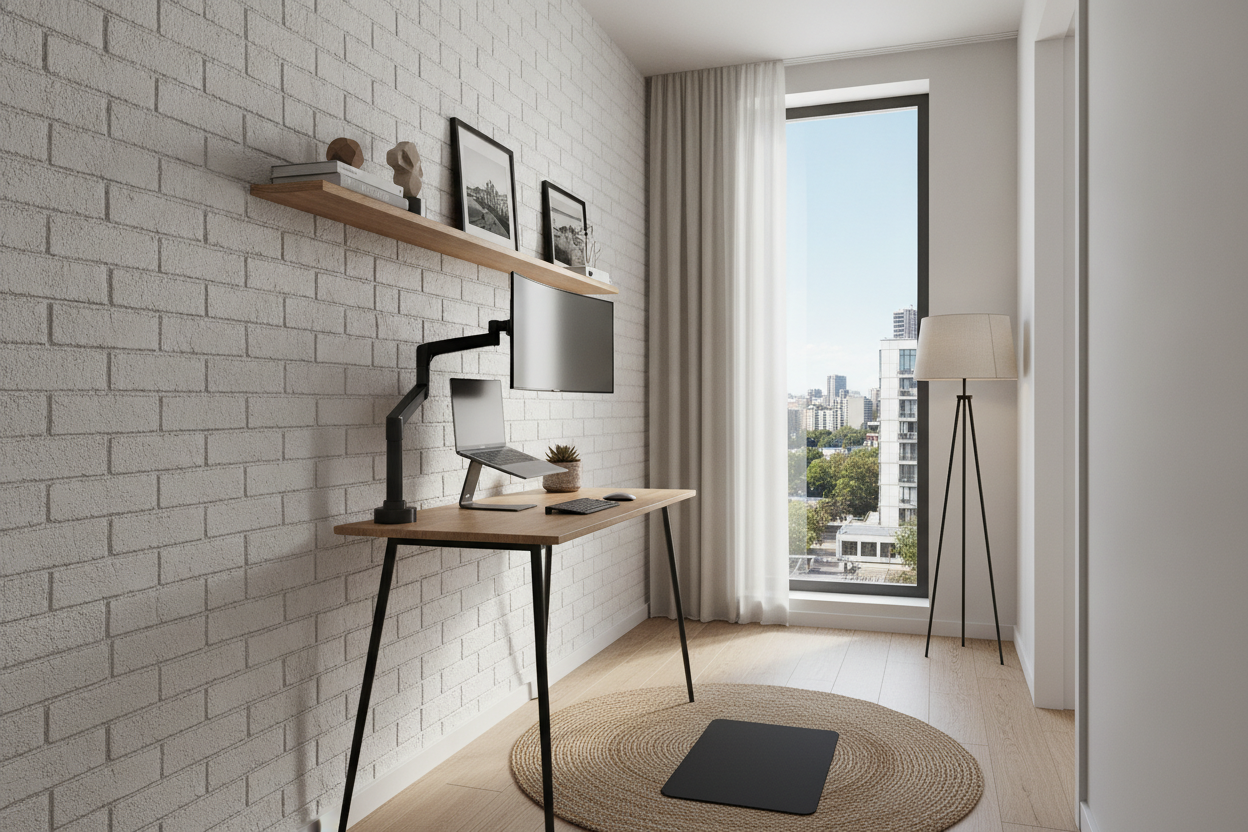
I spent three months staring at a four-foot-wide hallway in my Brooklyn apartment, wondering why I was paying for a dead zone that only served as a graveyard for Amazon boxes. Every time I tried to put a standard desk there, I ended up having to shimmy past it like a crab just to get to the bathroom. The breakthrough didn't come from a smaller chair—it came when I finally bought a skinny tall desk.
- Depth is the enemy: Look for 12 to 15 inches to keep walkways clear.
- Height creates visual volume: Elevated desks make small rooms feel less cramped.
- Standing is social: It’s easier to hop on a quick call and then walk away.
- Cable management is vital: Thin desks show every wire, so buy some clips.
The Dead Space Dilemma (And Why Standard Desks Failed Me)
Standard desks are almost always 24 to 30 inches deep. That is great if you have a dedicated room, but in a narrow apartment, it’s a total space killer. I tried a 24-inch model in my hallway and it felt like I was living in a crowded storage unit. Every time I walked by, I’d clip my hip on the corner or snag my sweater.
Switching to a thin tall desk changed the geometry of the room. By cutting the depth down to 14 inches, I reclaimed enough floor space to actually walk like a normal human. It turns out you don't need a massive mahogany slab to answer emails; you just need enough room for a laptop and a coffee mug. The verticality of the piece makes the hallway feel intentional, rather than just a place where I store my shoes and my regrets.
Why I Chose a Skinny Tall Desk Over a Folding Table
I know what you're thinking: Why not just buy a cheap folding table? Because folding tables are depressing. They wobble, they look like you're at a high school bake sale, and they are never the right height for actual work. I spent weeks finding a truly tall desk that didn't feel like it was made of cardboard.
Standing desks are naturally better for high-traffic areas. When you're sitting, you have a chair sticking out another two feet behind you, creating a massive obstacle. When you're standing, your footprint is just... you. It makes the transition from 'working' to 'living' much faster. I can stand there for a twenty-minute sprint, then step away without having to tuck in a bulky swivel chair.
The Secret to Not Feeling Claustrophobic
There is a psychological trick to working at a shallow desk. When you sit at a 12-inch deep surface, your face is practically pressed against the drywall. It feels like a timeout. But when you stand, your center of gravity is further back, and you have a wider field of vision.
If you compare this setup to a motorized sit stand up desk, you realize how much bulk those heavy-duty frames actually add. By going with a fixed, narrow frame, you lose the weight and the mechanical noise, leaving you with a clean, airy workspace that doesn't dominate the room's aesthetic.
How to Style a Narrow Setup Without It Looking Like Clutter
The biggest risk with a skinny desk is that it quickly becomes a landing pad for mail, keys, and loose change. To avoid this, I had to get aggressive with my organization. I mounted a monitor arm to the back of the desk to get the screen off the surface, which effectively doubled my usable space. If you have too much gear for a 14-inch depth, you might be better off with a compact writing computer desk in a corner, but for a hallway, minimalism is your only friend.
Cable management is the other non-negotiable. On a thin desk, there’s no modesty panel to hide the 'spaghetti' of chargers. I used adhesive clips to run every wire down the back of the leg. If the cords are visible, the whole setup looks like a temporary workstation rather than a permanent piece of furniture.
It's Not Just for Laptops
I’ve found myself using this nook for things that have nothing to do with my job. It’s the perfect height for sorting mail or laying out a planner without having to clear off the dining table. Because it's a tall work desk, it’s also great for quick hands-on tasks like sketching or even folding a small load of laundry.
My one honest mistake? I initially bought a desk with a cross-bar right where my feet wanted to go. Make sure the base is open enough that you aren't constantly kicking the frame. Once you find that balance, you'll wonder why you ever tried to cram a 'real' office into a space that clearly didn't want one.
FAQ
Will my 27-inch monitor fit?
Yes, but use a clamp-on monitor arm. If you use the stock plastic stand, it will take up 60% of your desk depth and you won't have room for your keyboard.
Is it stable enough for typing?
If you buy a model with a steel H-frame or one that anchors to the wall, it's solid. Avoid the ultra-cheap ones with single-pole legs; they shake like a leaf if you type too fast.
What if I want to sit down occasionally?
Get a bar-height stool with a small footprint. Just make sure it can tuck completely under the desk when you aren't using it, otherwise, you've defeated the purpose of the skinny desk.


Laisser un commentaire
Ce site est protégé par hCaptcha, et la Politique de confidentialité et les Conditions de service de hCaptcha s’appliquent.