


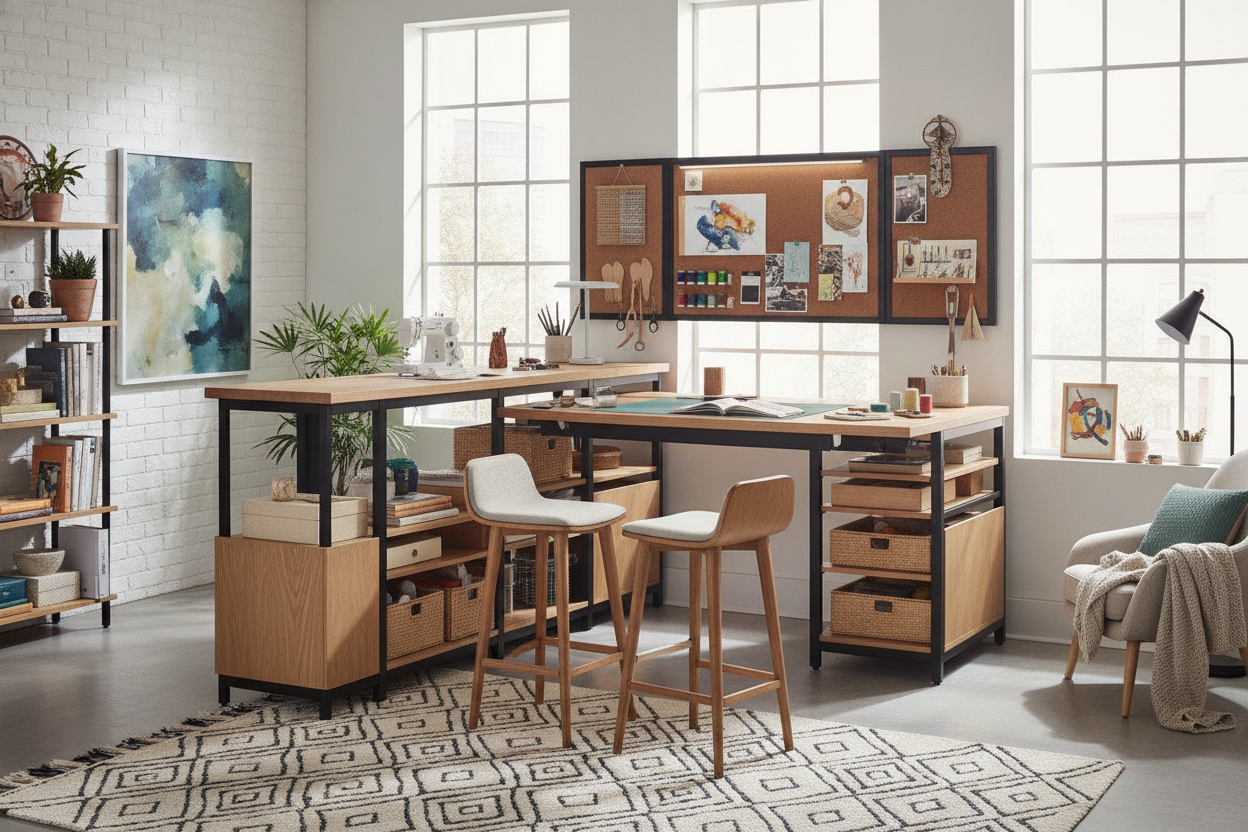
I remember spending four hours straight hunching over my dining table trying to cut fabric for a quilt. By the time I finished, my neck felt like it had been fused into a permanent 'C' shape and my lower back was screaming. We have all been there—trying to force a standard 29-inch table to do the work of a professional studio surface. If you are doing anything more active than typing, you need a tall work desk that actually meets you where you stand.
- Standard 29-inch desks are designed for sitting and typing, not active, hands-on work.
- Fixed-height tall desks offer significantly more stability than cheap motorized frames.
- A wide surface area is just as important as height for creative projects.
- Pairing a tall workstation with a drafting stool allows for a 'perch' posture that saves your knees.
The 29-Inch Trap: Why Standard Tables Ruin Creative Work
Most people buy a writing computer desk thinking it is a universal piece of furniture. It is not. Those desks are engineered for a very specific ergonomic triangle: feet flat on the floor, knees at 90 degrees, and elbows resting gently for a keyboard. That is fine for answering emails, but the second you try to sketch a blueprint, cut a pattern, or assemble a 1,000-piece puzzle, that ergonomics model falls apart. You end up leaning forward, putting your weight on your forearms, and rounding your shoulders.
I have seen so many friends quit their hobbies because of the physical toll. They think they have a 'bad back,' but they actually just have a table that is six inches too low. When you are working on a surface that is too short, your spine is constantly under tension. You lose the ability to use your core for stability and instead rely on your neck muscles to hold your head up while you look down. It is exhausting, and it is entirely avoidable if you stop trying to make office furniture do a studio's job.
My Fix: Committing to a Fixed Tall Work Desk
I fell for the motorized standing desk trend early on. I thought having the option to go up and down was the ultimate solution. But here is the dirty secret about electric frames: most of them are incredibly wobbly once they pass the 40-inch mark. If you are trying to apply pressure to a linocut block or use a heavy sewing machine, the whole desk vibrates like it is in an earthquake. That was my biggest frustration when finding a truly tall desk for standing that actually felt solid.
Eventually, I ditched the motors and bought a fixed-height tall workstation desk with a heavy steel H-frame. The difference was night and day. Because it does not have moving parts or telescoping legs, it is rock solid. I can lean my entire body weight against the edge while I am stretching a canvas and it does not budge. If you are serious about your craft, skip the cheap electronics and go for a fixed frame. You lose the 'one-button' convenience, but you gain a workspace that actually supports the physical reality of making things.
Why You Actually Need a Large Tall Desk (Not a Tiny Cart)
There is a weird trend of selling tiny rolling carts as 'standing workstations.' Unless you are just holding a single 13-inch laptop, those things are useless. If you are a maker, you need a large tall desk. You need room for your cutting mat, your reference books, your coffee, and your actual project. I have found that a 60-inch width is the absolute minimum for a functional workspace. Anything smaller and you are constantly shuffling items around like a slide puzzle, which kills your creative momentum.
Surface area is the one thing no one ever regrets buying more of. You want a desk big enough to actually work without feeling like you are trapped on a tiny island. When I upgraded to a wider top, I noticed I could keep my tools on the periphery and keep the center clear for the task at hand. It sounds simple, but having that 'white space' on your desk prevents that cluttered-brain feeling that usually sets in about an hour into a project. It also means you are not constantly dropping expensive tools off the edge of a cramped table.
Stools vs. Standing: Finding Your Drafting Groove
The biggest mistake people make with a tall desk unit is thinking they have to stand the entire time. Nobody stands for an eight-hour shift without feeling it in their heels. The pro move is to pair your desk with a proper drafting stool—one with a heavy-duty foot ring and a hydraulic lift. This allows you to 'perch.' You are not quite sitting, not quite standing, but your weight is distributed so your legs don't fatigue.
I usually start my morning standing to get the blood flowing while I am prepping materials. Once I get into the fine-detail work that requires more focus, I pull the stool in. Because the desk is already at the right height, I do not have to change my perspective or move my lighting. It is a seamless transition that keeps me in the zone for much longer than a standard chair ever could.
Styling a Tall Writing Table Without Looking Like a Bar
One valid concern is that a tall writing table can sometimes look like a piece of furniture swiped from a local pub. To avoid the 'sports bar' aesthetic, look for architectural details. Avoid the central pedestal base—that is the dead giveaway for a bistro table. Instead, look for clean, rectangular legs or a trestle base. Natural wood finishes like walnut or white oak help the piece feel like an intentional part of your home’s design rather than a piece of commercial equipment.
I personally use a tall desk with a matte black metal frame and a thick butcher-block top. It sits in the corner of my living room, and because the lines are so clean, it looks like a high-end console table when it is not in use. I keep a few ceramic vases on one end to soften the look. It is all about the proportions; if the desk is wide enough and the materials are high-quality, it becomes a focal point of the room rather than an eyesore.
Frequently Asked Questions
What is the ideal height for a tall work desk?
For most people, 36 inches (counter height) is the sweet spot for a mix of sitting and standing. If you are over six feet tall, you might want to look closer to 40 or 42 inches (bar height) to avoid leaning over.
Can I just put bed risers on my current desk?
You can, but I would not recommend it for heavy work. Bed risers make a desk top-heavy and prone to tipping. If you are just typing, it might work, but for crafting or assembly, it is a safety hazard.
Do I need a floor mat?
Absolutely. If you are standing on hardwood or tile for more than an hour, your knees will hate you. Get a high-density foam anti-fatigue mat. It is the best 40 dollars you will ever spend on your hobby.

Laisser un commentaire
Ce site est protégé par hCaptcha, et la Politique de confidentialité et les Conditions de service de hCaptcha s’appliquent.