


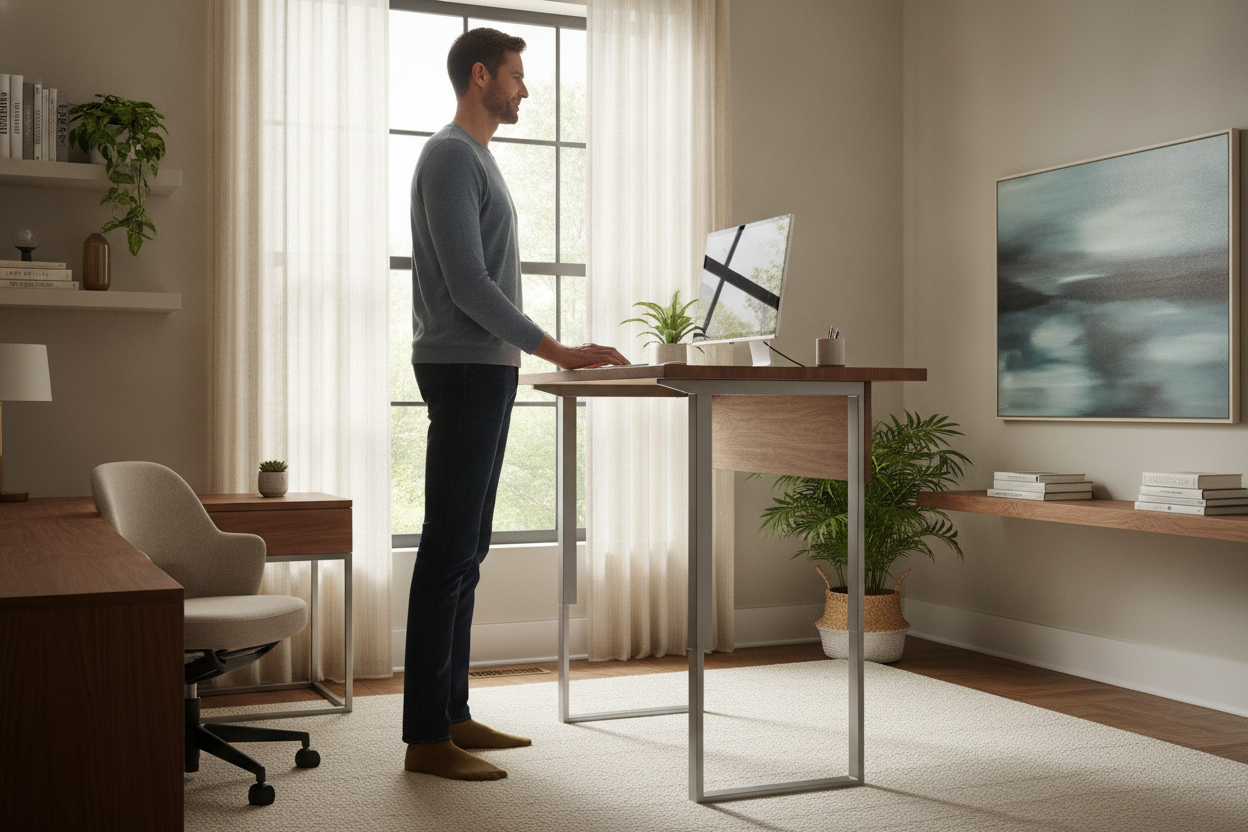
I spent three years hunching over a desk that promised 'ergonomic freedom' only to realize my spine was slowly being shaped into a question mark. At 6'4", the world of office furniture usually feels like it was built for people who stop growing in the eighth grade. Finding a tall desk for standing shouldn't feel like an elite scavenger hunt, but most 'adjustable' options on the market are a total lie for anyone over six feet.
You see the ads with a smiling model, but look closer: that person is 5'8" on a good day. When I finally set up my first budget standing desk, I realized that even at its max height, I was still looking down at my monitors. My neck was screaming by noon. If you are tired of being told a 45-inch desk is 'tall,' this guide is for you.
Quick Takeaways
- Standard standing desks top out at 45-47 inches, which is too short for anyone 6'2" or taller.
- Stability is the biggest sacrifice; cheap desks wobble like crazy when fully extended.
- You need a minimum max height of 48 inches to keep your elbows at a 90-degree angle.
- Dual motors are non-negotiable for height and weight capacity.
The 'Average Height' Illusion of Most Stand-Up Desks
Most manufacturers build for the middle of the bell curve. That means the typical standing desk for tall person search usually ends in disappointment. Most frames are designed to accommodate users up to 5'11". If you are part of the 6-foot-plus club, those 'standard' heights force you into a subtle, painful hunch. You aren't really standing; you're just leaning forward in a way that’s arguably worse than sitting.
I’ve tested desks that claimed to be 'extra tall' only to find they barely cleared my waist. For a tall person desk to actually work, the surface needs to meet your elbows, not your hips. When you're tall, every inch of height translates to pounds of pressure on your lower back if the ergonomics are off.
What Happens When You Push a Standard Frame to Its Absolute Limit
Here is the dirty secret of the furniture industry: just because a desk *can* go to 46 inches doesn't mean it *should*. When you take a budget standing desk for tall people and crank it to the literal max, the leg columns become incredibly unstable. It’s physics. The less overlap there is between the telescoping segments of the legs, the more the desk will sway.
I once owned a cheap single-motor desk that felt like working on a boat during a storm. Every time I typed a 'P' or an 'L', my monitors would shimmy for three seconds. It’s distracting, it feels flimsy, and it makes your expensive setup look like a high school science project. If you want the tallest standing desk, you have to pay for the structural integrity that keeps it still.
How to Actually Spot the Best Standing Desk for Tall People
Stop looking at the pretty desktop finishes and start looking at the spec sheet. You need to be a detective about the 'Max Height' and 'Transit Speed.' A desk for tall people needs to move fast and reach high without sounding like a dying blender.
Look for a Minimum Max Height of 48 Inches
If you’re 6'3" or 6'4", 48 inches is your baseline. Anything less and you'll be looking down at your screen, which leads to 'tech neck.' I personally prefer an electric lift system with memory presets because once you find that sweet spot where your wrists are flat and your eyes are level, you never want to hunt for it manually again.
The math is simple: measure from the floor to your elbow while standing. For most desks for tall people, that measurement is going to be higher than you think. Don't forget to account for the thickness of the desktop itself, which adds about an inch to your working surface.
Don't Ignore the Base (You Need a Dual Motor)
Single motors are for lightweight setups and shorter heights. For a stand up desk for tall people, you need a dual-motor system—one in each leg. This provides the torque needed to lift a heavy workstation (monitors, mounts, speakers) to 50 inches without straining the hardware. It also ensures the lift is even, preventing that annoying lopsided tilt that ruins cheaper desks for big and tall users.
The DIY Route: Mixing and Matching for Maximum Height
Sometimes the 'all-in-one' kits just don't cut it for the executive desk for tall person vibe you're going for. I eventually gave up on pre-packaged deals and started buying desk tops for standing desks separately. This allowed me to find a commercial-grade heavy-duty frame that actually hit 51 inches and pair it with a solid wood top that didn't feel like plastic.
If you go this route, consider the aesthetics too. I’m a big fan of a grey standing desk because it hides the dust and coffee rings that inevitably accumulate during a 10-hour shift. It looks professional and doesn't show the wear and tear of a computer desk for tall person that gets used every single day.
FAQ
How tall should a standing desk be for a 6'4" person?
Generally, you want a desk that can reach at least 48 to 50 inches. This allows your elbows to stay at a 90-degree angle while your monitors stay at eye level.
Are standing desks for tall people more wobbly?
Yes, by nature of the height. To combat this, look for 'three-stage' legs (three telescoping pieces instead of two) and a heavy steel crossbar or wide foot bases.
Can I use a desk converter if I'm tall?
Most 'risers' or converters don't go high enough for tall people. They often top out at 15-18 inches above the table, which usually isn't enough to reach eye level for someone over 6'2".

Laisser un commentaire
Ce site est protégé par hCaptcha, et la Politique de confidentialité et les Conditions de service de hCaptcha s’appliquent.