


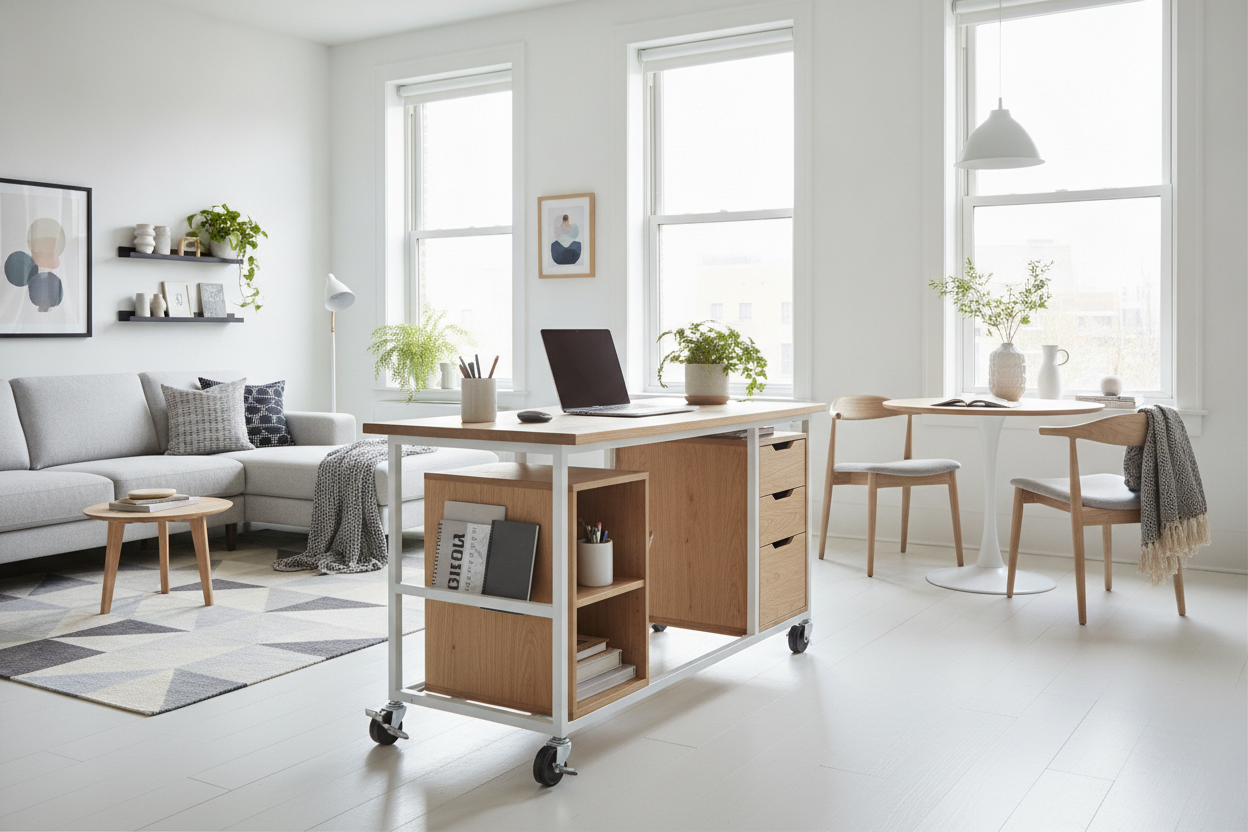
I used to spend my Tuesday nights staring at a tangle of HDMI cables while trying to enjoy a bowl of pasta on my sofa. Living in a studio means my 'office' is also my dining room and my cinema. For months, my work setup felt like a permanent intruder that refused to leave after the clock struck five.
The breaking point was when I realized I hadn't seen my floorboards in weeks because of the sprawling footprint of my old setup. I finally ditched the heavy wood for a rolling standing desk with storage, and it was like my apartment suddenly grew an extra fifty square feet. It turns out, when your furniture isn't anchored to one spot, your floor plan can actually breathe.
- Mobility lets you chase the natural light during the day and hide the 'office' at night.
- Built-in storage eliminates the need for those depressing plastic bins from big-box stores.
- Locking casters are the difference between a stable workspace and a desk that drifts away while you type.
- Vertical storage modules keep your tech footprint small but your utility high.
The Problem With Static Furniture in a Tiny Apartment
We’ve all been there: buying a standard writing computer desk because it looks sleek in a catalog, only to realize it’s a total magnet for clutter. Without drawers, every bill, pen, and charging cable lives on the surface. In a small space, that visual noise is exhausting. You can’t relax on the couch when your 'To-Do' list is literally looming over your TV.
I tried every hack in the book. I even bought a desk chair with storage to stash my notebooks, but the desk itself remained a massive, immovable block of wood. Static furniture demands you build your life around it. In a multi-use room, you need furniture that works for you, then gets out of the way when the workday is done.
Why a Rolling Standing Desk With Storage Is the Ultimate Hack
The 'ah-ha' moment happened when I realized I didn't need a massive mahogany fortress to be productive. I needed a rolling standing desk with storage that could pivot from the window to the wall. Having those built-in cubbies and drawers means my laptop, mouse, and external hard drives have a home that isn't 'the top of the desk.'
Most standing desks are just flat slabs on legs. They’re great for your back, but terrible for your organization. By choosing a model with integrated storage, you stop the 'clutter creep' before it starts. You don't need extra shelving units or rolling carts taking up more precious real estate when the storage is baked right into the frame.
Wheels Mean My Living Room Actually Stays a Living Room
There is a massive psychological shift that happens when you physically move your workspace. At 5:01 PM, I unlock the casters and push my setup into the corner behind my armchair. Using a standing desk on wheels with storage allows me to reclaim my living room. The 'office' effectively disappears, and I’m no longer reminded of that 9 AM meeting while I'm trying to decompress.
Built-In Drawers Stop the Clutter Before It Starts
I’ve found that two slim drawers are worth more than a six-foot desktop. My standing desk with wheels and storage holds my 16-inch Macbook, a mechanical keyboard, and all my messy charging bricks. When the workday ends, everything goes inside. The surface stays clear, which makes the whole room feel instantly cleaner. No more 'doom piles' of paper gathering dust next to my monitor.
What to Look For (So Your Setup Doesn't Tip Over)
Don't just buy the cheapest thing with wheels. I made the mistake of buying a desk with tiny 1-inch plastic casters that snagged on my rug every single time. Look for heavy-duty, 2-inch polyurethane wheels with individual locks. You also need to check the weight capacity. If you’re running dual monitors and a heavy monitor arm, a flimsy frame will wobble like a leaf in the wind.
Think about your knees, too. Some storage modules are positioned so low that you’ll bang your shins every time you sit down. Compare this to a massive executive desk with computer storage—those are built for corner offices with infinite space. For us, the goal is a nimble footprint that doesn't sacrifice the stability of a 'real' desk.
How I Organize My Roaming Workspace
Since the desk moves, cable management is non-negotiable. I use a weighted power strip bolted to the underside of the desk so only one cord ever touches the floor. I’ve also found that a desk with dual storage modules is the sweet spot for keeping peripherals organized. I use one side for tech and the other for 'life' stuff like my Kindle and blue light glasses.
If you have a pegboard attachment, use it for your headphones and cables. It keeps them off the desk surface and prevents them from swinging around and getting caught in the wheels when you move the desk across the room. It’s about creating a self-contained ecosystem that functions perfectly whether it's in the middle of the room or tucked against the wall.
FAQ
Will a rolling desk be stable enough for typing?
Yes, provided you get one with high-quality locking casters. Look for a steel frame rather than aluminum. If the desk feels 'bouncy' when you lean on it, it’s a sign the gauge of the metal is too thin.
Do the wheels work on carpet?
Standard plastic wheels struggle on high-pile rugs. If you have carpet, look for larger 'rollerblade style' rubber wheels. They glide over fibers without snagging or leaving deep indents in your flooring.
How much storage do I actually need?
At a minimum, you want enough space to hide your laptop and your power bricks. If you can't clear the desktop entirely at the end of the day, the 'storage' part of the desk isn't doing its job.

Laisser un commentaire
Ce site est protégé par hCaptcha, et la Politique de confidentialité et les Conditions de service de hCaptcha s’appliquent.