


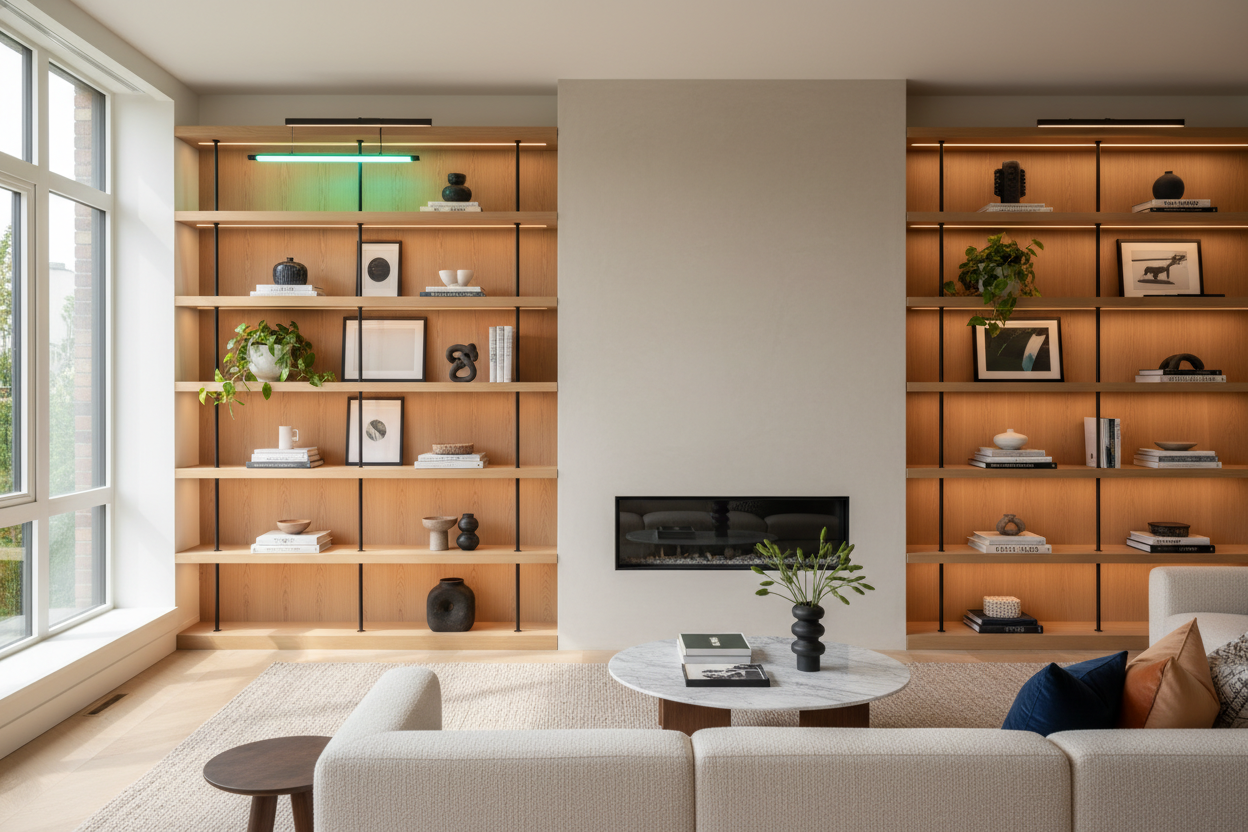
I’ve spent way too many Friday nights hunched over a drill, trying to figure out why my lighting for shelves looked like a back-alley garage instead of a high-end boutique. You see the photos on Pinterest—those perfectly glowy, museum-style built-ins—and you think, 'I can do that with a $15 sticky strip.' Then you plug it in, sit on your sofa, and get blinded by forty-eight tiny, angry LED dots.
It’s a classic DIY trap. We focus so much on getting the led light on shelf setups to actually turn on that we forget about the optics. If you can see the actual bulb or the strip itself, you’ve already lost. You want the light, not the hardware. Here is how to stop making your living room look like a 7-Eleven refrigerator aisle.
- Never leave LED diodes exposed; always use a diffuser or a physical lip.
- Stick to 2700K to 3000K color temperatures for a 'home' feel.
- Aluminum channels act as heat sinks, making your shelf light last years longer.
- Integrated lighting is almost always better for adjustable shelving to avoid wire spaghetti.
The Awful 'Convenience Store' Effect (And Why It Happens)
The biggest mistake people make with shelves light is mounting the strip flat against the underside of the shelf, right at the front edge. When you sit down on your couch, which is usually lower than the shelf, those LED diodes shine directly into your retinas. It’s harsh, it’s cold, and it highlights every speck of dust on your books.
This 'convenience store' look happens because of 'spotting.' Cheap led lighting for shelves often has wide spacing between the diodes. Without a way to blur those points of light together, you get weird scalloped shadows on your wall. It feels sterile and industrial, which is the last thing you want when you’re trying to settle in with a glass of wine and a movie. If your led light in shelf setup makes you feel like you’re waiting for a bus at 2 AM, it’s time to rethink the diffusion.
The 'Lip and Channel' Trick Custom Cabinet Makers Use
If you want that high-end glow, you need to hide the source. Pro cabinet makers don’t just slap a led strip for shelves on the wood and call it a day. They use aluminum channels. These are slim U-shaped tracks that you mount the strip inside. They come with a 'milky' or frosted plastic cover that snaps on top. This cover diffuses the light, turning those harsh dots into a solid, continuous bar of glow.
I remember when my own floating shelf lighting looked cheap because I skipped the channels. I thought the lip of the shelf would hide it, but the reflection on the wall gave the secret away. If you don’t want to route a groove into your wood, you can add a small piece of decorative trim (a 'light valance') to the front of the shelf. This creates a physical barrier that blocks the direct line-of-sight to the shelf strip lighting, forcing the light to bounce off the wall or the items below it instead of hitting your eyes.
Why You Must Use Diffusers for Glass Shelving
Glass is a nightmare for lighting shelves. It’s basically a mirror for electronics. If you put a bare led strip light shelf above a glass pane, you’ll see the reflection of every single diode in the glass below it. It creates an infinite 'hall of mirrors' effect that looks incredibly messy.
For glass, you absolutely need a 45-degree corner channel with a heavy diffuser. This aims the led on shelves toward the back corner or the center of the objects, rather than straight down. It softens the bounce and makes the glass look like it’s glowing from within rather than just being a surface that's being shouted at by a flashlight.
Kelvins Matter: Stop Buying 'Daylight' Bulbs
Please, for the love of your interior design, check the Kelvin rating on your led strip light for shelves. Most cheap kits at big-box stores are 5000K, often labeled as 'Daylight.' In a kitchen or a garage, sure. In a library or living room? It’s a disaster. 5000K light is blue-toned and clinical. It makes your skin look gray and your furniture look cheap.
You want 2700K (Warm White) or 3000K (Soft White). This mimics the glow of a traditional incandescent bulb. A properly warmed bookcase with light can actually replace your harsh overhead fixtures entirely, creating a cozy perimeter glow that makes the whole room feel larger and more expensive. If the box doesn't list the Kelvins, don't buy it.
Should You Skip the DIY and Buy Pre-Lit?
I’ve retrofitted dozens of units with led strip lights for shelving, and I’ll be honest: it’s a pain. Managing the wires—especially if you have adjustable shelf storage—is a logistical puzzle. Every time you move a shelf, you risk tugging a wire loose or having to re-drill a hole. It often ends up looking like a 'science project' behind the unit.
Sometimes, the math just favors buying a piece that has the tech built-in. A tall bookcase with dual cabinets that already includes integrated, multi-color LED strips saves you about six hours of frustration and three trips to the hardware store. These units usually have the channels pre-routed and the wires hidden inside the frame, which is nearly impossible to replicate perfectly on a DIY budget. If you value your Saturday afternoon, integrated shelves with lighting are the way to go.
FAQ
How do I hide the wires on my shelf light?
Use adhesive wire clips or plastic 'raceways' painted the same color as your wall. If you're feeling brave, you can drill small holes through the back panel of the bookcase to snake the wires behind the unit.
Can I cut led strip lights for shelving?
Yes, but only at the designated 'cut points' (usually marked with a copper line or scissors icon). If you cut anywhere else, the whole led strip light shelves segment will die.
What is the best brightness for shelf lighting?
Look for strips that are dimmable. Lighting for shelves should be an accent, not the main light source. You want enough 'lumen output' to see your items, but not so much that the shelf becomes a glowing orb that distracts from the TV.

Laisser un commentaire
Ce site est protégé par hCaptcha, et la Politique de confidentialité et les Conditions de service de hCaptcha s’appliquent.