


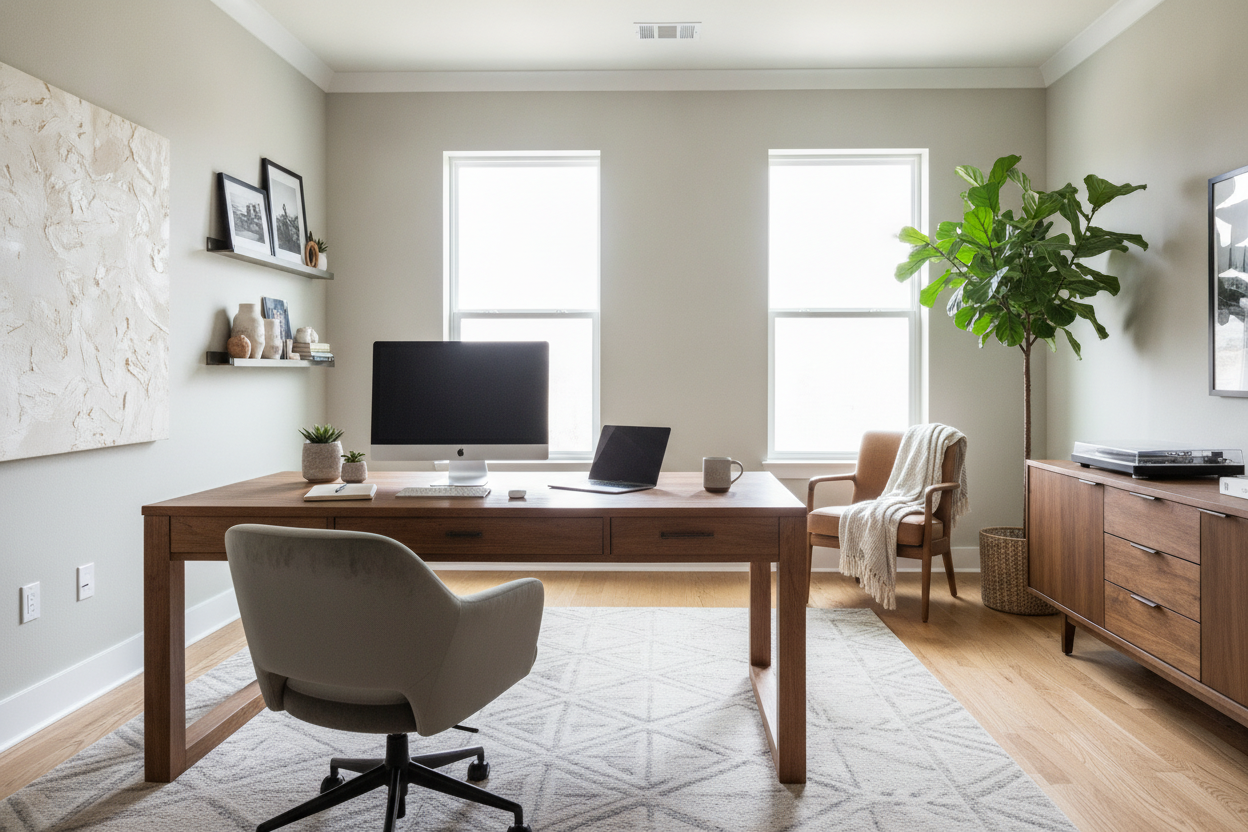
I spent three years staring at a patch of eggshell-white drywall that had a single, infuriating scuff mark from my chair. It felt like being in permanent timeout. I had a perfectly good office room desk, but because I followed the 'save space' rule, I was basically living in a corporate cubicle of my own making.
The shift happened when I realized I was constantly retreating to the dining room just to work. It wasn't because the chairs were better—they weren't—but because I could see the rest of my house. I needed a layout that didn't feel like a punishment.
- The Command Position: Facing the door reduces 'startle response' and boosts focus.
- Visual Depth: Staring into a room rather than a wall reduces eye strain.
- Cable Management: Floating a desk requires a plan for wires (think rugs and sleeves).
- Small Room Reality: If the room is under 10x10, a perimeter layout might be your only choice.
The 'Timeout' Corner: Why Wall-Facing Layouts Drain Energy
We are conditioned to push furniture against the edges of a room. It makes sense for a dance floor, but it’s terrible for a workspace. When your office room desk is shoved against the drywall, your entire peripheral vision is blocked. It mimics the soul-crushing cubicle farms of the 90s, where the goal was to minimize distractions by literally boxing you in.
I noticed that after four hours of staring at the wall, I felt drained. My brain felt as flat as the paint. I started retreating to the dining room table because it offered a view of the living area and the kitchen. Even in a messy house, having ten feet of 'air' in front of your face makes a massive difference in how long you can sit and focus without feeling claustrophobic.
The 'Floating' Layout: A Complete Psychological Shift
Designers call it the 'command position.' You place your home working table in the center of the room, or at least pulled out from the wall, facing the entrance. It sounds aggressive, but it feels incredibly grounding. You aren't tucked away; you are the center of the operation. It instantly makes a standard 12x12 bedroom feel like a legitimate executive suite.
The catch is that the back of your desk is now on full display. Most cheap desks have unfinished particle board on the back, which looks hideous. This is where you have to be intentional. I learned a few deco office table secrets about styling the 'public' side of the desk—think modesty panels or even just a well-placed low bookshelf tucked behind it to hide the structural bits.
But What About the Cord Nightmare?
This is the number one reason people chicken out and push their desk back into the corner. A floating home working table with a 'tail' of black plastic cords looks messy. I solved this by using a thick, high-pile rug to hide a flat extension cord running to the nearest outlet. I then used zip ties to secure every single wire to the underside of the desk frame.
Cable management is non-negotiable if you are using a sit stand up desk in the center of the room. Since the desk moves, those cables need a 'snake' or a spine to keep them from tangling or pulling. I spent about $30 on a cable management kit, and it was the best money I ever spent to keep the floating look from looking like a tech accident.
When the Wall Is Actually the Better Choice
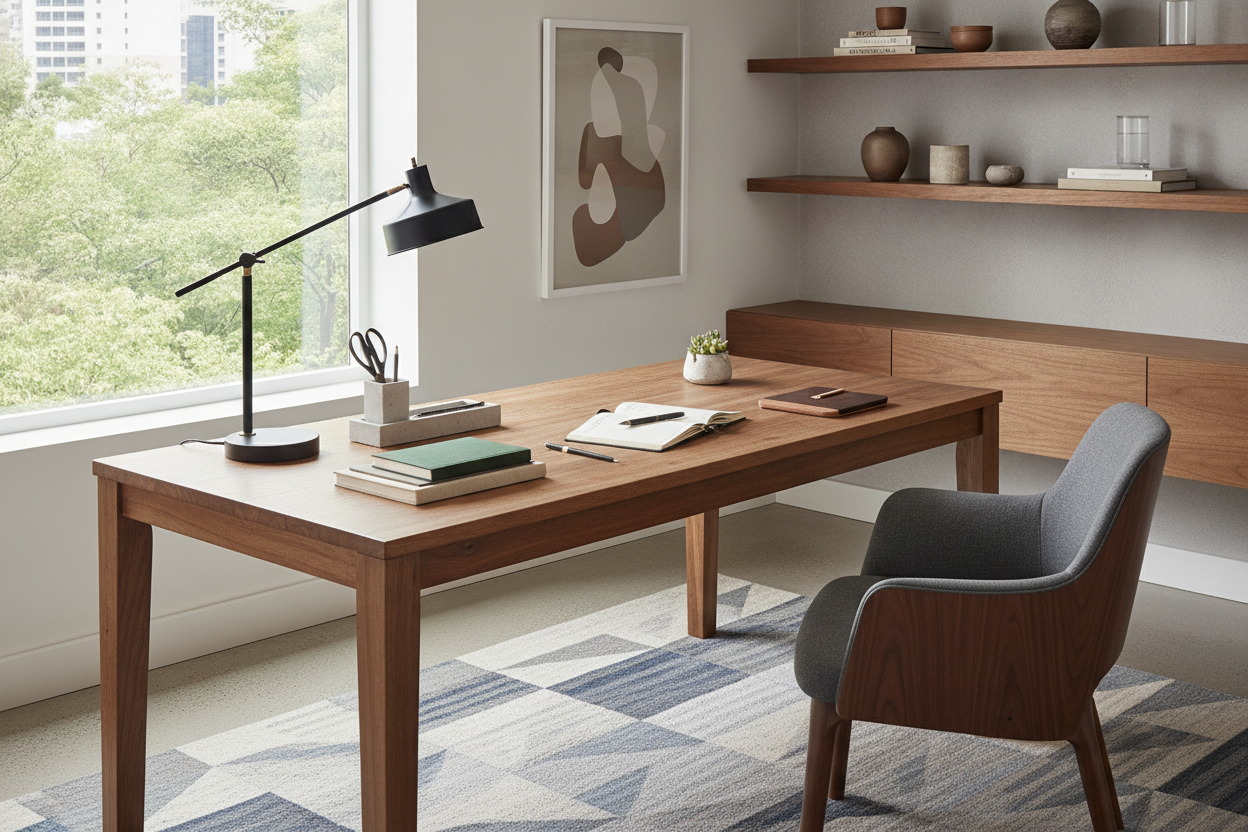
I’m not a zealot. If you’re working out of a literal closet or a tiny 8x8 spare room, floating a desk is just going to make you trip over your own feet. In those cases, the perimeter is your friend. But don't just face the wall—try to put the desk under a window. Natural light is the only thing that beats a 'command' layout.
If you absolutely must stay in the corner, don't settle for a tiny writing table. A corner desk with large storage can make that dead space feel functional. The goal is to avoid the 'temporary' feeling. If your desk feels like a piece of equipment squeezed into a gap, your work will feel like a chore.
Treating Your Setup Like a True Command Center
Your home working table isn't just a place to put a laptop; it's where you spend a third of your life. I’ve seen people try to make a standing desk out of a vintage table, and while the DIY spirit is great, the placement matters more than the material. A $2,000 mahogany desk facing a wall still feels like a cubicle.
Pull it out. Turn it around. Give yourself some breathing room. Even if you only pull the desk eighteen inches away from the wall and put a plant behind it, you’ll feel the shift. You aren't just an employee in your own home; you're the one in charge of the space.
FAQ
Is a floating desk layout bad for small rooms?
It depends on the 'walk-around' space. You need at least 30 inches behind the desk for your chair and another 24 inches in front to walk past. If you don't have that, stick to the wall.
How do I hide cables on a floating desk without a rug?
Use 'leg sleeves' that match the color of your desk legs. You can bundle all the wires into one tube and run it down the leg closest to the power outlet. It's almost invisible if done right.
Does facing the door actually help focus?
Yes. It’s an evolutionary thing. Our brains are slightly more relaxed when we can see who is entering the room. When your back is to the door, a tiny part of your brain is always 'on guard,' which contributes to end-of-day fatigue.

Laisser un commentaire
Ce site est protégé par hCaptcha, et la Politique de confidentialité et les Conditions de service de hCaptcha s’appliquent.