


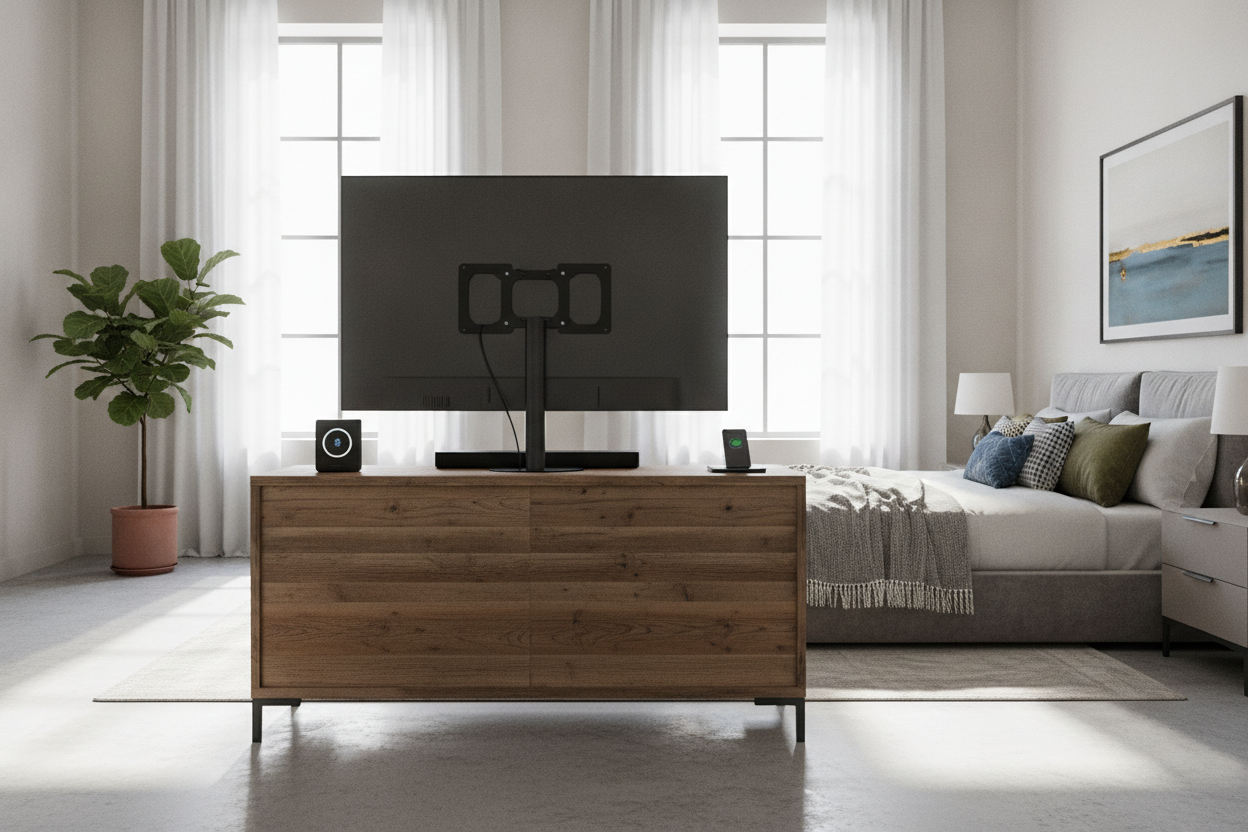
I remember the night I almost lost my 50-inch Samsung. I had it perched on a vintage mid-century dresser that was about two inches too narrow for those spindly, plastic 'chicken feet' legs that come in the box. One accidental bump while reaching for my phone and the whole thing wobbled like a Jenga tower. It was the moment I realized that table top stands for tv aren't just an accessory; they are a safety requirement for anyone living in a real-world apartment.
- Factory legs are usually too wide for standard dressers and consoles.
- A central VESA mount provides a much lower center of gravity.
- Swivel functions let you adjust the screen for viewing in bed without moving the furniture.
- Heavy steel bases prevent the 'tipping hazard' common with large screens.
The Terrifying Physics of Factory Legs on a Dresser
Modern TV manufacturers assume you have a massive, 70-inch wide media console. They design those little plastic feet to sit at the far edges of the screen. If you are trying to squeeze a large screen onto a bedroom dresser, you quickly realize the legs are literally hanging off the edge. It is a disaster waiting to happen, especially compared to traditional dedicated tv stands that are built with enough depth to handle the spread.
The physics are simple and scary. Those wide legs offer zero stability against forward or backward tilts. If you have a cat that likes to jump or a vacuum that occasionally bumps the furniture, your screen is a goner. Most tv tabletop stands solve this by using a heavy, weighted central base that grips the surface, moving the support to the strongest part of your furniture.
Why I Finally Swapped to Table Top Stands for TV
After my near-miss, I spent a week obsessing over VESA patterns and bolt sizes. I realized that swapping out factory legs for a central base was the only way I was going to sleep soundly. I bought a heavy-duty tv table top stand with a tempered glass base, and the difference was immediate. The screen didn't just feel more secure; it looked more expensive.
There is a certain 'cheapness' to the plastic feet that come with even high-end OLEDs. A solid tv top stand made of cold-rolled steel gives the setup a professional, mounted look without the hassle of drilling holes in your rental walls. Plus, the height adjustability is a lifesaver. I was able to lift my screen about four inches higher, allowing my soundbar to sit perfectly underneath without blocking the bottom of the picture.
Finding the Right Fit: A Tabletop TV Stand 55 Inch and Up
When you start looking for a tabletop tv stand 55 inch or larger, weight becomes your biggest enemy. You can't just buy the cheapest thing on the internet. You need to check the 'gauge' of the steel. I always look for a tv stand table top that is rated for at least 20% more weight than my actual TV. If your screen weighs 40 pounds, look for a stand rated for 50 or 60.
I personally like the Atlantic Contemporary universal mount because it handles that awkward middle ground where the screen is heavy but the furniture footprint is small. Always measure the depth of your dresser. If your dresser is 15 inches deep and the stand base is 14 inches, you are cutting it too close. Aim for at least two inches of clearance on all sides.
Will It Scratch the Wood? (Protecting Your Surface)
One valid concern with these heavy metal bases is what they do to your finish. Whether you are using table top stands for tv on a heirloom dresser or placing countertop tv stands on a granite kitchen island, metal-on-wood is a recipe for gouges. Most stands come with cheap rubber 'nubs,' but I usually throw those away and buy heavy-duty felt pads.
If you are placing your screen on a high gloss entertainment center, the risk is even higher. High gloss shows every micro-scratch. I recommend a thin neoprene mat or even a piece of shelf liner cut to the exact shape of the stand base. It distributes the weight more evenly and ensures that if you ever move the TV, you aren't left with a permanent rectangular scar on your furniture.
Don't Guess: When to Buy a Table Top TV Stand In-Store
I am a big fan of online shopping, but sometimes you need to see a table top tv stand in-store to understand the build quality. If the metal feels like a soda can, walk away. You want something that feels substantial—if the box is surprisingly heavy, that is usually a good sign. You want to test the swivel mechanism; it should be smooth, not gritty. A gritty swivel means the bearings are cheap, and it will eventually start to lean to one side.
FAQ
Will a universal stand fit any TV?
Almost always, yes, as long as your TV is VESA compliant. Check the four screw holes on the back of your TV. As long as the stand matches those measurements (like 200x200 or 400x400), you are good to go.
Can I install this by myself?
You can assemble the stand alone, but you definitely need a second person to help you lift the TV onto the mount. Trying to line up VESA bolts while holding a 50-pound glass panel is a great way to end up in the ER.
Does the glass base break easily?
The bases are usually tempered glass, which is incredibly tough. Unless you drop a hammer directly on the edge, it is not going to shatter under the weight of a TV.

Laisser un commentaire
Ce site est protégé par hCaptcha, et la Politique de confidentialité et les Conditions de service de hCaptcha s’appliquent.