


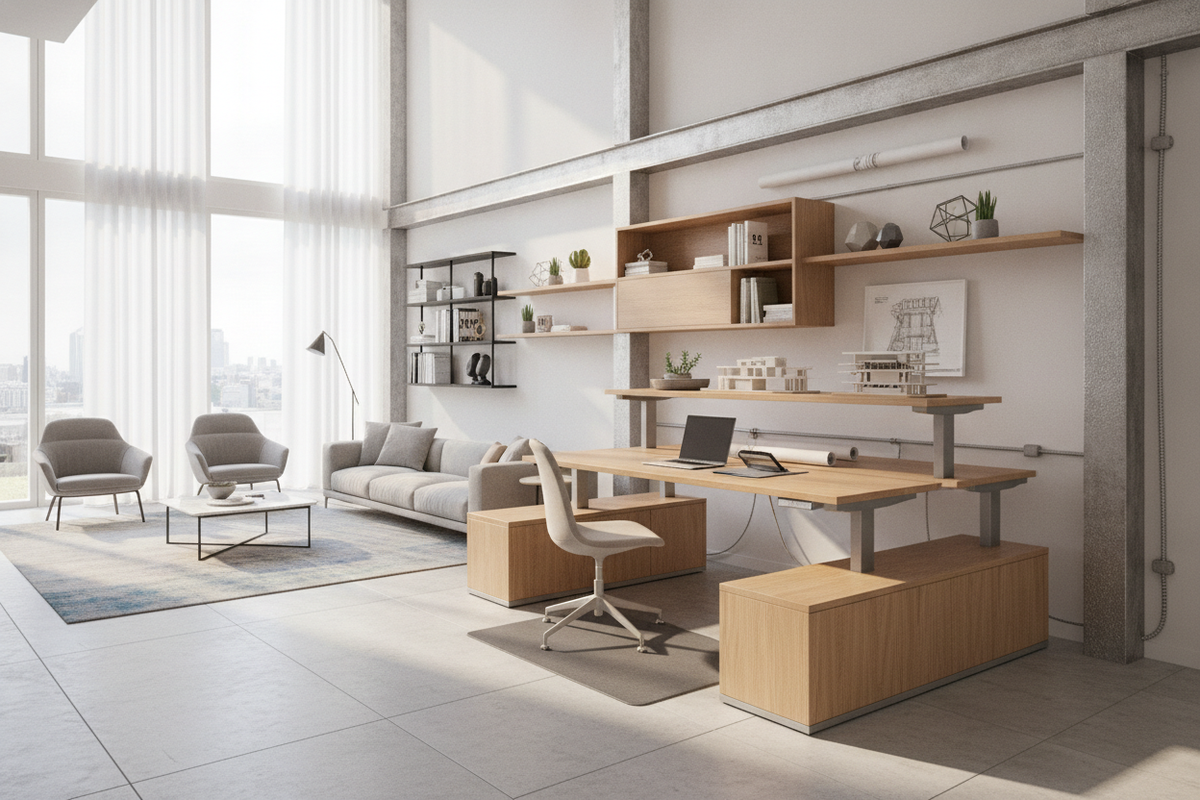
Conversion Architectures: Evaluating Desktop Risers, Leg Extenders, and Frame Retrofits
Upgrading a traditional workspace into an active workstation offers flexibility throughout the workday. When planning to convert sitting desk to standing desk configurations, homeowners typically choose between three structural approaches: surface-mounted desktop risers, static leg extenders, and complete subframe conversions. Each method interacts differently with your existing tabletop and surrounding room architecture.
Surface-mounted risers rest directly on top of your primary desk surface. They provide an adjustable platform for displays and peripherals without altering the underlying furniture. In contrast, static leg extensions raise the entire table frame permanently, creating a counter-height profile that pairs well with drafting stools. A more comprehensive structural route is a motorized base retrofit, where you retain your existing tabletop and mount it onto an adjustable-height underframe. For broader layout considerations, exploring our standing desk guide helps align ergonomics with interior style.
Dimensional Footprint Tiers: Sizing Converters to Desktop Depths and Room Clearance
Selecting the right hardware depends on your desktop surface area and the surrounding clearance in your home office. When you convert desk into standing desk configurations, physical balance and peripheral access depend heavily on desk depth and perimeter margins.
- Compact Tier: Desks with shallow depths require minimal footprint risers or compact single-column lift platforms to prevent crowding the work zone.
- Medium Tier: Standard writing tables accommodate dual-tier converter units featuring separate keyboard trays, leaving adequate side space for note-taking.
- Expansive Tier: Broad executive surfaces provide enough depth to support heavy multi-display converters or complete subframe retrofits like a dedicated height standing desk product while maintaining ample stationary workspace.
Vertical travel arc is equally critical. Scissor-lift designs move straight up and down within their base footprint, making them suitable for tighter alcoves. Cantilevered lift mechanisms swing forward toward the user as they rise, requiring additional rear clearance from walls and back panels.
Material Substrates and Load Distribution: Assessing Structural Weight Limits
Before installing heavy lift hardware or clamping dual-monitor arms, evaluating the tabletop substrate is essential when planning to raise desk to standing height. Different core materials handle structural stress, dynamic motion, and concentrated loads in distinct ways.
Solid hardwood boards offer robust structural resilience, accommodating clamp-on accessories and central converter bases without sagging. Engineered boards, such as high-density composite or particle panels, perform well with broad-base converters that spread weight evenly across the surface. For larger surfaces requiring widespread equipment support, retrofitting onto an expansive base like a height standing desk product distributes dynamic movement across reinforced crossbars.
Tempered glass tabletops require specialized caution. Heavy desktop converters and point-load edge clamps can place localized mechanical stress on glass edges. For glass surfaces, standalone floor-mounted riser tables or complete frame replacements represent a more reliable structural path.
Storage Architecture and Cable Routing in a Converted Workstation
Converting a desk introduces vertical movement that affects storage accessibility and cable organization. When an active surface moves up and down, fixed drawers, privacy panels, and peripheral wiring must adapt cleanly without tension or pinching.
Under-desk drawer units mounted to the original frame remain stationary when using desktop risers, ensuring seamless storage access regardless of riser height. If retrofitting a motorized frame under an existing tabletop, integrated storage boxes must clear the central crossbar and motor housings. Maintaining adequate wire slack with flexible spine sleeves or under-mounted cable trays prevents cords from disconnecting or straining as the desk transitions between postures.
Step-by-Step Retrofit Workflow: Assembly, Alignment, and Stability Validation
Successfully executing a workstation conversion involves systematic preparation, hardware alignment, and stability verification.
- Clear and Inspect: Remove all hardware, monitors, and stationary items. Clean the surface and examine structural joints for loose fasteners.
- Position the Base: Center the conversion unit or riser along both the lateral and longitudinal axes to maintain a balanced center of gravity.
- Fasten or Secure: If attaching a subframe, pre-drill pilot holes to protect composite materials. For desktop units, apply protective padding under contact points to preserve tabletop finishes.
- Balance Peripheral Weight: Mount displays and organize computing accessories so weight is distributed evenly between left and right sides.
- Check Travel Clearances: Test the vertical movement smoothly through its full range, verifying that cables remain untangled and wall trims clear the moving components.
Room Flow and Aesthetic Synergy: Blending Converted Desks with Home Office Storage
A converted workstation should integrate seamlessly with your overall interior decor. When you retrofit standing desk mechanisms into a home office, maintaining visual balance alongside credenzas, bookcases, and storage cabinets preserves an inviting atmosphere. You can find comprehensive layout ideas in our standing desk guide.
Matching the hardware finish of the riser or subframe to existing drawer pulls, metal shelving frames, or lamp bases creates visual continuity. Additionally, positioning your standing workstation near ambient perimeter lighting avoids direct glare on screens at elevated heights. By balancing structural integrity, spatial clearances, and storage cohesion, you achieve a versatile, ergonomic workspace tailored to your everyday workflow.


Laisser un commentaire
Ce site est protégé par hCaptcha, et la Politique de confidentialité et les Conditions de service de hCaptcha s’appliquent.