



Modern home offices and multipurpose living spaces demand furniture that adapts seamlessly to shifting layouts and functional requirements. A convertible l-shaped desk delivers this adaptability by blending expansive corner ergonomics with reconfigurable engineering. Whether transitioning between tight alcoves, open-concept floor plans, or collaborative tandem setups, an l shaped convertible desk gives professionals the freedom to reshape their work zone without replacing core furniture pieces.
Understanding the Convertible L-Shaped Desk: Geometry and Dual-Form Modularity
Traditional corner workstations rely on rigid, one-directional frames that permanently lock a room into a single layout. In contrast, convertible models utilize modular connecting brackets, symmetrical framing, or rotating pivot points that allow the secondary return surface to sit on either side of the primary tabletop or unfold into a long, continuous bench.
This dual-form modularity is especially valuable for dynamic households where a dedicated study might shift into a shared crafting area or multi-monitor workstation. When planning your office layout for better flow, choosing a modular configuration ensures that architectural barriers, such as window frames, heating vents, and doorway swings, never compromise desk functionality.
Spatial Footprint Tiers: Sizing Categories for Flexible Workspaces
Selecting the right desk scale requires balancing available floor clearance with equipment demands. Convertible units generally fall into three spatial tiers:
Compact and Studio Footprints: Maximizing Corner Efficiency
Compact convertible desks are engineered for secondary bedrooms, apartment studios, or niche alcoves. These units prioritize vertical storage integration and streamlined wing depths, preserving central floor space while ensuring essential peripherals remain within comfortable reach.
Mid-Range Multi-Monitor Setups: Balanced Span and Depth
Mid-tier configurations offer balanced surface areas capable of supporting dual-display mounts, desktop computers, and task lighting. Models such as mid-sized white corner workstations provide generous primary surfaces while retaining a compact footprint that neatly borders standard room perimeters.
Expansive Executive Spans: Long Linear Runs and Deep Corner Wings
For dedicated home offices, wide executive frames provide extensive room for creative drafting, multi-screen control stations, and physical paperwork. When extended into a linear layout, these desks become dual-user workspaces suitable for tandem projects or shared family study zones.
Conversion Mechanisms: Corner Pivot, Reversible Returns, and Linear Unfolding
The core advantage of a convertible desk lies in its transformation mechanism. Understanding how the frame adjusts simplifies both the initial assembly and future room updates.
Reversible Left-or-Right Return Bracing
Reversible desks feature mirrored pre-drilled pilot holes and symmetrical under-desk supports. This structural layout allows owners to mount the secondary desktop wing on either the left or right side of the main workspace. If furniture arrangements change, the return can be unbolted and reattached to the opposing flank.
Pivoting and Straight-Run Expansion Systems
Some convertible models use heavy-duty central pivot hinges. Instead of detaching components, the return rotates smoothly from a 90-degree corner fit into a 180-degree inline desk. Exploring specialized writing desk frame architecture helps illustrate how creative structural joinery accommodates unconventional spatial orientations without sacrificing baseline rigidity.
Integrated Storage Architecture: Drawers, Open Shelving, and CPU Modules
Effective storage engineering preserves the structural balance of convertible furniture. When desktops shift between corner and straight layouts, the supporting storage modules must remain accessible.
- Tiered Open Shelving: Under-desk shelving provides structural shear resistance while offering dedicated zones for book collections, paper trays, and network hardware.
- Reversible Filing Drawers: Built-in pedestals with full-extension glides keep hanging folders organized without obstructing legroom.
- Dedicated CPU Towers: Elevated lower shelves lift computer cases away from floor dust and facilitate adequate airflow around cooling fans.
Choosing integrated storage corner desks ensures storage compartments remain functional whether the desk is arranged in a corner profile or stretched across a feature wall.
Structural Stability, Frame Engineering, and Material Resilience
Because convertible desks feature multiple connection joints, frame materials play a critical role in long-term durability and deflection resistance.
Heavy-Duty Powder-Coated Steel vs. Engineered Wood Legs
Steel subframes equipped with welded mounting plates and diagonal rear crossbars deliver excellent torsional rigidity across extended spans. Engineered wood side panels offer a clean, enclosed aesthetic that conceals cables while maintaining solid downward support.
Surface Laminates, Edge Banding, and Scratch Resistance
Quality desktops feature dense core composite panels shielded by water-resistant and scratch-resistant melamine or laminate finishes. Impact-resistant edge banding protects corners against daily wear from office chairs and monitor arms.
Dynamic Workstations: Integrating Lift Mechanisms and Active Postures
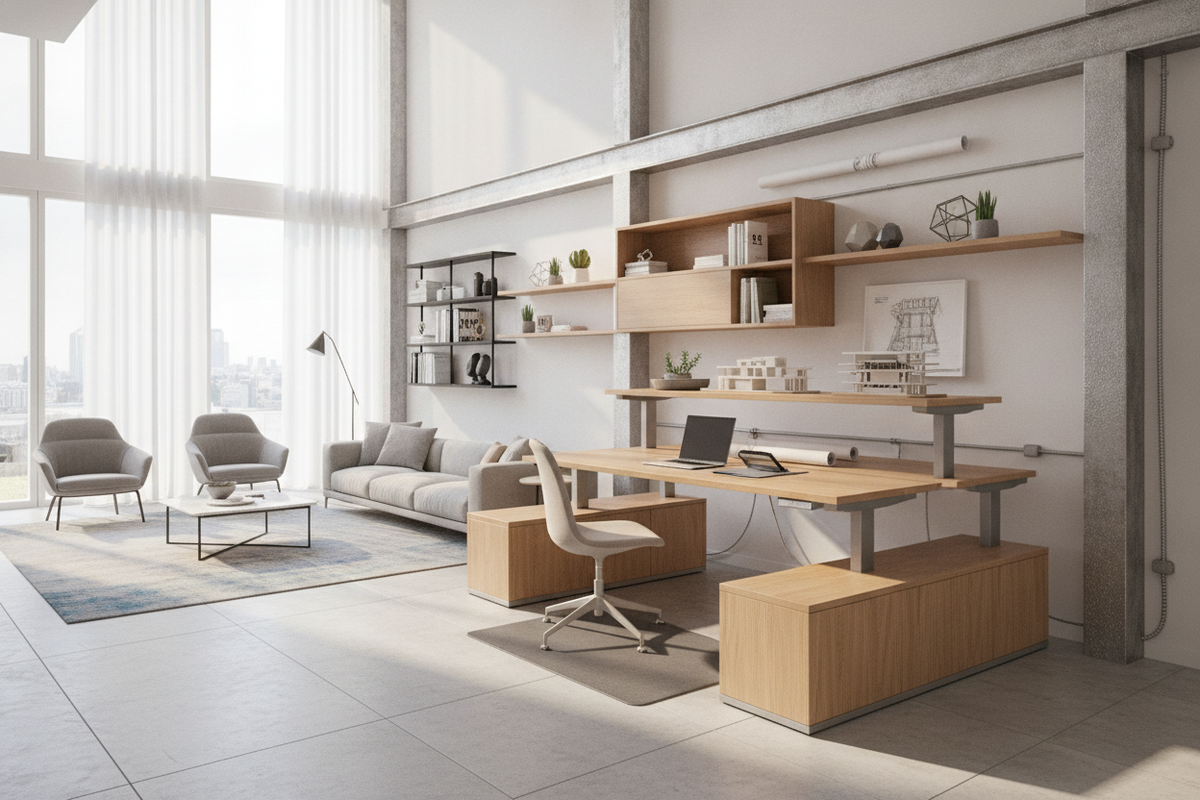
Modern professionals often blend active work routines into their convertible setups. Selecting multi-functional lift computer workstations adds dynamic elevation to the primary work surface. This integration allows seamless transitions between seated computer tasks and standing drafting work while keeping secondary storage stable and accessible at seated height.
Room Layout Synergy: Adapting Convertible Desks to Varied Floor Plans
Integrating a convertible desk successfully involves considering natural light, traffic flow, and electrical connections.
Corner Placement vs. Floating Center Island Layouts
Positioning a desk against perimeter walls frees up open central space and simplifies cable concealment. Alternatively, placing an L-shaped unit in a floating configuration acts as a visual room divider, separating work areas from relaxation zones in larger open-plan rooms.
Cable Routing, Outlet Access, and Clear Walkway Boundaries
To preserve clean room aesthetics, map power cord paths before finalizing the desk orientation. Maintain comfortable clearances between desk edges, door frames, and adjacent seating to ensure open walkways throughout the room.
Step-by-Step Decision Checklist for Selecting a Convertible L-Shaped Desk
- Measure Usable Clearances: Record wall lengths, baseboard offsets, window sill heights, and door swing arcs.
- Determine Orientation Requirements: Decide whether your layout needs a reversible return, a rotating joint, or a linear expansion capability.
- Audit Equipment Volume: Account for monitor display sizes, desktop computers, printers, and document storage needs.
- Check Frame Materials: Select powder-coated steel or reinforced composite structures with leveling feet to ensure stability across uneven flooring.
- Plan Cable Pathways: Choose designs featuring integrated grommets, modesty backings, or open rear channels for organized wire management.


Laisser un commentaire
Ce site est protégé par hCaptcha, et la Politique de confidentialité et les Conditions de service de hCaptcha s’appliquent.