


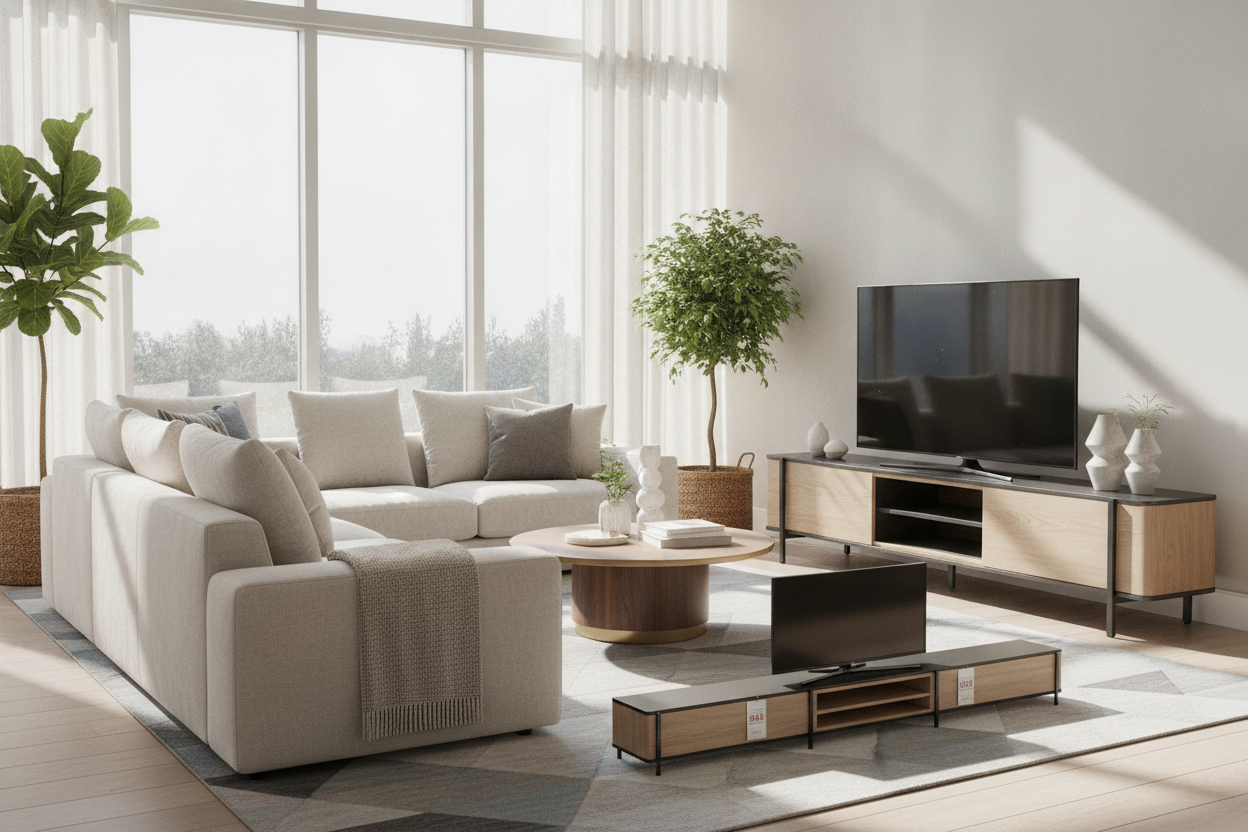
I’ve spent more time than I care to admit staring at living rooms that just feel 'off.' Usually, the culprit isn't the rug or the wall color—it’s a media console that was clearly bought during a late-night scrolling session. We’ve all been there: you see a massive discount on television stands on sale, and suddenly your brain ignores the laws of physics and interior design. You convince yourself that a 40-inch stand will look 'minimalist' under your 65-inch screen. It won't; it will look like a bodybuilder standing on a toothpick.
The problem is that a 'good deal' doesn't account for the fact that your TV is now the size of a small car. If the proportions are wrong, your entire living room feels top-heavy and cramped. I once bought a gorgeous teak unit on clearance, only to realize it was so shallow my receiver hung off the back like a diving board. Don't be like me. Before you click buy, let's talk about the math that actually matters.
- Measure your TV's actual physical width, not the diagonal screen size advertised.
- The stand should be at least 20% wider than the screen to avoid a top-heavy look.
- Calculate your eye level from the sofa to prevent 'TV-too-high' neck strain.
- Verify weight capacities, especially if you're buying budget-friendly MDF pieces.
The Danger of 'Sale Goggles'
Sale goggles are a real psychological phenomenon. When you see a red 'Clearance' tag or a '70% Off' banner during a tv stand sale, your brain stops looking at the 15mm particle board construction and starts looking at the money you're 'saving.' You convince yourself that the slightly-too-small width or the flimsy cam-lock assembly won't matter once the TV is on top of it. It’s the same logic that makes us buy shoes that are half a size too small just because they were the last pair on the rack.
In reality, buying a piece just because it’s cheap is how you end up with a sagging shelf in six months. I’ve seen consoles made from low-density fiberboard that literally bow under the weight of a modern soundbar. You have to learn how to spot quality over junk before you get blinded by the price. Look for kiln-dried wood or at least high-grade plywood with real wood veneers. If the listing doesn't mention the material, it's almost certainly the cheap stuff that smells like formaldehyde for three weeks. The goal is to find a piece that would still be a good design choice at full price. If you wouldn't buy it for $800, don't rush to buy it for $299 just because it's a 'deal.'
The Two-Thirds Rule You Can't Ignore
Here is the golden rule: your TV should ideally take up about two-thirds of the width of the stand. If your TV is 55 inches wide (actual width, not diagonal), your stand should be at least 70 to 80 inches long. This creates a visual 'buffer' that grounds the screen. When the TV is wider than the stand, it creates a sense of instability that makes the whole room feel chaotic. I see this mistake constantly when people shop a tv stand sale—they find a great 50-inch unit and try to center a 65-inch TV on it. It looks like the TV is wearing a shirt three sizes too small.
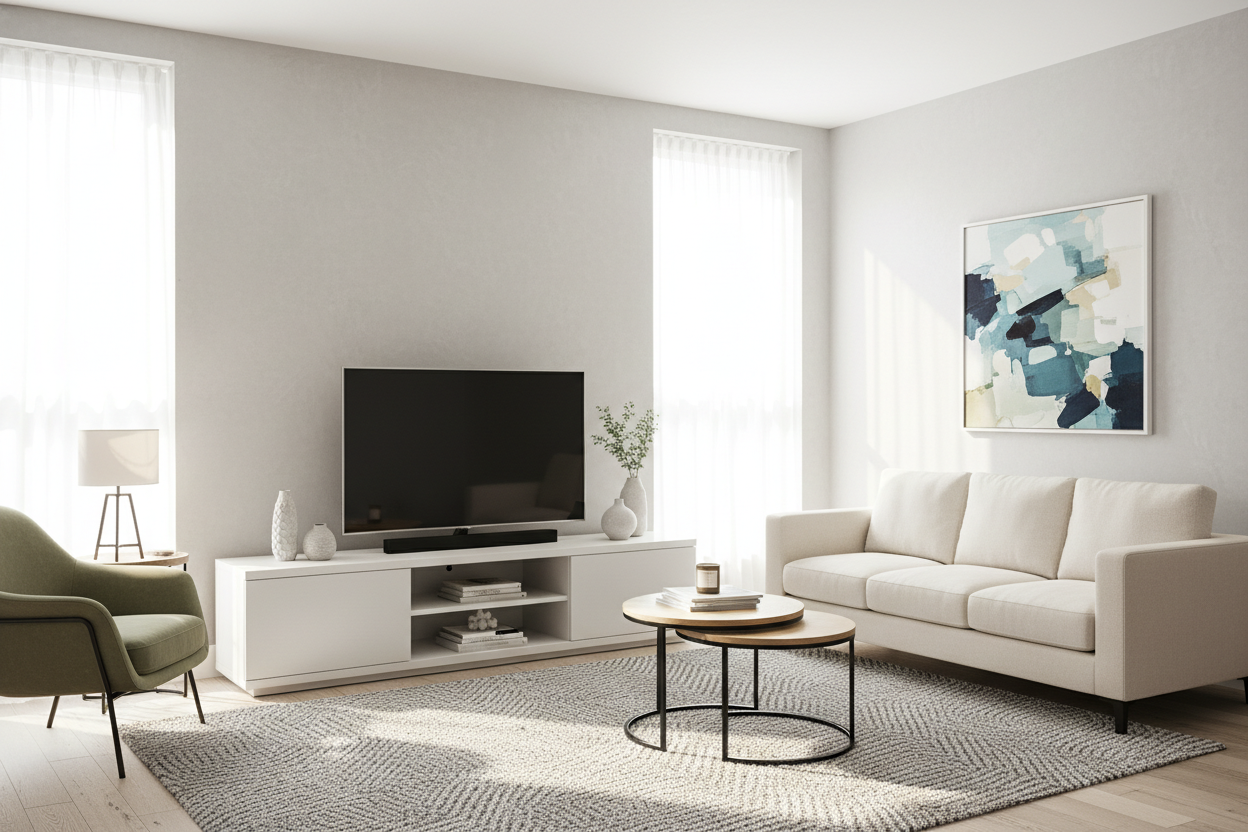
Proportion isn't just about aesthetics; it's about functionality. A wider stand gives you room for a soundbar, a lamp, or even just a place to set your remote. If you're struggling to find something that fits, it's better to browse properly proportioned tv stands that might cost a bit more rather than settling for a clearance piece that ruins the room's scale. Remember, a 65-inch TV has an actual width of about 57 inches. To follow the rule, you’re looking for a unit in the 75-inch range. Anything less and the TV starts to swallow the wall.
Why Height Ruins Your Viewing Angle
We’ve all seen those 'TV Too High' subreddits, and they exist for a reason. Most people buy a media console without ever measuring their sofa’s seat height. If you have a low-slung, modern Italian-style sofa with a 15-inch seat height, a standard 30-inch tall credenza is going to have you looking up at the ceiling. Conversely, if you have a chunky, traditional sofa with 20-inch high cushions, a low-profile media bench will make you feel like you’re sitting in the nosebleed seats at a stadium.
Your eyes should hit the middle of the screen when you're sitting comfortably. This usually means the stand itself should be between 18 and 24 inches tall. Grabbing a random clearance piece because it's the right color but the wrong height is a recipe for a chiropractor appointment. It is worth the extra effort to spot real hardwood deals that actually meet your ergonomic needs. Hardwood pieces are easier to modify, too—you can often swap out the legs to gain or lose two inches of height, something you can't easily do with cheap hollow-core legs.
Visual Weight vs. Physical Space
A stand can have the perfect dimensions but still look 'heavy.' This is the difference between a solid black box that goes all the way to the floor and an airy unit on tapered legs. In a small apartment, a 70-inch solid cabinet can feel like a monolith that eats the room. In that scenario, you want something that allows you to see the floor underneath it, which tricks the eye into thinking the room is larger than it is. I usually recommend a storage credenza with sliding glass doors for this very reason. The glass breaks up the solid surface, and the sliding mechanism saves space in tight quarters.
Check the depth, too. Modern TVs are paper-thin, but your equipment isn't. I once bought a 'slim' console that was only 12 inches deep. My PlayStation 5 stuck out the front by three inches, and I couldn't close the door. Always measure your deepest piece of gear—usually the receiver or a gaming console—and add two inches for cable clearance. If the television stands on sale are all too shallow for your gear, the discount isn't worth the headache of having to cut holes in the back panel just to plug things in.
How much wider should a stand be than the TV?
At a minimum, the stand should have 3 to 6 inches of clearance on each side. For the best look, aim for the TV to be about 60-70% of the total width of the stand. This prevents the 'overhang' look that makes furniture feel cheap.
Can I put a 65-inch TV on a 50-inch stand?
Technically, yes, if the weight capacity allows it. Design-wise, no. It will look unstable and top-heavy. If you're stuck with a small stand, wall-mount the TV above it to create some visual breathing room between the two pieces.
What material is best for a long-lasting TV stand?
Solid wood or high-quality plywood (like Baltic Birch) is the gold standard. Avoid 'hollow core' or thin MDF if you have a heavy TV, as these materials will bow over time, making it impossible to open the drawers or doors properly.


Laisser un commentaire
Ce site est protégé par hCaptcha, et la Politique de confidentialité et les Conditions de service de hCaptcha s’appliquent.