

Introduction: The Balanced Footprint of the Medium Corner Desk
Finding the right balance between desktop surface area and open room volume often leads homeowners and remote professionals toward a medium corner desk. While compact wedge tables can feel restrictive during multitasking and oversized executive setups can overwhelm multipurpose rooms, a balanced medium size corner desk bridges the gap seamlessly. Positioned along room vertices, it captures previously underutilized floor area while preserving clear sightlines and easy traffic flow throughout the room.
A well-proportioned corner configuration creates a functional cockpit where screens, notebooks, and reference materials remain within arm's reach. By nesting the primary workstation into the junction of two walls, you effectively double your usable perimeter while maintaining an open, uncluttered interior atmosphere.
Dimensional Decision Framework: Sizing Tiers and Wing Geometry
Choosing the ideal medium corner desk requires understanding how physical dimensions interact with room boundaries. When evaluating a room, assessing the two intersecting walls helps determine whether a symmetrical or asymmetrical profile best complements the space. For additional context on navigating tighter footprints before sizing up, you can review techniques to fit a stylish work desk into any small corner.
Symmetrical Corner Profiles vs. Extended Return Wings
Symmetrical corner desks feature equal depth and width along both perimeter walls. This layout produces a balanced visual weight, making it an excellent choice for dedicated square home offices or centered corner nooks. Symmetrical wings offer equal flexibility for left- or right-handed tasks, allowing you to alternate between computing and analog writing without altering your posture.
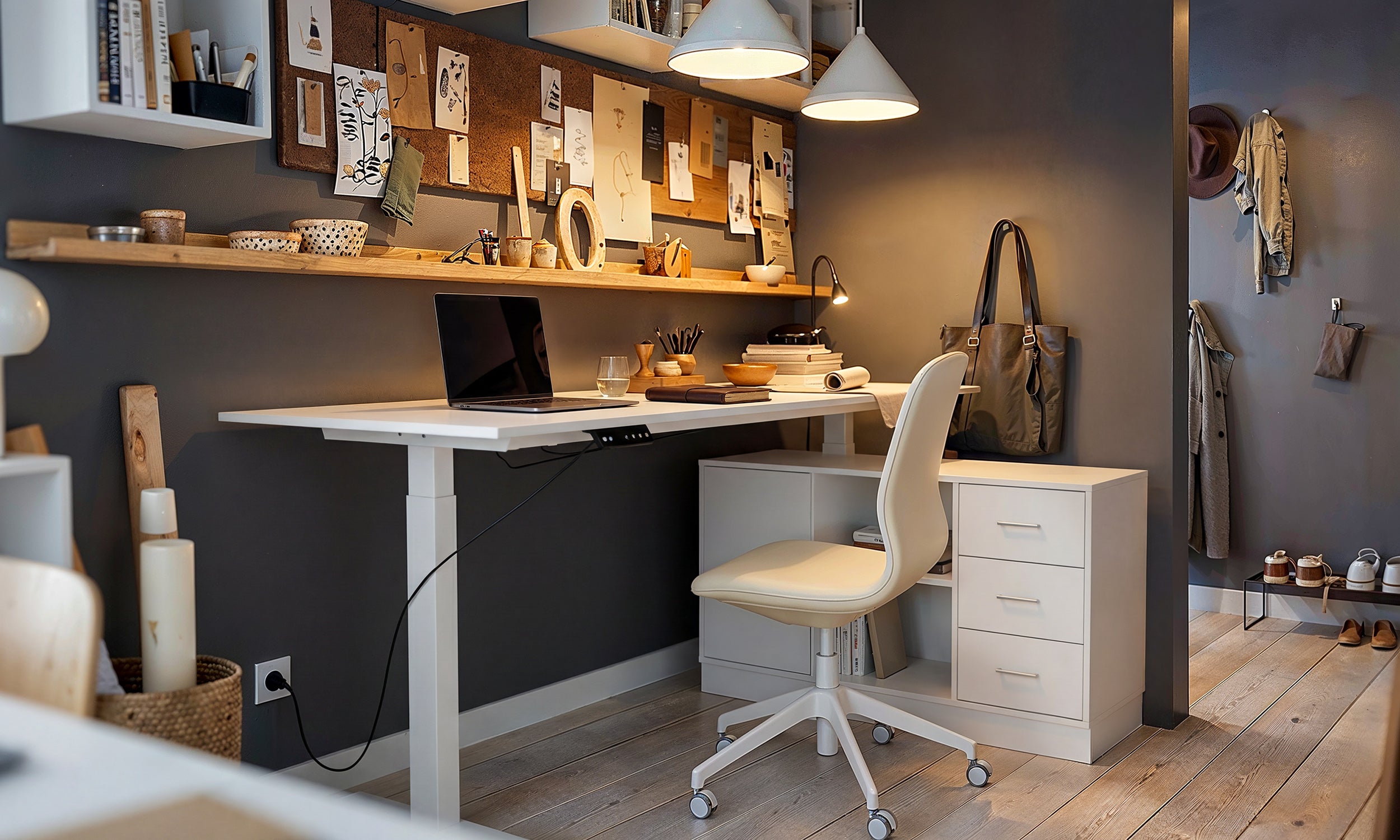
In contrast, an asymmetrical configuration pairs a longer primary workstation wing with a shorter return wing. Desks such as a wide L-shaped corner desk in white provide a defined primary surface for multiple screens alongside an auxiliary wing for printers, organizers, or secondary devices. This division helps establish dedicated focus zones within a single cohesive workstation.
Clearance Envelopes, Chair Swivel, and Wall Flow
Beyond the surface dimensions of the desk itself, you must account for dynamic clearance envelopes. A fully functioning workspace requires adequate room behind the central seating zone to allow an office chair to roll, swivel, and recline without striking baseboards or nearby furnishings.
- Chair Rotation Zone: Maintain unobstructed floor space directly behind the central desk junction to allow smooth chair movement.
- Door and Window Margins: Verify that desktop edges do not cross window trims, heat registers, or room entry door arcs.
- Perimeter Circulation: Ensure primary walkways through the room remain clear, avoiding awkward bottlenecks around the outer edges of the desk wings.
Surface Zoning and Cockpit Ergonomics
The geometric advantage of a medium corner desk lies in its ergonomic cockpit layout. By dividing the tabletop into clear operational zones, you can maintain an organized workflow while minimizing neck strain and reaching fatigue. Learning how to style a corner desk for an elevated look can further enhance the balance between clean aesthetic presentation and daily practical utility.
Corner Apex Depth vs. Wing Utility
The deepest area of any corner desk is the diagonal intersection where the two wings meet. This corner apex serves as the ideal zone for mounting heavy monitors or placing wide displays, positioning screens at a comfortable viewing distance without crowding your foreground. The lateral surface extensions along the wings can then remain dedicated to active daily work, such as typing, sketchpads, and reference literature.
Cable Channels and Concealed Power Pathways
Because corner desks sit flush against two intersecting walls, managing electrical cords requires thoughtful planning. Without proper routing, power cables can easily become pinched between the furniture frame and the wall.
- Desktop Grommets: Route monitor leads, keyboard cables, and desk lamp wiring down through integrated surface pass-throughs.
- Under-Desk Wire Trays: Suspend power strips and surge protectors below the apex junction to keep power cords off the floor.
- Baseboard Channels: Align leg frames slightly outward from baseboard trim to protect wiring pathways and prevent wall scuffing.
Storage Architecture: Integrating Cabinets, Shelves, and Pedestals
A primary benefit of selecting a medium footprint over a minimalist writing table is the opportunity to incorporate structured, built-in storage. Comprehensive units like the corner desk product provide integrated shelving to house office essentials within the desk's perimeter.
Integrated Side Shelving and Lower Cabinet Modules
Lower cabinetry and open side shelves help anchor the structural frame while offering dedicated compartments for computer towers, paper archives, and organizing bins. Desks such as a 55-inch L-shaped corner desk with storage illustrate how lateral shelving towers can maximize vertical space beneath the return wing without encroaching on essential knee clearance.
Material Profiles and Structural Underframe Stability
Corner desks rely on stable underframe architecture to prevent tabletop sag across extended spans. Look for desks built with sturdy engineered wood panels, durable laminate finishes, and reinforced steel frame members. Adjustable leveling feet positioned under perimeter legs and central corner supports ensure the entire assembly remains completely level, even on uneven floorboards or carpeting.
Room Integration, Assembly Coordination, and Long-Term Care
Successfully introducing a medium corner desk into your home office requires methodical assembly and careful room preparation. Because wall corners in residential homes are rarely perfectly square, assembling the furniture requires close attention to spatial alignment.
- Wall Angle Inspection: Check the corner angle prior to assembly to plan appropriate spacing along baseboards.
- Staged Modular Assembly: Build individual wing modules and storage pedestals separately before joining them at the central corner bracket in their final room location.
- Hardware Tensioning: Secure structural cam locks and frame fasteners firmly, re-checking frame alignment once the desk is settled in place.
- Surface Preservation: Clean laminate and veneer surfaces using soft microfiber cloths and mild wood-safe cleaners, avoiding harsh abrasives that could wear down the protective coating.
By thoughtfully assessing your room dimensions, surface zones, and storage requirements, a medium corner desk transforms an underused corner into an organized, highly productive home office hub.


Laisser un commentaire
Ce site est protégé par hCaptcha, et la Politique de confidentialité et les Conditions de service de hCaptcha s’appliquent.