


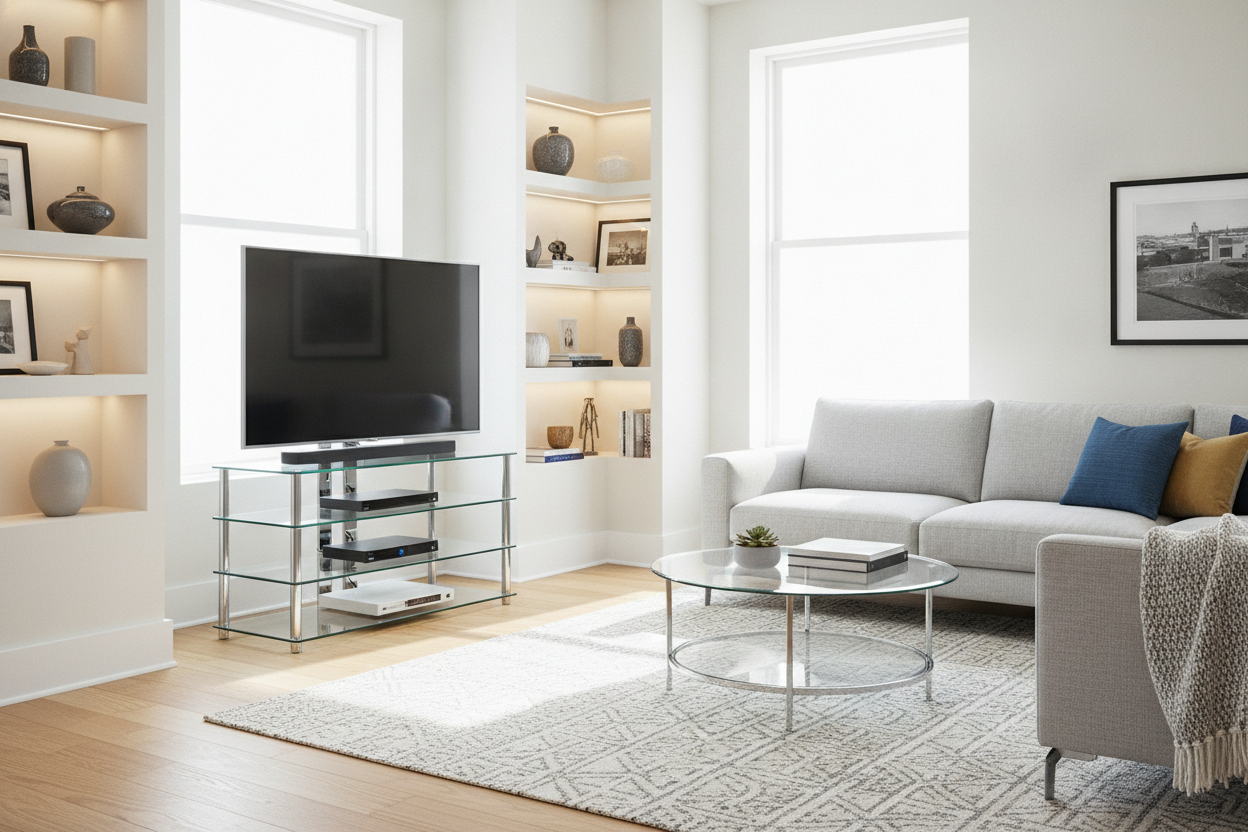
I spent three hours last Tuesday staring at a floor plan that felt like a personal insult. My new living room has exactly zero long, unbroken walls. Between a radiator that clicks like a metronome, a fireplace that sits four feet off-center, and a door that swings right into the only logical media spot, I was ready to just mount my TV to the ceiling and call it a day. Then I remembered the one piece of furniture most designers treat like a dirty secret: the corner glass tv stand.
Quick Takeaways
- Reclaims dead space in rooms with too many doors or windows.
- Glass shelves eliminate 'visual clutter' and make small rooms feel larger.
- Modern tempered glass and steel frames are significantly more durable than the flimsy units of the past.
- Styling with plants and books prevents the 'sterile' electronics showroom look.
The 'Impossible' Living Room Dilemma
Most modern TV stands are designed for the platonic ideal of a home—a massive, open-concept rectangle with 20-foot walls. In reality, many of us are living in 1940s bungalows or awkward new builds where every wall is interrupted by a window, a closet, or an HVAC intake. When you try to force a standard rectangular console against a short wall, it looks like you’re trying to shove a square peg into a round hole. It sticks out, blocks the walkway, and makes the room feel like a storage unit.
A corner setup solves the geometry problem by utilizing the most underused real estate in your home. By angling the screen, you create a natural focal point that doesn't compete with the architectural 'features' of the room. I’ve seen this work in 12x14 rooms where a traditional setup would have left the sofa practically touching the screen. It’s about working with the physics of your space rather than fighting them.
Getting Over the 90s Stigma
I know what you’re thinking. You hear 'corner tv stand with glass shelves' and your brain immediately flashes to 1994—dusty black plastic, chunky CRT monitors, and a nest of tangled VCR cables. We need to move past that. The current generation of media furniture has undergone a massive architectural glow-up. We aren't talking about cheap, hollow tubes anymore.
Modern corner tv stand glass shelves are made from 8mm or 10mm tempered safety glass that can support 100+ pounds without breaking a sweat. The silhouettes are slimmer, often featuring brushed nickel, matte black steel, or even brass accents. They look more like high-end gallery shelving than something you'd find in a college dorm. The goal is a piece that feels light and intentional, not like a heavy block of wood that's just taking up space.
The Visual Magic of 'Invisible' Furniture
In interior design, we talk a lot about 'visual weight.' A solid oak credenza might be beautiful, but it’s a giant, opaque block that stops the eye. In a cramped corner, that block makes the walls feel like they’re closing in. A corner tv stand with glass shelves acts like a magician’s trick—it provides the utility of storage without the bulk. Because you can see the floor and the baseboards through the unit, the room feels continuous.
If you genuinely have the wall space, you might prefer a storage credenza with sliding glass doors for a more traditional look. But for the corner-dwellers, the transparency is a lifesaver. It allows light to bounce around rather than being absorbed by dark wood. It’s the difference between a room feeling 'stuffed' and a room feeling 'designed.' When the furniture doesn't block the sightline, the corner actually recedes, giving you back those precious perceived square inches.
How to Warm Up Steel and Glass
A metal and glass corner tv stand can lean a bit industrial, which is great if you’re into that. But if you want a cozy vibe, you have to style it correctly. Don't just put a TV and a soundbar on it and walk away. That’s how you get the sterile showroom look. I always suggest layering in organic textures. Think linen-bound coffee table books, a ceramic bowl for remotes, or a trailing Pothos plant on the lower shelf.
If you're worried about the materials feeling cold, you aren't alone. I’ve written before about Is a Glass and Metal TV Stand Too 'Cold' for a Living Room? and the answer is always in the accessories. I’m a huge fan of swapping a chunky wood credenza for metal and glass because it gives you a neutral foundation. It’s much easier to warm up a glass shelf with a few well-placed items than it is to make a heavy, dark wood cabinet feel light and airy.
The Cord Management Reality Check
Let’s be honest: glass is unforgiving when it comes to cables. If you have a mess of wires, a transparent stand will broadcast that chaos to the entire room. But this isn't a dealbreaker; it just requires a 10-minute plan. First, use 1/2-inch braided cable sleeves to group your power and HDMI cords into a single 'trunk.' It looks clean and intentional.
Second, use the 'stacking' method. Place a few oversized art books or a decorative opaque box on the bottom shelf to hide the power strip. If the stand has a central support column, use clear zip ties to anchor the cables directly behind the metal frame. When you hide the 'guts' of the tech, the glass stand goes from being a utility piece to a legitimate design element.
My Personal Experience
A few years ago, I lived in a rental where the only TV-ready corner was directly next to a floor-to-ceiling window. I initially bought a heavy walnut corner unit, and it looked like a giant tooth missing from the room's smile. It was just too much dark wood in a bright space. I swapped it for a three-tier glass and steel unit, and the change was instant. The light from the window passed right through the shelves, and suddenly the room didn't feel lopsided anymore. My only mistake? I didn't buy a microfiber cloth immediately. Glass shows dust, but a 30-second wipe-down once a week is a small price to pay for a layout that actually works.
FAQ
Is glass furniture safe for homes with kids or pets?
Yes, as long as it is tempered glass. Tempered glass is designed to crumble into small, dull pebbles rather than sharp shards if it breaks. Most high-quality stands use this as a standard. Just check the weight rating for the top shelf.
How do I keep the glass from looking dusty all the time?
Keep a small spray bottle of 50/50 water and white vinegar and a microfiber cloth nearby. Avoid paper towels, which leave lint. A quick wipe once a week keeps it looking invisible.
Will a corner stand fit a 65-inch TV?
Most corner stands are rated by the width of the base. For a 65-inch TV, you usually need a stand that is at least 55-60 inches wide, but because it's in a corner, the TV will likely overhang the sides of the stand. As long as the TV's feet or pedestal fit securely on the top shelf, you're good to go.

Laisser un commentaire
Ce site est protégé par hCaptcha, et la Politique de confidentialité et les Conditions de service de hCaptcha s’appliquent.