



Selecting an executive-sized workstation transforms both the functionality and visual weight of a home office or corporate workspace. Among expansive furniture choices, 80 inch desks represent a commanding category that bridges standard single-user furniture and sprawling multi-surface stations. Choosing a desk of this scale requires careful architectural planning, ergonomic balancing, and deliberate layout execution.
Understanding the 80-Inch Desk Footprint: Sizing Spans and Spatial Scale
An 80-inch desk spans roughly six and a half feet in horizontal width, creating an expansive visual plane that anchors any room. When planning an installation, tabletop depth must be evaluated alongside overall span. Standard depths typically pair with wide widths to balance reach zones, ensuring that peripheral equipment, task lighting, and writing pads remain within natural arm extension.
Because of this substantial surface area, large desks command significant visual weight. In smaller rooms, a wide surface can overwhelm perimeter walls if proportions are misjudged, whereas in open-concept spaces or dedicated executive dens, it provides a grounded center of operations. When evaluating broad workspaces, browsing an expansive computer desk collection helps clarify how different widths and structural styles fit within modern interior layouts.
Room Fit and Clearance: Planning Walkways, Window Placements, and Door Radii
Proper spatial clearance is critical when introducing an 80-inch workstation to ensure comfortable movement and uninterrupted daily routines. Beyond measuring wall length, spatial planning requires assessing the perimeter pathways around the furniture.
- Seating and Movement Clearance: Allow generous buffer space behind the desk to accommodate chair roll-back, recline depth, and natural standing transitions.
- Primary Walkways: Maintain clear circulation paths between the desk edges, entry doors, and nearby architectural elements so the room does not feel constricted.
- Window Orientation: Position expansive surfaces perpendicular to direct natural light sources where possible to mitigate monitor glare while preserving exterior sightlines.
- Door and Closet Radii: Verify that adjacent entry doors, closet panels, or low-level windows can open fully without colliding with the desk corners or side returns.
Configuration Archetypes: Linear 80-Inch Desks vs. 80-Inch L-Shaped Layouts
An 80-inch dimension manifests in two primary architectural profiles: a continuous linear straight run or an L-shaped corner configuration. Each design serves distinct spatial configurations and daily workflow demands.
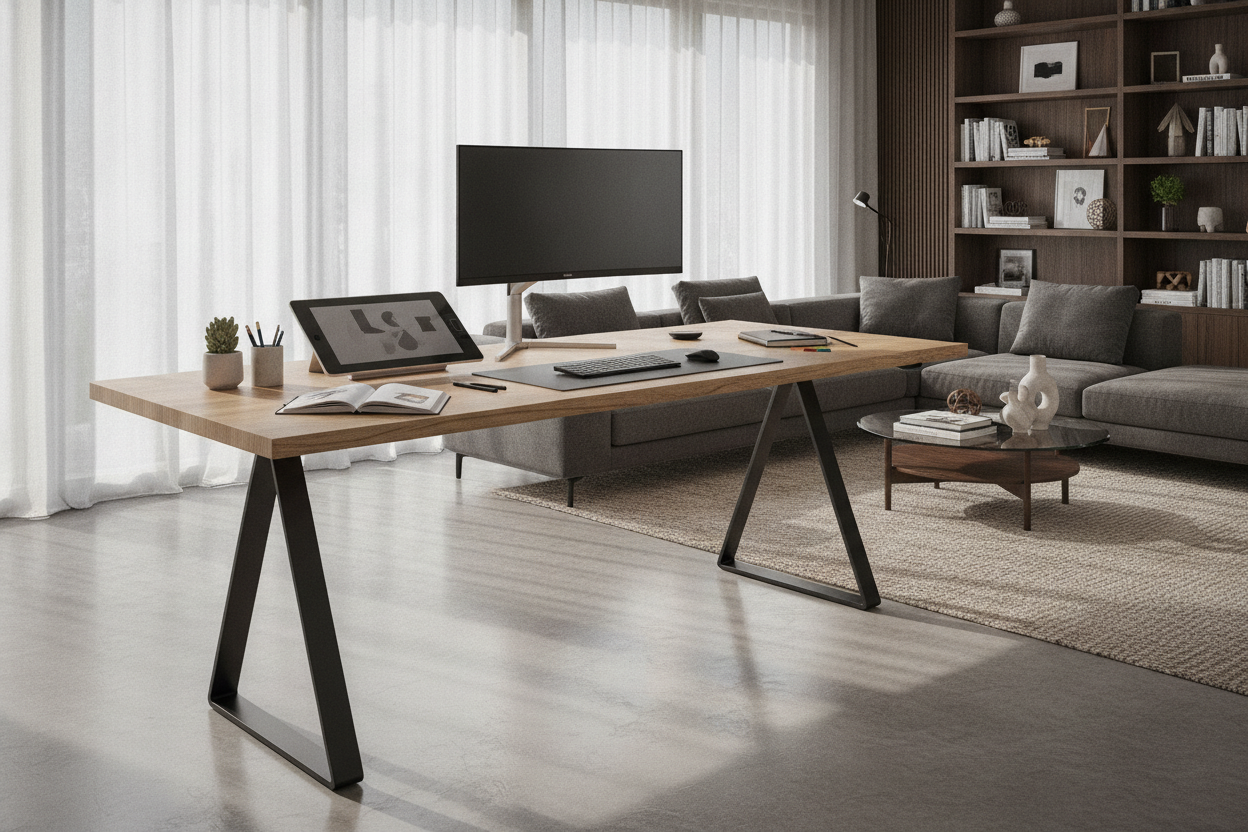
A linear 80-inch desk provides a seamless, unbroken horizontal plane. This orientation excels along primary feature walls or floated in the center of an executive study facing into the room. It supports side-by-side tasks, such as housing a full digital computing array alongside an analog sketchpad or document review area.
In contrast, an 80-inch L-shaped desk utilizes an extended main desk surface paired with a perpendicular return. This setup creates dedicated functional zones, allowing users to swivel effortlessly between screen-intensive work and reference materials. For rooms requiring even broader modular wrapping surfaces beyond standard corner units, reviewing a desk shaped office product provides valuable spatial context on expansive perimeter coverage. Conversely, homeowners weighing large standalone spans against compact corner alternatives can compare dimensions with an office computer desk product to determine ideal wall utilization.
Storage Needs and Under-Desk Clearance: Integrating Drawers and Pedestals
Maintaining clear legroom while maximizing organization is an essential consideration for an 80-inch frame. Because the span is so wide, storage can be positioned strategically across the base without cramping central seating.
Double-pedestal configurations place drawer stacks at both outer edges, leaving a generous central bay for seating, footrests, and ergonomic movement. For open-frame designs, mobile filing pedestals provide modular versatility, allowing users to shift storage outward or tuck it away depending on changing tasks. Maximizing executive desk pedestals requires systematic internal organization, as detailed in our desk drawers office guide for streamlining daily tools and documents.
Under-desk cable routing channels, power brackets, and horizontal wire trays should be incorporated during initial assembly. An expansive desktop invites multiple hardware connections; keeping power bricks and cables elevated off the floor preserves the clean aesthetic and ensures unrestricted foot movement.
Material Selection, Frame Stability, and Assembly Logistics for Wide Spans
A continuous 80-inch surface demands robust structural engineering to prevent center sagging or horizontal sway. Wide furniture spans place higher demands on joinery and base structures than standard-sized writing desks.
Look for frames engineered with reinforced steel under-beams, integrated metal aprons, or center support stanchions that distribute weight evenly across the entire surface span. Solid hardwood, engineered composite cores with durable laminates, or reinforced wood veneers offer stable surfaces suited to supporting heavy multi-monitor mounts and office equipment.
Logistics also play a significant role. Before purchasing an 80-inch desk, trace the pathway from the delivery point to the intended room. Long single-piece desktop panels require ample turning clearance in stairwells, narrow hallways, and standard door frames. Two-piece or modular desktop designs can simplify delivery and assembly in multi-story homes or compact apartments.
Workflow Scenarios: Multi-Monitor Command Centers, Dual Workstations, and Executive Suites
The versatility of an 80-inch desk makes it suitable for diverse professional environments and technical requirements:
- Multi-Monitor Command Centers: Accommodates dual ultrawide displays or triple-monitor arrays with dedicated room left over for studio audio monitors, broadcast lighting, and desktop peripherals.
- Shared Dual Workstations: Serves as a collaborative side-by-side desk for two users in compact study spaces, particularly when paired with dual task chairs and separate cable drops.
- Executive Suites: Provides an authoritative focal point when positioned in a room-centered floating layout, offering sufficient workspace for personal computing while presenting an uncluttered meeting surface for visiting colleagues.
While open 80-inch workstations showcase expansive gear, consulting our computer desk office guide helps users assess when enclosed or concealed alternatives might better suit multipurpose living spaces. Careful planning of dimensions, spatial clearances, and storage ensures your 80-inch desk delivers long-term ergonomic comfort and executive functionality.


Laisser un commentaire
Ce site est protégé par hCaptcha, et la Politique de confidentialité et les Conditions de service de hCaptcha s’appliquent.