


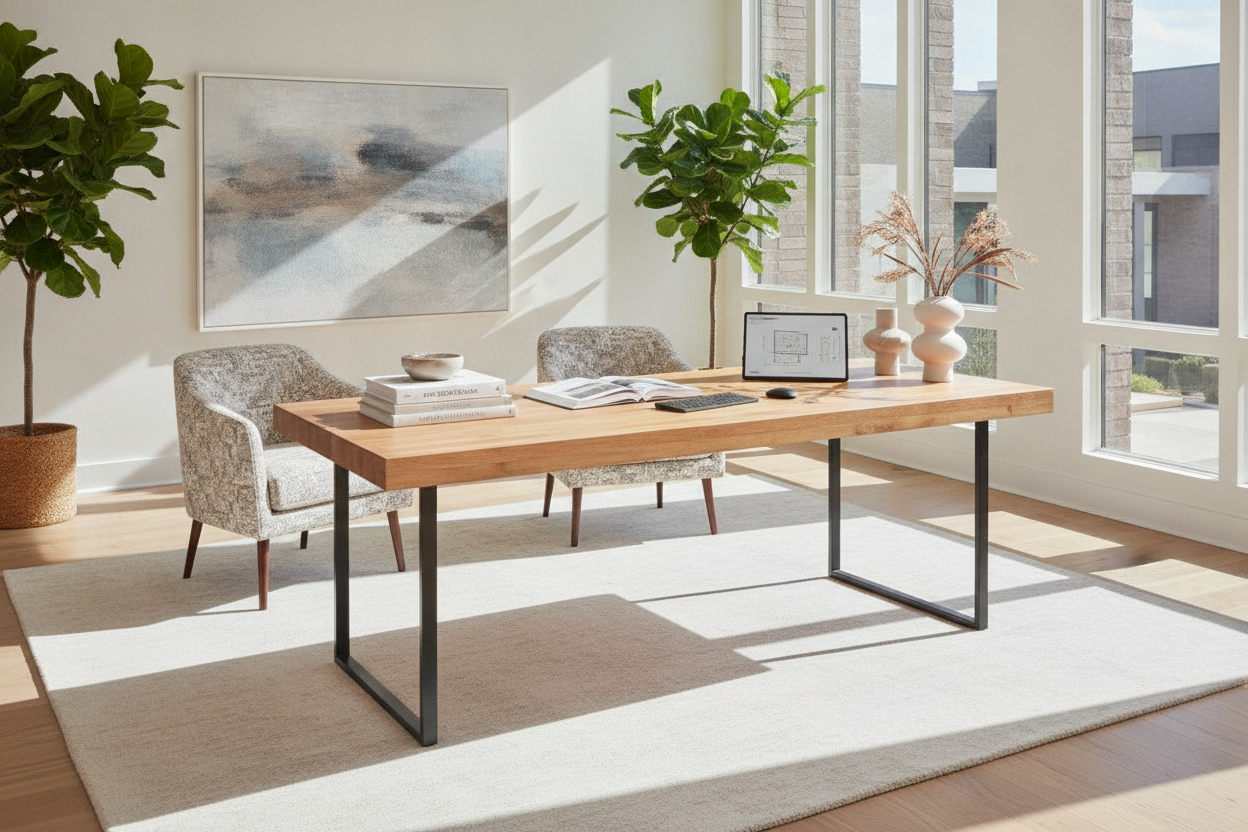
When browsing online marketplaces for home office furniture, standard workstations frequently default to shallow dimensions. While narrow tables suit compact spaces, searching specifically for a 30 inch deep desk amazon listing opens up a substantially more functional category of workspace. A thirty-inch depth creates generous physical breathing room between visual displays, active input devices, and analog note-taking materials.
Navigating digital product catalogs requires a discerning eye. Online photographs often obscure structural details, joinery methods, and the true footprint of the desk base relative to the tabletop. Understanding how to evaluate product schematics, confirm structural stability in flat-pack designs, and manage floor circulation ensures you select a deep workstation that integrates seamlessly into your interior layout.
Why Workspace Depth Matters: The Advantages of a 30-Inch Profile
The primary advantage of a deep desktop profile lies in visual ergonomics and physical task separation. Shallow surfaces often force computer monitors uncomfortably close to the user, creating a crowded environment where keyboards, notebooks, and display stands compete for the same narrow strip of space.
With a deeper surface, you gain distinct operational tiers. You can position large monitors or dual-screen setups at an optimal visual distance while maintaining ample room directly in front of you for resting your forearms, laying out open references, or placing an oversized desk pad. Furthermore, the additional depth provides expanded under-desk clearance, offering comfortable leg extension without bumping against support beams or back panels.
Evaluating Online Desk Listings: Decoding Dimensions and Schematics
Online product titles often summarize overall dimensions broadly, which makes reviewing the technical schematic drawings essential. As highlighted in our finding the best office desk for home amazon guide, verifying both overall and usable measurements helps prevent common layout mistakes.
When reviewing product diagrams, distinguish between the outer boundary of the base and the usable top surface. Some models feature splayed legs or outward-angled steel frames where the base footprint is wider and deeper than the tabletop itself. Conversely, desks with inset legs provide full surface depth while conserving floor space, making them easier to position flush against a wall.
Checking Tabletop Overhang and Monitor Arm Clamping Clearance
If you plan to use aftermarket monitor arms, cable management trays, or clamp-on task lights, pay close attention to the rear edge of the desk. Flat-pack desks frequently incorporate perimeter support aprons, rear privacy panels, or crossbars positioned directly beneath the tabletop edge.
- Rear Lip Clearance: Look for diagrams indicating an unobstructed overhang along the rear perimeter so C-clamps can seat flush without interference.
- Edge Contours: Be mindful of heavy bevels or rounded perimeter trims that might reduce the stability of clamp-style accessories.
- Grommet Cutouts: Check whether pre-drilled cable grommets align with your planned monitor placement or if they interfere with desk pads.
Flat-Pack Shipping and Structural Geometry Verification
Because deeper desks feature larger top spans, evaluating structural bracing is crucial to prevent center sag and lateral wobble. When reviewing product imagery and customer setup photos, inspect the under-structure for reinforcement elements.
Look for steel subframes with dual longitudinal rails or heavy-duty corner gussets that connect the legs directly to a rigid perimeter. Desks utilizing single center beams or thin connector plates without diagonal bracing are more susceptible to lateral movement, especially when loaded with heavy desktop towers, audio gear, or books.
Spatial Planning and Circulation Around Deeper Desks
A thirty-inch deep work surface protrudes further into a room than conventional writing desks, requiring intentional spatial planning. In home offices, maintaining open traffic pathways prevents the room from feeling cramped or obstructed.
To ensure comfortable movement, calculate both the desk depth and the clearance needed for your task chair. A standard office chair requires dedicated space behind the desk edge to roll back smoothly and allow the user to stand comfortably without hitting walls or adjacent storage. If your room features an angular or narrow layout, alternative footprints such as a 55 inch L-shaped corner desk with storage can provide extended work surface depth while preserving central walking paths.
Zoning a 30-Inch Deep Tabletop for Maximum Productivity
Maximizing the benefits of a deep workstation involves establishing front-to-back functional zones across the surface. Rather than scattering equipment arbitrarily, dividing the tabletop into purposeful tiers keeps your primary work area clear.
According to principles covered in our curating desk organization amazon guide, a structured front-to-back layout creates an intuitive flow:
- The Immediate Zone (Front 10–12 Inches): Reserved exclusively for active input devices, such as the keyboard, mouse, and open paperwork, providing comfortable wrist and forearm support.
- The Transition Zone (Middle 8–10 Inches): Ideal for secondary tools, including desk risers, charging pads, stationery organizers, or resting a laptop open beneath an external display.
- The Peripheral Zone (Rear 8–10 Inches): Accommodates heavy monitor stands, articulated display mounts, desk lamps, and concealed cable channels.
Complementary Storage and Layout Configurations
A deep desktop provides generous open volume beneath the surface, making it well-suited for integrated or modular storage elements. Mobile pedestal drawers, slim filing units, or low CPU caddies can sit neatly under one side of the desk without compromising your primary legroom.
For rooms that require substantial vertical storage alongside deep work zones, consider pairing your main desk with dedicated credenzas or exploring integrated options like a wide computer desk with glass cabinets. Balancing a deep table profile with coordinated, vertically efficient storage ensures that your workspace remains organized, practical, and visually balanced.


Laisser un commentaire
Ce site est protégé par hCaptcha, et la Politique de confidentialité et les Conditions de service de hCaptcha s’appliquent.