


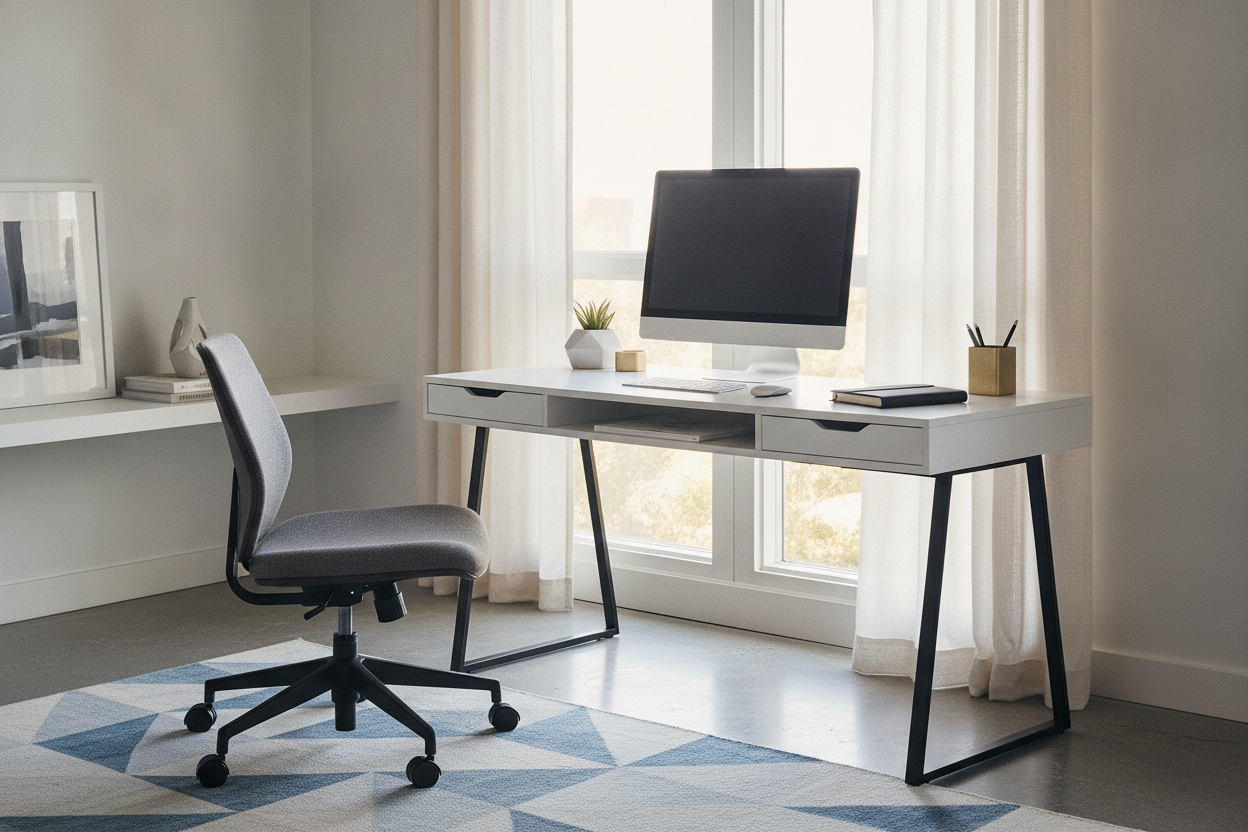
I have spent more hours than I care to admit staring at 47 different browser tabs, all featuring some variation of a modern desk under $200. It usually happens at 1 AM when I’m convinced that a new workspace will finally fix my productivity. But let’s be real: most budget furniture looks like it was designed for a college freshman’s first dorm room. It’s either that weirdly orange 'oak' laminate or a frame so thin it wobbles when you type an email.
Finding a sleek, grown-up workspace on a budget is a minefield of 'reclaimed' stickers and hollow metal tubes. I’ve assembled enough flat-pack furniture to know that the price tag doesn't always dictate the style, but you have to know which corners are okay to cut and which will leave you with a sagging piece of junk in six months. Here is how I sift through the noise to find pieces that actually look like they belong in a curated home.
Quick Takeaways
- Avoid split-top boards; they look cheap and collect dust in the seams.
- Stick to solid white or matte black to hide the fact that it isn't solid wood.
- Skip the built-in drawers—they usually have terrible hardware at this price point.
- Prioritize a 47-inch to 55-inch width for a balanced, modern look.
The Dorm Room Trap of Budget Furniture
The biggest issue with most computer desks under 200 is that they try too hard to look 'expensive' by mimicking high-end materials. You’ve seen it: the 'industrial' desk with a top that is clearly a low-resolution photo of a barn door printed onto a piece of particle board. These faux-wood veneers are a dead giveaway of a budget buy. They have a weirdly reflective sheen that screams plastic, and the 'grain' never actually lines up at the edges.
Then there are the legs. A lot of budget options use chunky, square metal legs finished with a gritty, gray powder coating. It’s meant to look like raw steel, but it just looks like a construction site. When I’m hunting for a home office desk under $200, I look for slim, tapered legs or clean T-frames. The thinner the profile, the more 'designer' it feels. If the welding looks like a glob of gum painted over, it’s a hard pass. You want clean joints and smooth finishes, even if the metal is hollow.
Rule 1: Prioritize Single-Piece Tops
If there is one hill I will die on, it is the 'no-seam' rule. To save on shipping costs, many manufacturers ship computer desks under 200 in two separate pieces that you bolt together in the middle. This results in a visible line running right down the center of your workspace. Not only does it look unfinished, but it’s also a structural nightmare. These desks tend to sag at the seam over time, especially if you’re using a heavy monitor arm.
A single-piece top provides a much cleaner, minimalist aesthetic that mimics high-end custom builds. It’s the same reason I’d never buy a split-top standing desk—the visual clutter of that gap ruins the flow of the room. When you're looking at product photos, zoom in on the tabletop. If you see a line, or if the 'wood grain' suddenly changes direction in the middle, keep scrolling. A solid, continuous surface is the easiest way to make a budget desk look like a custom piece of furniture.
Rule 2: Keep the Color Palette Brutally Simple
At the sub-$200 price point, 'wood' is almost always a lie. Unless you’re buying bamboo, you’re getting a sticker over MDF. My advice? Don’t try to fake the wood look. A white desk under $200 or a crisp matte black desk is much more convincing. Solid colors don't have to worry about looking 'realistic.' A white desk under 200 instantly brightens a room and makes a small corner feel like a dedicated office rather than a cluttered nook.
I’m a huge fan of a minimalist white home office desk because it acts as a blank canvas. You can pair it with a high-end chair or a colorful desk lamp, and the desk itself fades into the background. If you go for black, make sure it’s a matte finish. Glossy black budget furniture is a magnet for fingerprints and dust, and it tends to show every little scratch from your mouse. Stick to a simple, solid palette to keep the focus on your decor, not the price of your furniture.
Rule 3: Look for Hidden (or Zero) Storage
We all think we need drawers, but an executive desk under $200 is usually a disaster. To hit that price point while including drawers, manufacturers use the cheapest possible hardware. We’re talking plastic rollers that squeak and fabric drawers with 'wood' fronts that eventually fall off. It’s bulky, it’s clunky, and it makes the desk look like a heavy block of 1990s office equipment.
Instead, look for minimalist writing and computer desks that offer a slim profile. A simple writing desk under $200 looks significantly more modern and expensive because it has a lighter visual footprint. If you absolutely need storage, buy a separate metal filing cabinet or a set of drawers on casters that you can tuck underneath. This allows the desk to maintain its sleek lines while keeping your clutter out of sight. Plus, it’s much easier to move two small pieces than one giant, heavy, poorly-made executive desk.
Finding Decent Materials on a Strict Budget
You aren't going to find a solid walnut desk for $180—it just isn't happening. But you can find a wood desk under 200 if you know what to look for. Bamboo is the secret weapon of the budget world. It grows fast, it’s incredibly durable, and it has a natural, light-colored grain that looks high-end without the high-end price tag. It’s significantly better than the particle board you’ll find at big-box retailers.
If you have to go with engineered wood, look for 'high-grade MDF' with a melamine finish. It’s much more resistant to water rings and scratches than the cheap paper veneers. Also, pay attention to the frame. Look for powder-coated steel. If the description says 'painted iron,' be careful—that paint tends to chip off the moment your vacuum cleaner bumps into the leg, leaving you with ugly silver scars on your furniture.
How to Fake an Expensive Setup
Once you’ve landed the best computer desk under 200, the magic happens in the styling. You can make a $150 desk look like a $600 designer piece with about $40 worth of accessories. First, get an oversized leather or felt desk mat. This covers the majority of the 'budget' surface and provides a high-end texture for your hands. It also hides the sound of your keyboard echoing off a hollow tabletop.
Lighting is the next step. Never use a harsh overhead light; it makes the cheap finishes on budget furniture look flat and plastic. Use a warm desk lamp to create shadows and depth. I’ve written extensively about styling a computer desk under $150, and the biggest takeaway is always cable management. If you have a mess of black wires hanging under your sleek new desk, it doesn't matter how 'modern' the design is—it will look messy. Use some cheap velcro ties to hide those cords behind the desk legs.
Personal Experience: The 'Walnut' Disaster
I once bought a 'walnut' desk online for $145. In the photos, it looked like a mid-century dream. When it arrived, it was the color of a burnt orange and felt like it was made of literal cardboard. Within a month, the 'wood' sticker started peeling at the edges where my wrists rubbed against the desk. It was a lesson learned the hard way: if you're spending less than $200, don't try to mimic expensive hardwoods. I replaced it with a simple, solid white desk that I still use today. It’s sturdy, it’s clean, and it doesn't try to be something it’s not.
FAQ
Can I find a real wood desk under $200?
Rarely. You might find bamboo or small 'solid wood' desks made of Paulownia or Pine, but they are often quite small. Your best bet for the 'wood' look is a high-quality veneer or bamboo.
Are budget desks stable enough for dual monitors?
Yes, but check the weight capacity. Most modern desks in this price range can handle 100-150 lbs, which is plenty for two monitors. Just avoid the split-top models as they have a weak point in the center.
How long do these desks actually last?
If you get one with a metal frame and a solid (non-split) top, it can easily last 5+ years. The main point of failure is usually the veneer peeling or the legs wobbling due to loose bolts—so keep that hex key handy for occasional tightening.

Laisser un commentaire
Ce site est protégé par hCaptcha, et la Politique de confidentialité et les Conditions de service de hCaptcha s’appliquent.