


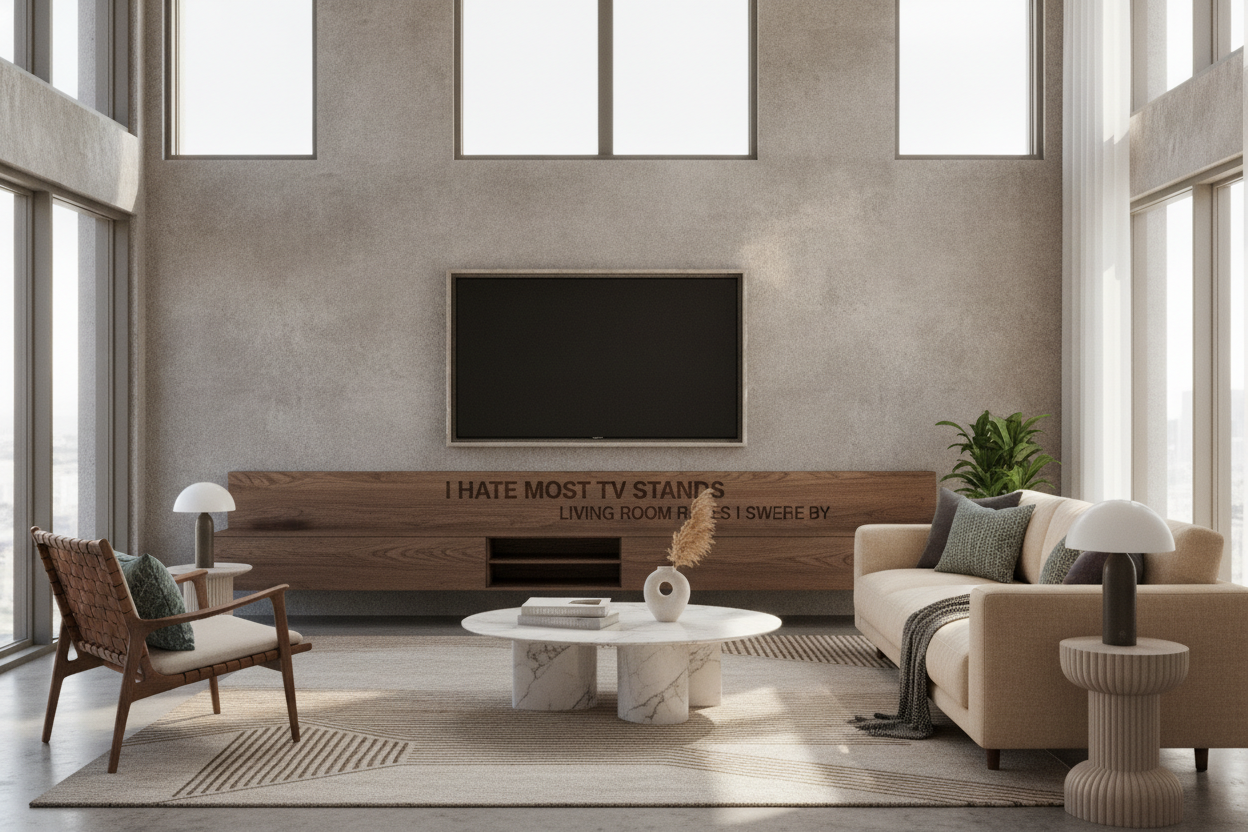
I spent three years staring at a particleboard monster that took up half my wall and did nothing but gather dust and hide a tangled nest of HDMI cables. It was heavy, deep, and had the aesthetic appeal of a hospital waiting room cabinet. Most tv stands living room options are designed for 2005-era tech—they are built for depth and weight we just don't deal with anymore. They turn your space into a shrine to a black glass rectangle instead of a place where people actually want to hang out.
Quick Takeaways
- Legs are non-negotiable; seeing the floor underneath makes a small room feel twice as large.
- Standard media consoles are often too low; aim for a surface height of 30 inches to keep the screen at eye level.
- Dining room sideboards offer better hidden storage for messy electronics.
- Avoid 'open shelving' unless you enjoy dusting your PlayStation every three days.
The 'Tech Shrine' Effect (And Why I Loathe It)
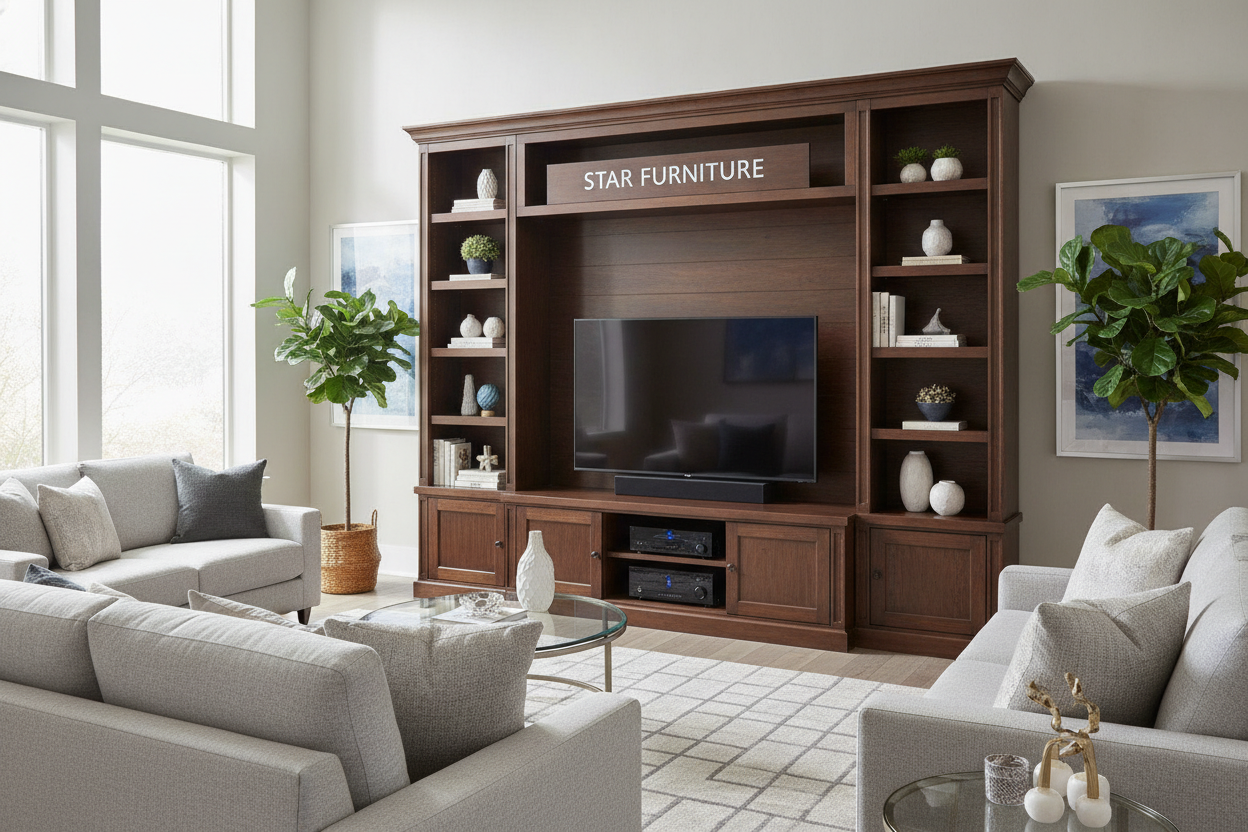
Big-box stores love selling those massive, hulking units that look like they belong in a basement man-cave. You know the ones: dark espresso laminate, glass doors that show every smudge, and enough depth to house a tube TV from 1998. These pieces force all your furniture to point awkwardly at a single spot, creating a 'tech shrine' that kills the flow of the room. They are visual anchors in the worst way possible, dragging the energy of the space down to the floor.
I remember being so desperate to avoid the bulky look that I considered a slim console table TV hack just to reclaim some floor space. Standard consoles are usually 18 to 20 inches deep, which is overkill for a modern flat screen that is barely two inches thick. That extra foot of wasted space is a magnet for clutter—old remotes, half-empty coasters, and mail you will never open. Plus, the back panels are usually made of that flimsy cardboard that rips the second you try to thread a power cord through those tiny, poorly placed holes.
When you choose a heavy, floor-hugging unit, you lose the ability to see your baseboards and flooring. In a small apartment, that is a death sentence for the 'airy' feel we all want. You want furniture that stands on its own merits, not something that looks like it was designed by a cable company engineer.
Why I Swapped to a TV Table (Living Room Magic)
The moment I finally downsized to a small wood TV table, my entire apartment felt like it had been through a detox. A proper tv table living room setup should prioritize 'visual lightness.' This means choosing a piece with actual legs—tapered Mid-Century legs or thin metal frames—that allow light to pass underneath. It sounds like a small detail, but being able to see the floor extend all the way to the wall trick your brain into thinking the room is bigger than it is.
I once tested a 'floating' console that mounted directly to the studs. While it looked cool, it was a nightmare for anyone who likes to rearrange their furniture twice a year (me). A high-quality wood table offers the same lightness without the commitment of drilling twelve holes into your drywall. Look for materials like kiln-dried oak or walnut. Avoid the cheap 1.5 lb density MDF; it will sag in the middle within six months if your TV has any significant weight.
The height is also a factor people miss. Most 'media units' are 20-24 inches tall. If you are sitting on a modern sofa with a standard 18-inch seat height, you are constantly looking down. A 30-inch table puts the center of the screen at eye level, which is much kinder to your neck during a Sunday afternoon movie marathon. My rule is simple: if it looks like it belongs in a bedroom or a hallway, it probably makes a better TV stand than an actual TV stand.
The Case for Sideboards Over Traditional Consoles
If you need storage but refuse to settle for a clunky media center, start shopping the dining room category. Sideboards, buffets, and credenzas are secretly the best media units ever made. They are typically taller, sleeker, and built with much better materials because they are intended to hold heavy china and serving platters. A solid wood modern sideboard offers deep cabinets that can hide everything from a clunky router to a messy collection of board games.
I currently use a vintage-style buffet that is 34 inches high. It has three drawers for chargers and two large cabinets for my sound system. Because it is solid wood, I don't worry about the weight of my 55-inch screen causing the top to bow. Most dining pieces also feature better hardware—think soft-close hinges and brass pulls—instead of the plastic bits you find on furniture specifically labeled as 'media storage.'
The downside? You usually have to drill your own holes for cords. But honestly, taking ten minutes with a 2-inch spade bit is worth it for a piece of furniture that looks like it was chosen by an adult with taste. You get a cleaner silhouette and a piece of furniture that can move with you to a dining room or an entryway in your next home. It is a long-term investment rather than a disposable solution.
How to Style Television Table Living Room Furniture
Once you have the piece, the goal is to make the TV disappear—or at least look like it belongs there. Styling television table living room furniture is all about creating balance. If you have a massive black screen centered on a table, it looks like a giant eye staring at you. Break that symmetry. Place the TV slightly to one side and balance the other side with a tall ceramic lamp or a leaning piece of art. This draws the eye across the furniture rather than straight to the screen.
I love using a modern brown sideboard buffet because the integrated lighting can act as 'bias lighting' behind the screen, which reduces eye strain and makes the black levels on your TV look deeper. If your unit has glass shelves, use them to display books or textured objects like stone bowls. This breaks up the solid 'block' of wood and adds layers to the room.
Avoid the temptation to put small, dinky knick-knacks around the TV. They just look like clutter next to a large electronic device. Go for 'anchor' objects: a stack of large coffee table books, a single oversized vase, or a tray to hold your remotes. The goal is to make the tech feel like an afterthought in a beautifully curated room.
My Go-To Trick for Hiding Ugly Cords
If you buy a piece of furniture that wasn't built for media, cords will be your biggest enemy. My trick? I use a heavy-duty power strip mounted to the underside of the cabinet with Command strips. This way, only one cord ( the main power cable) actually runs to the wall. For everything else, I use plastic cable raceways that I paint the exact same color as my walls. It takes twenty minutes and makes a $200 table look like a $2,000 custom built-in. If you have an open-leg table, wrap the cords down the back of one leg using clear zip ties. It’s nearly invisible from the sofa.
FAQ
Is it okay to put a TV on a dresser?
Absolutely. Just check the height. If the dresser is over 40 inches tall, you will be craning your neck. Look for 'lowboy' dressers that stay around the 30-34 inch mark for the best viewing angle.
How wide should my TV stand be?
Your furniture should be at least 4 to 6 inches wider than the TV on both sides. If the TV is wider than the stand, the whole room feels top-heavy and precarious.
Do I need ventilation for my consoles?
Yes. If you hide a PlayStation or Xbox inside a sideboard, you need to leave the back panel off or install a small USB-powered fan. Modern consoles run hot and will die quickly in a sealed wooden box.

Laisser un commentaire
Ce site est protégé par hCaptcha, et la Politique de confidentialité et les Conditions de service de hCaptcha s’appliquent.