


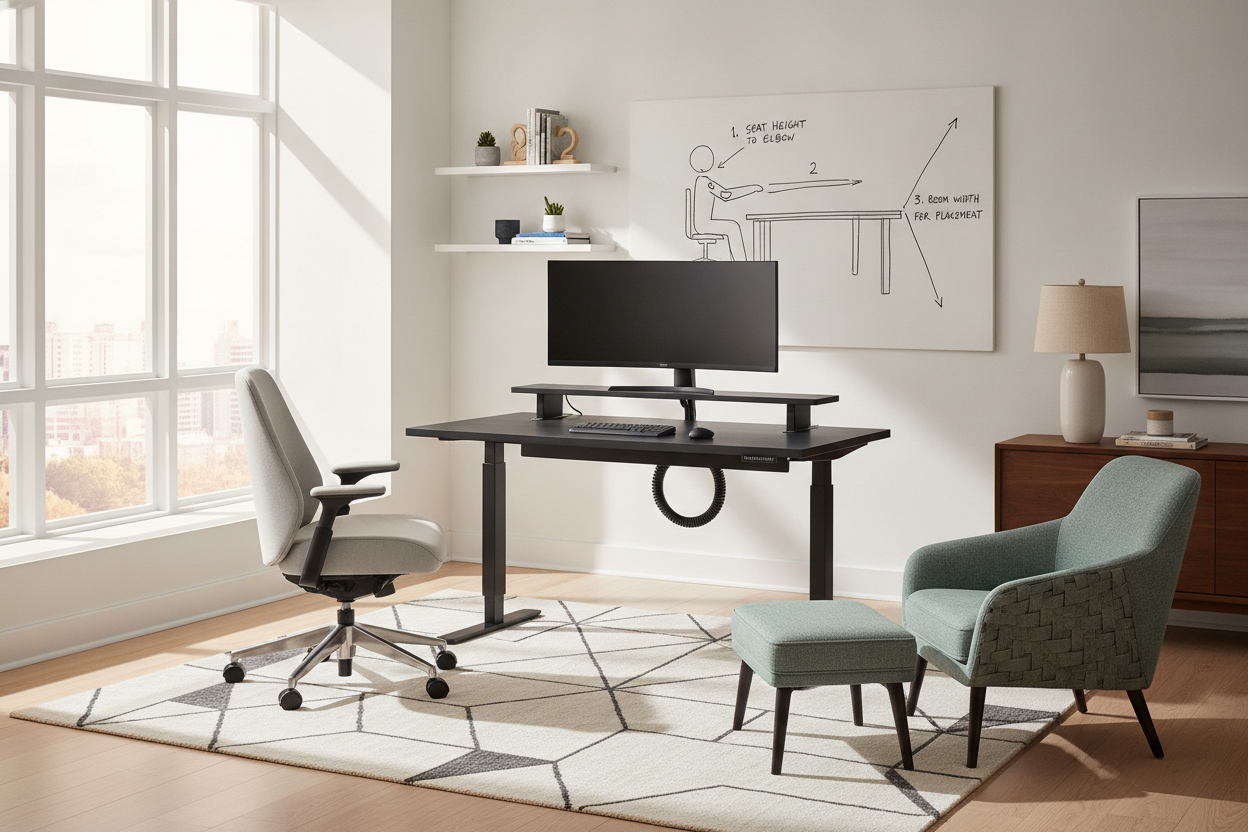
I once fell for a walnut desk that looked like a mid-century masterpiece on my screen. When it arrived, my knees hit the underside every time I shifted, and my 27-inch monitor felt like it was two inches from my face. Buying a modern desk for office use isn't just about finding a pretty slab of wood; it's about the math of how you actually move through your day.
Quick Takeaways
- Depth is more important than width for eye health and monitor placement.
- The 'apron' height determines if you can actually cross your legs.
- Always leave 36 to 48 inches behind the desk for chair movement.
- Blue painter's tape is your best friend for visualizing the footprint.
Why guessing your workspace dimensions is an ergonomic trap
Most people shop for desks by looking at the length. They think, 'I have six feet of wall, so I'll buy a six-foot desk.' That’s how you end up with a room that feels like a storage unit. When you guess on dimensions, you’re usually sacrificing your posture or your floor flow.
I’ve seen dozens of home offices where the desk is technically 'modern' but functionally a disaster. If the desk is too high, your shoulders stay hunched. If it’s too shallow, you’re staring at pixels from a foot away. It’s not just about the furniture fitting the room; it’s about the furniture fitting your body.
Measurement 1: The 'arm-reach' surface depth
Depth is the most underrated measurement in office furniture. A standard writing computer desk often clocks in at 20 to 24 inches deep. That is fine for a laptop and a notebook, but it’s a nightmare for a full desktop setup. If you use a large monitor, you need at least 30 inches of depth to keep the screen at a comfortable focal distance.
Anything shallower than 24 inches forces your keyboard right up against the screen. Your eyes will be strained by noon, and you won’t have any room to rest your forearms. If you’re a power user with dual monitors, don't settle for less than 30 inches. Your retinas will thank you.
Measurement 2: Finding the right knee clearance
This is the one that gets people. You see a desk with beautiful, chunky drawers and think, 'Great, storage!' But every inch of drawer depth is an inch of legroom you lose. I’ve written before about the struggle of finding a desk with drawers that doesn't sacrifice your ability to actually sit comfortably.
Measure from the floor to the bottom of the desk frame—this is your knee clearance. Most adults need at least 25 inches of vertical space to move their legs freely. If you like to cross your legs or use a thick ergonomic chair, you might need 27 inches. If the desk has a thick 'apron' (the wooden frame under the top), you might find yourself trapped in a very expensive wooden cage.
Measurement 3: Total footprint for a modern desk for home office
The desk might fit on the wall, but will you fit behind it? When planning for a modern desk for home office setups, you have to account for the 'active zone.' This is the space the desk occupies plus the 36 inches needed to pull your chair out and stand up without hitting a wall or a bookshelf.
If you are tight on space, a white home office computer corner desk is a smart way to maximize a footprint because it tucks the 'dead space' into the corner. On the flip side, if you have a massive dedicated room, you might consider something like a large L-shaped executive counter. Just remember: the bigger the desk, the more it dictates the traffic flow of the entire room. Don't let your desk turn your office into a parkour course.
How to map these dimensions in your actual room
Before you click 'add to cart,' go get a roll of blue painter's tape. Tape out the exact footprint of the desk on your floor. Then, place your office chair where it would go. Sit in the chair. Can you get out easily? Can you open the door to the room? If you have to shimmy past the desk to get to the window, the desk is too big.
Once you have the physical footprint locked in, you can focus on the fun stuff. Even if you start with a basic frame, you can work on elevating standard big-box furniture with better lighting and cable management. But no amount of styling can fix a desk that’s three inches too tall or five inches too shallow.
Personal Experience: The 'Perfect' Desk Mistake
I once bought a gorgeous reclaimed wood desk that was 31 inches high. Standard is 29. Those two inches felt like a mile. My elbows were constantly angled upward, and within a week, I had tingling in my wrists. I ended up having to saw two inches off the legs of a $600 desk just to make it usable. Measure twice, or you'll be the person with a saw in your home office at 10 PM on a Tuesday.
FAQ
How deep should a desk be for two monitors?
You want at least 30 inches. This allows you to push the monitors back so you aren't turning your neck at sharp angles to see the edges of the screens.
What is the standard height for a modern desk?
Most desks are between 28 and 30 inches high. If you are shorter or taller than average, consider an adjustable height desk to avoid back pain.
How much space do I need behind my desk?
At a minimum, 36 inches. If you have a deep, reclining chair or want people to be able to walk behind you, aim for 48 inches.


Laisser un commentaire
Ce site est protégé par hCaptcha, et la Politique de confidentialité et les Conditions de service de hCaptcha s’appliquent.