


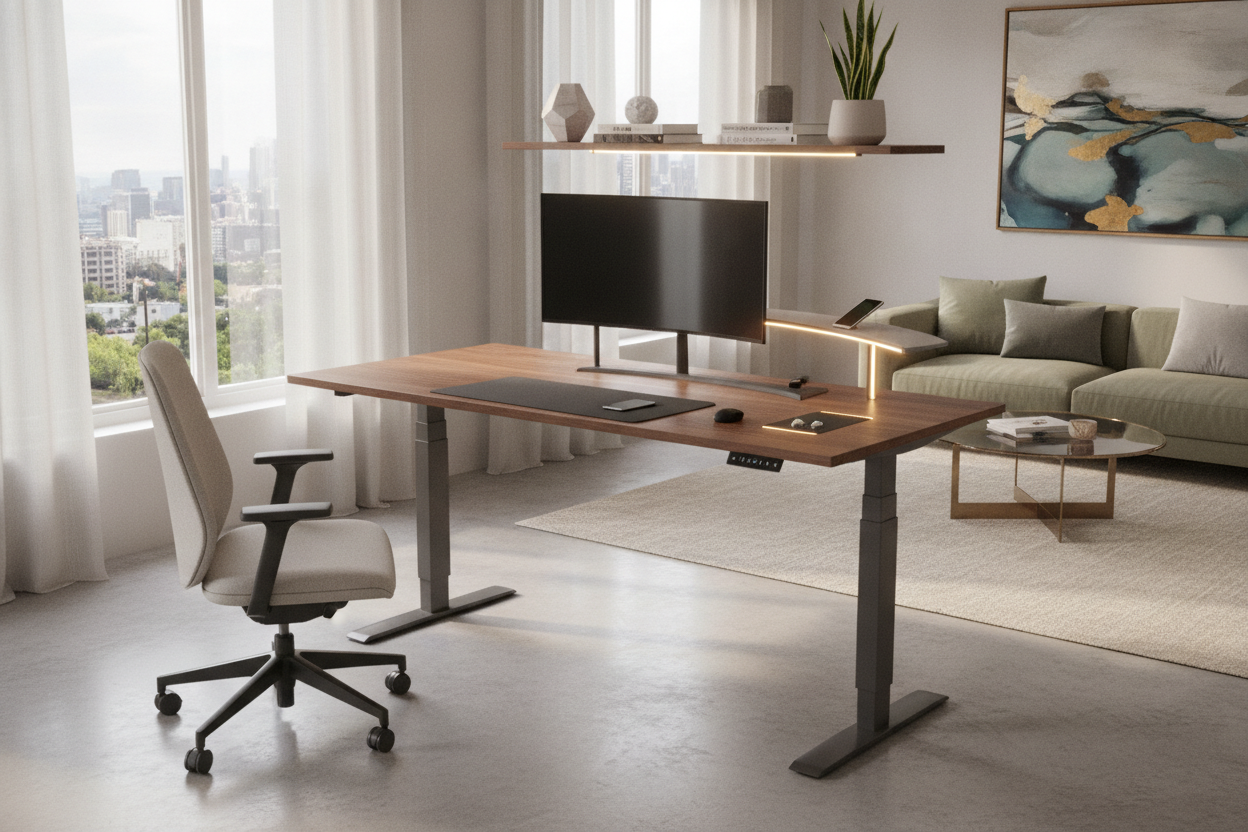
I was halfway through color grading a 4K timeline when I realized I was actually getting seasick. Every time I hit the spacebar or tapped a quick keyboard shortcut, my dual 27-inch monitors performed a synchronized, jittery dance. It wasn't a cool standing desk moment; it was a rhythmic vibration caused by a $180 particle-board top struggling to stay upright on spindly, single-motor legs.
Quick Takeaways
- Cheap frames wobble at standing height because they lack enough steel overlap in the legs.
- Dual motors are non-negotiable if you have more than one monitor or heavy audio gear.
- 3-stage legs provide a wider height range and significantly better stability than 2-stage versions.
- Investing in a high-quality frame saves you from replacing a burned-out motor every two years.
The Moment I Realized My Cheap Desk Was Ruining My Work
For a long time, I thought a desk was just a flat surface that held my stuff. I spent three grand on a camera body and two grand on a GPU, then put them all on a desk that felt like it was made of compressed cardboard and hope. Whenever I worked standing up, the micro-vibrations from my typing made the fine details in my video edits look blurry. I thought I was losing my eyesight; turns out, I just had a quality standing desk problem.
The breaking point came during a client call. I shifted my weight, leaned slightly on the front edge of the desk, and my coffee mug slid two inches to the left because the whole surface tilted. It was embarrassing. That’s when I realized that a good quality standing desk isn't a luxury for people with too much aesthetic sense—it is a structural necessity for anyone with a heavy gear setup.
If your monitors shake when you type, you aren't being productive. You're just fighting your furniture. I spent weeks researching T-frames vs. C-frames and motor torque ratings before I finally admitted that I needed to stop being cheap about the thing that literally supports my entire career.
What Makes a Desk Actually 'Cool' (Hint: It's Not Just the Wood Top)
We all get distracted by the pretty wood tops. We want the live-edge walnut or the reclaimed oak. But after testing a dozen setups, I can tell you that the 'cool' factor of a desk is 100% about how it moves. There is nothing less cool than standing there like a statue, holding down a cheap plastic arrow button for 20 seconds while your desk groans its way up to standing height.
True functionality comes from a seamless electric lift system with memory presets. I have mine set to 29 inches for sitting and 44 inches for standing. One tap, and I can walk away to grab a glass of water; by the time I'm back, the desk is exactly where it needs to be. No hovering, no micro-adjusting, no manual labor.
A desk is cool when it disappears into your workflow. If you have to think about the transition, the desk has already failed. Premium motors are also whisper-quiet. My old desk sounded like a coffee grinder and woke up my toddler in the next room. My current setup is a low hum that doesn't even register on my desk mic during Zoom calls. That’s the kind of quality that actually matters when you're working 10-hour days.
The 3 Non-Negotiables for a High Quality Standing Desk
If you're looking for a high quality standing desk, stop looking at the color of the legs and start looking at the specs. First: you need dual motors. Single-motor desks use a hex rod to drive the second leg, which is a massive point of failure and often results in an uneven desk that eventually jams. Dual motors house a dedicated engine in each leg, providing more power and a much higher weight capacity.
Second, look for 3-stage column legs. These are the ones with three telescoping sections instead of two. Why does this matter? Stability. When a 2-stage desk is at its max height, there is very little overlap between the metal tubes, which is why they wobble like Jell-O. A 3-stage leg has more 'meat' overlapping at every height, keeping the frame rigid even when you're standing at 45 inches. It also allows the desk to go lower, which is vital for shorter users who need proper ergonomic sitting heights.
Finally, consider the footprint. If you’re running an ultrawide monitor, a laptop, and maybe some studio monitors, a 48-inch surface is a recipe for clutter-induced anxiety. I upgraded to a spacious 71-inch height adjustable standing desk and it changed everything. I finally have room for my audio interface and a notebook without knocking my mouse off the edge. When you have 71 inches of real estate, the weight capacity becomes even more critical. You want a frame rated for at least 250 lbs so it doesn't struggle under the weight of your tech stack.
Yes, an Expensive Standing Desk Hurts to Buy (But Saves You Money Later)
I’ll be the first to admit that dropping $800 to $1,200 on a desk feels aggressive. It’s an expensive standing desk, no doubt. But I’ve lived the alternative. I’ve bought the $300 budget models that start 'walking' across the floor because the motors are out of sync. I’ve dealt with the controllers that throw 'E08' error codes and refuse to move until you unplug everything and reset it for the fifth time that month.
When you buy a premium desk, you aren't just paying for the brand; you're paying for the warranty and the build tolerances. High-end frames use thicker gauge steel and better electronics. A cheap motor is rated for maybe 2,000 cycles; a high-end one is rated for 10,000+. If you plan on using this desk for the next decade, the 'expensive' option is actually the cheapest per year of use.
Think of it like a mattress. You spend a third of your life at your desk. If you buy a flimsy one, you'll be replacing it in two years when the motor burns out or the top bows under the weight of your iMac. Buy the right one once, and you’ll never have to think about your furniture again. That peace of mind is worth the entry fee.
How to Style a Beefy Desk Frame for a Home Office
The downside of a quality standing desk is that the frames are often heavy and industrial-looking. They can easily make a bedroom look like a corporate IT closet if you aren't careful. The key is balance. If you have a heavy-duty black steel frame, pair it with a warm wood top or a soft-textured desk mat to cut the 'office' vibes.
When designing a standing desk setup, cable management is your best friend. A premium desk usually comes with a tray or a channel to hide your power bricks. Use it. Nothing ruins the look of a sleek, expensive desk like a 'spaghetti monster' of cables hanging down the back. I use magnetic cable clips to run my monitor wires down the back of one leg so they are virtually invisible.
Don't forget the floor, either. A beefy desk deserves a nice rug, but make sure it’s low-pile so your office chair can still roll. I also recommend adding a few 'non-tech' items—a ceramic planter, a stack of real books—to remind people that a human lives here, not just a set of dual monitors and a mechanical keyboard.
Final Verdict: Finding the Best Sit and Stand Desk for Your Gear
At the end of the day, the best sit and stand desk is the one that stays still. If you’re a creative professional, your desk is your foundation. Don't build your career on a shaky foundation. Look for dual motors, 3-stage legs, and a weight capacity that can handle your future upgrades.
It took me three 'cheap' desks to realize that I was just wasting money on temporary fixes. If you have the budget, go for the heavy steel and the smart controllers. Your monitors—and your neck—will thank you every time you hit that preset button and the desk glides silently into place.
FAQ
Is a dual-motor desk really that much better than a single-motor?
Yes. Single-motor desks are slower, louder, and have lower weight capacities. More importantly, they tend to lift unevenly over time, which can warp your desktop or cause the legs to bind.
What is the benefit of 3-stage legs?
Stability and range. 3-stage legs use more steel overlap, which eliminates the 'wobble' at standing heights. They also go lower than 2-stage legs, making them better for shorter users who need proper ergonomics while sitting.
How much weight can a high-quality standing desk actually hold?
Most premium dual-motor frames are rated for 250 to 350 lbs. This is plenty for three monitors, a heavy desktop PC, studio speakers, and you leaning on it for a bit.

Laisser un commentaire
Ce site est protégé par hCaptcha, et la Politique de confidentialité et les Conditions de service de hCaptcha s’appliquent.