
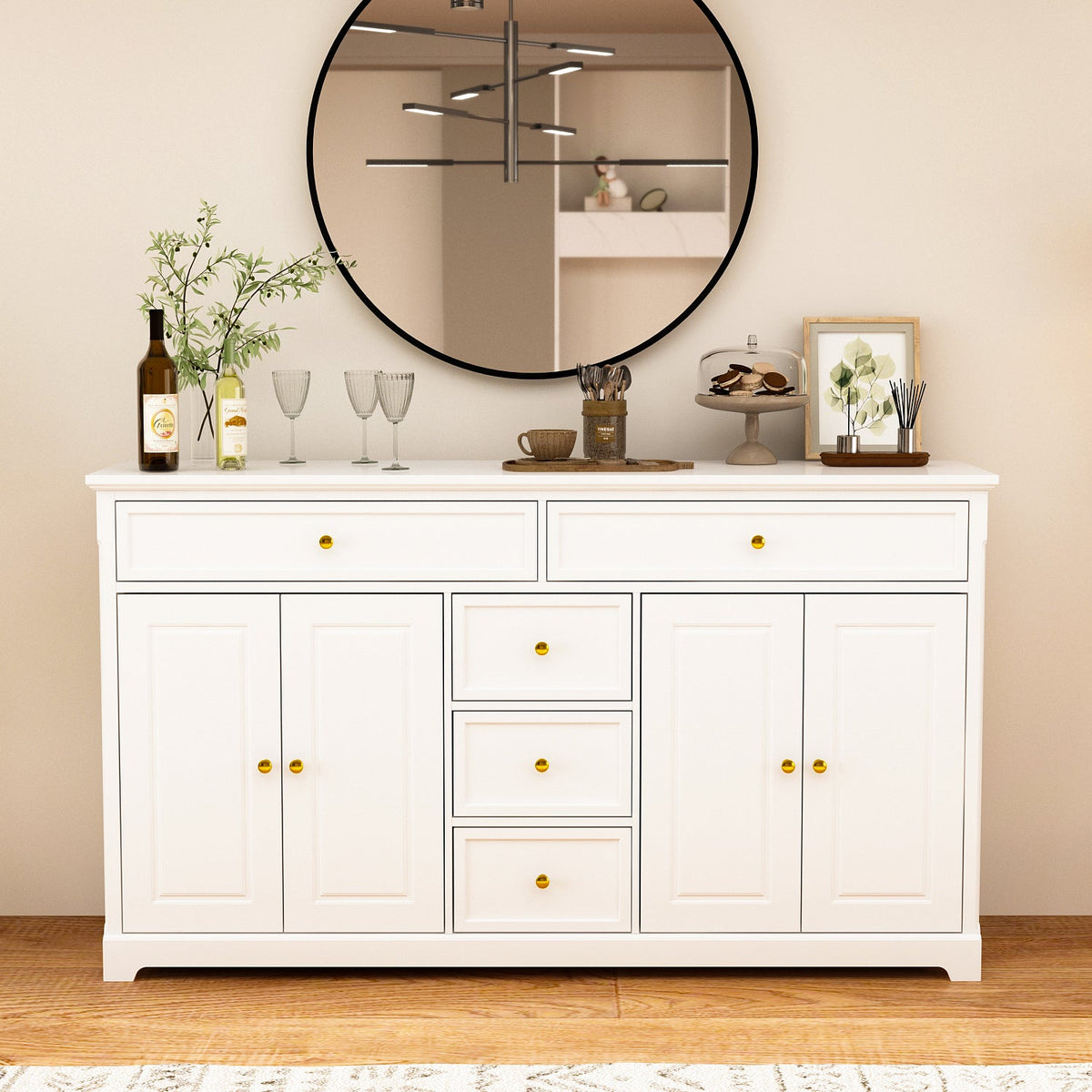
Short answer: the standard sideboard height is 30 to 36 inches, close to dining table height so the top works as a serving surface. A typical sideboard is 48 to 72 inches wide and 16 to 20 inches deep, and it should be about 60 to 75 percent of your dining table's length. Leave at least 36 inches between the table edge and the sideboard, and hang art or a mirror so its bottom edge sits roughly 6 to 10 inches above the top.
Those numbers are a useful starting point, but the right sideboard depends on your room: the wall length, the table size, how people move around the dining area and what you plan to put on top. This guide gives standard dimensions, then shows how to size a dining room sideboard to the table and wall, how much clearance to leave behind chairs, and how high to hang art above it. Every model in our sideboards and buffets collection lists its overall height, width and depth, so you can check each number against your space.
Standard Sideboard Dimensions at a Glance
| Dimension | Common range | FUFU&GAGA range | What it affects |
|---|---|---|---|
| Height | 30–36" | 24.1–47.4" (51 of 72 models are 30–36") | Serving comfort, art placement, TV viewing height |
| Width | 48–72" | 23.6–94.5" (median 59.1") | Proportion to the table and wall |
| Depth | 16–20" | Mostly 13.8–16" (median 15.7") | Walkway and chair movement |
Most sideboards fall inside these ranges because they are designed around the dining table: tall enough to serve food comfortably while standing, low enough to sit below a window or artwork, and shallow enough to preserve circulation in many dining rooms.
Sideboard Height: How Tall Should a Sideboard Be?
Aim for a sideboard height near your dining table height, or slightly taller. Standard dining tables are about 30 inches tall, so a 30- to 34-inch sideboard lines up visually with the tabletop, while a 34- to 36-inch top is more comfortable for serving from a standing position. Contemporary sideboards usually sit around 30 to 34 inches; traditional buffets often stand 34 to 38 inches.
| Height | Best for | Example |
|---|---|---|
| 24–30" | Under a wall-mounted TV, open-plan rooms, under a window | 55" glass-door sideboard with LED lights, 29.5" |
| 30–34" | Everyday dining room sideboard that lines up with the table | 59.1" contemporary buffet sideboard, 33.5" |
| 34–36" | Comfortable serving height, coffee or drinks station | 59.1" sideboard with track socket, 36" |
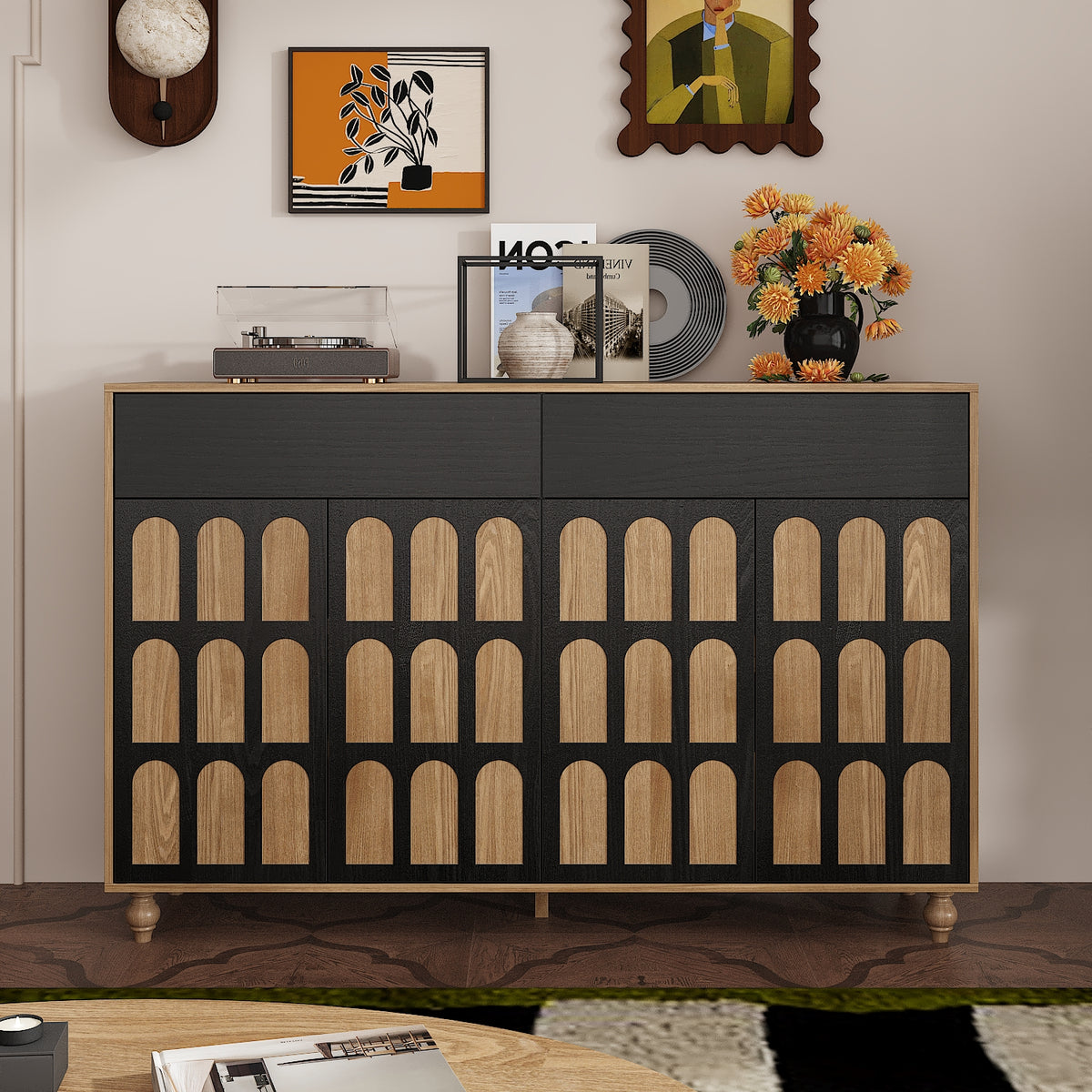
| 36–40" | Tall buffet in a room with high ceilings or a long wall | 59" mid-century sideboard, 39.3" |
Which is taller, a sideboard or a buffet?
A buffet is usually the taller of the two, often 34 to 38 inches on longer legs, while a sideboard is closer to 30 to 36 inches. Low credenzas run about 25 to 30 inches. Our guide to sideboard vs buffet vs credenza explains the other differences.
Ceiling height and visual weight
Ceiling height also influences the best choice. In a room with high ceilings, a taller sideboard of 36 to 42 inches or a tall mirror above it fills the vertical space. In compact rooms, a lower sideboard with short legs and clean lines keeps the visual weight down, and a piece on raised legs makes the floor look larger because you can see under it. Also check what sits behind the cabinet: a window sill, a thermostat or a cooling vent can decide the maximum height for you.
Sideboard Width: Size It to the Dining Table and the Wall
The most useful starting point is a sideboard 60 to 75 percent of the dining table length. That keeps the two pieces in proportion without the sideboard overpowering the table.
| Dining table length | Sideboard width (60–75%) |
|---|---|
| 60" | 36–45" |
| 72" | 43–54" |
| 84" | 50–63" |
| 96" | 58–72" |
Then check the wall length. Leave at least 6 to 12 inches of breathing room on each side, so the sideboard does not run into corners, door frames or nearby furniture. A sideboard should not fill the whole wall unless it is built in. If the table sits in the middle of the room and the sideboard faces it, center the sideboard on the table rather than the wall when the two disagree, so the dining zone reads as one group.
For example, a 72-inch table on a 10-foot (120-inch) wall pairs well with a 47- to 55-inch sideboard, such as the 47.2" black buffet cabinet, which leaves plenty of empty wall on each side.
Sideboard Depth and Front Clearance
Most sideboards are 16 to 20 inches deep, and depth is the measurement people most often underestimate. Every extra inch of depth comes out of the walkway between the sideboard and the dining chairs. In compact rooms, a 14- to 16-inch depth is often the practical range: the 55" mid-century sideboard with rattan doors is just 13.9 inches deep.
A simple way to find your maximum sideboard depth: measure from the table edge to the wall, then subtract the clearance you need (see below). With 54 inches between table and wall and 36 inches of clearance, the deepest sideboard that fits is 18 inches.
Also plan for door swings and drawers. Hinged doors swing out roughly their own width, so the doors on a 63-inch four-door sideboard each need about 15 to 16 inches of space in front. Make sure the door swings and drawers open fully without hitting a chair back. If space is very tight, choose drawers or a cabinet whose doors open with chairs pushed in.
Clearance Behind Dining Chairs
The clearance between the dining table and the sideboard has to cover chair movement and anyone walking past. The National Kitchen & Bath Association's kitchen planning guidelines give these figures for seating areas, measured from the table edge to any wall or obstruction:
| Situation | Clearance from table edge |
|---|---|
| No traffic behind the seated diner | 32" |
| Someone edges past the seated diner | 36" |
| Someone walks past the seated diner | 44" |
For a dining room sideboard, 36 inches is a practical minimum, and 42 to 44 inches is better if the sideboard side is also a main walkway or a serving route. You can add it up for your room: a 40-inch-wide table with a 16-inch sideboard, 44 inches on the sideboard side and 36 inches on the other side needs a room about 136 inches (11.3 feet) wide. Use painter's tape on the floor to mark the sideboard footprint and pull out the chairs before you buy.

How High to Hang Art or a Mirror Above a Sideboard
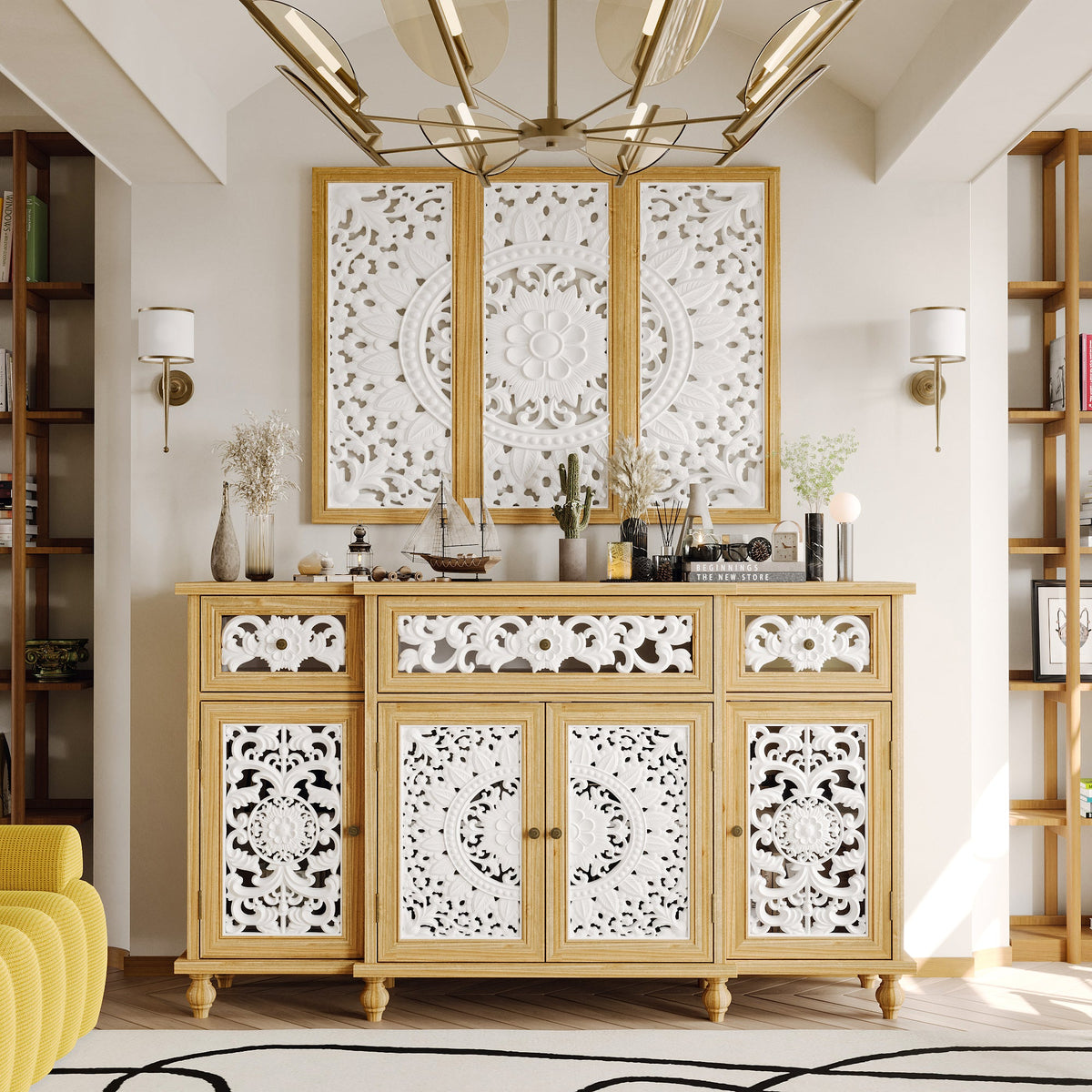
Hang art or a mirror so its bottom edge sits about 6 to 10 inches above the top of the sideboard. Framebridge recommends 7 to 10 inches above furniture, and Chairish suggests 6 to 12 inches of space between the furniture and the artwork. Closer than that, the piece looks crowded; much higher, it floats away from the sideboard.
- Width: choose art or a mirror about two-thirds the width of the sideboard. A 63-inch sideboard suits a piece about 40 to 44 inches wide.
- Center height: on a bare wall, art is usually centered about 57 to 60 inches from the floor. Above a sideboard, the furniture gap takes priority.
- Worked example: on a 31.5-inch sideboard, an 8-inch gap puts the bottom of the frame at 39.5 inches. A 36-inch-tall mirror then centers at 57.5 inches, right in the standard range.
- Tall items: if you plan buffet lamps or a tall vase, check that they overlap the frame slightly rather than hide it. Our guide on how to style a sideboard covers layering lamps, art and decor items.
For a TV above a sideboard, the rules change: the screen center should sit near seated eye level, which usually means a lower cabinet. See using a sideboard in the living room for TV sizing.
A Quick Measuring Checklist Before You Buy
- Measure the wall length and note windows, outlets, vents and door swings.
- Measure the dining table length and multiply by 0.6 and 0.75 for your width range.
- Measure table edge to wall and subtract 36 to 44 inches for your maximum depth.
- Decide on height: line up with the table (30 to 34 inches) or serve standing (34 to 36 inches).
- Tape the footprint on the floor and test the chairs, doors and drawers open.
- Check the delivery path: doorways, stairs and turns.

For a larger table, the 63" brown sideboard buffet cabinet with glass doors is 31.5 inches tall and 15.7 inches deep, with built-in lighting. FUFU&GAGA includes a tip-over restraint kit with most of its sideboards; anchor the cabinet once it is in place. Compare more sizes in our sideboard collection, where every product page lists exact dimensions.
FAQ
What is the typical height of a sideboard?
Most sideboards are 30 to 36 inches tall. Contemporary designs tend toward 30 to 34 inches, while traditional buffets are often 34 to 38 inches.
How tall is the average buffet?
The average buffet is about 34 to 38 inches tall, slightly taller than a sideboard, because it is designed as a standing serving surface and often has longer legs.
What is the standard height of a sideboard in a dining room?
In a dining room, 30 to 36 inches is standard. Choose 30 to 34 inches to line up with a standard 30-inch table, or 34 to 36 inches if you mainly use it for serving.
Should a sideboard be the same height as the dining table?
It does not have to be. The same height or slightly taller looks balanced; a noticeably taller buffet works best on a long wall or in a room with high ceilings.

Laisser un commentaire
Ce site est protégé par hCaptcha, et la Politique de confidentialité et les Conditions de service de hCaptcha s’appliquent.