


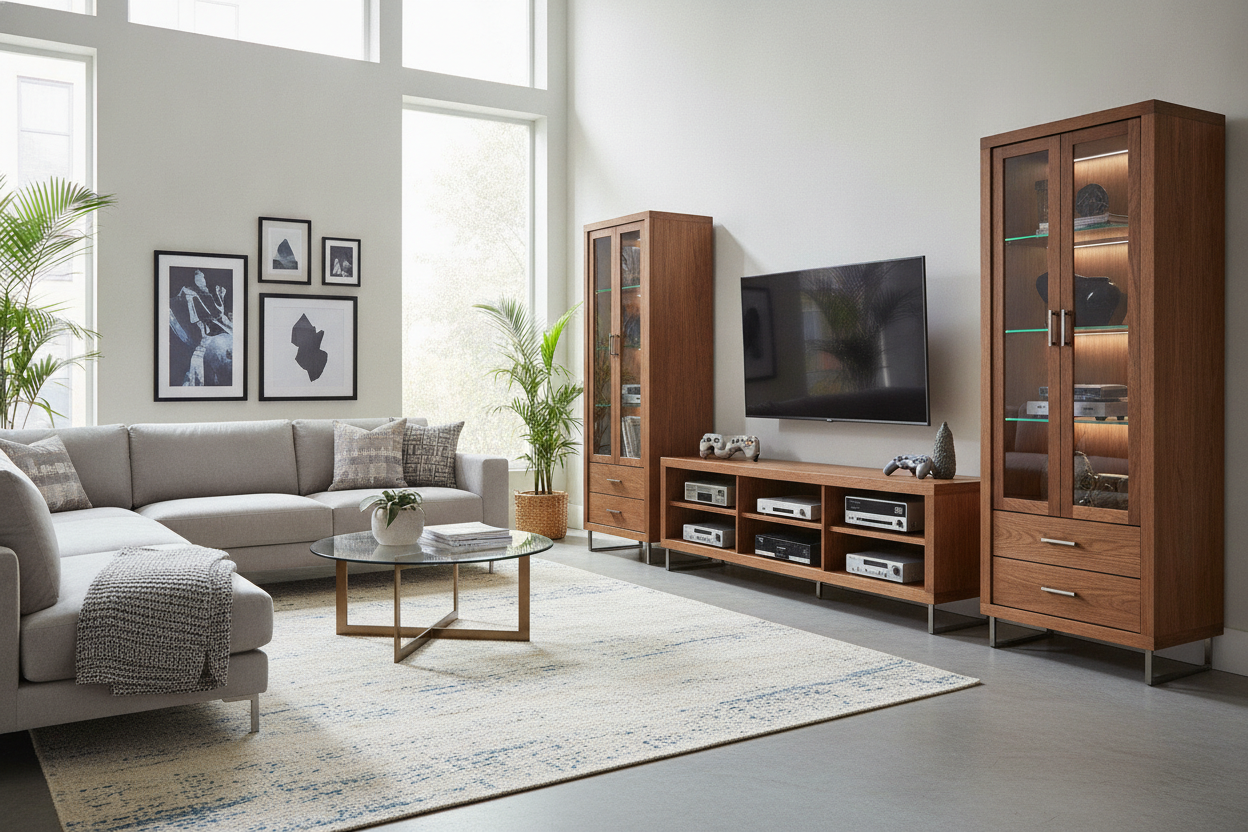
I have spent too many Sunday nights surrounded by Allen wrenches, cryptic diagrams, and a growing sense of existential dread. My last 'bargain' media unit from a big-box site started bowing in the middle after exactly three months of holding up my receiver. I spent hours trying to look at other TV stands online, but I could not shake the fear of another particle-board disaster. That is how I ended up driving to a local showroom to see if a jerome's tv stand could actually handle the weight of my electronics without groaning.
Quick Takeaways
- Pre-assembled Perk: Most units arrive built, saving you four hours of your life and a lot of swearing.
- Weight Capacity: Unlike flat-pack MDF, these consoles are designed for heavy 75-inch+ displays and actual audio gear.
- The Touch Test: You can verify the drawer glides and finish quality before the delivery truck arrives.
- Local Delivery: You get a specific window and people who actually carry the heavy thing into your room.
Why I Finally Gave Up on Flimsy Flat-Pack Furniture
The breaking point was a Tuesday evening when I heard a soft 'crack' from the living room. My $180 online-special console was literally splitting at the cam-lock because the weight of a soundbar was too much for it. We have been conditioned to accept furniture that is basically reinforced cardboard. I was tired of the wobble. I was tired of the 'wood-look' stickers peeling at the corners.
Going to a physical store felt like a retro move, but I needed to see the joinery for myself. Shopping for jerome's furniture tv stands meant I could actually apply pressure to the top surface to see if it flexed. If I am putting three thousand dollars worth of glass and silicon on a piece of furniture, I want to know it is not held together by hope and wood glue.
The Showroom Test: Judging Jerome's Furniture TV Stands in Person
There is a specific smell to a furniture showroom—a mix of wood polish and industrial air conditioning. Walking through the aisles, the first thing I noticed was the scale. Online photos are notoriously deceptive; they use tiny 32-inch TVs in their staging to make the stands look massive. In person, you realize exactly how much floor real estate a 70-inch console occupies.
I spent a good twenty minutes opening and closing doors on various jerome's furniture tv stands. I was looking for soft-close hinges and cord management holes that were actually large enough for a standard power plug. Most of the floor models felt surprisingly dense. They have that 'thunk' sound when you tap them, which is the universal language for 'this is not hollow.'
Does a Jerome's TV Console Actually Feel Solid?
The construction quality varies by price point, but even the mid-range options felt miles ahead of the stuff that comes in a flat box. I looked for solid wood frames and high-grade veneers. A jerome's tv console usually features reinforced back panels, which is where the cheap stuff usually fails first. If the back panel is just a sheet of stapled cardboard, the whole unit will eventually rack and lean.
I was particularly interested in the heavier units. If you are eyeing a mid-century modern entertainment center, you have to check the legs. Tapered legs look great, but they are a massive point of failure if they are just screwed into thin particle board. The Jerome's versions I inspected had proper mounting plates and felt stable enough to survive a move across town without the legs snapping off.
The Giant Screen Dilemma: Finding a Jerome's Entertainment Center That Fits
We keep buying bigger TVs, but we forget the physics of the setup. A 75-inch TV on a 60-inch stand looks like a lollipop—it is top-heavy and visually stressful. You want at least 4 to 6 inches of clearance on either side of the screen so the room does not feel cramped. Finding a jerome's entertainment center that provides that 'breathing room' is the goal.
I debated if a massive wall unit was worth the floor space in my living room. Those big 'hutch' style units are great for hiding messy wires and storing physical media, but they can swallow a small room whole. Ultimately, a long, low console is the sweet spot for most modern homes. It keeps the TV at eye level—which your neck will thank you for—while providing enough storage for a PS5 and a mess of controllers.
The Verdict: Are We Going Back to Buying Furniture in Person?
The delivery was the real win. Instead of a 150-pound box left in the rain on my driveway, two guys carried a fully assembled unit into my living room. No 'Part J' was missing. No screws were stripped. The price was higher than the budget sites, but the lack of a Saturday-killing assembly project made it worth the premium.
If you are tight on space or want a minimal, floating look, you might prefer a wall-mounted media console. But for a piece of furniture that anchors a room and actually lasts through a few lease renewals, the showroom trip won this round. Sometimes, you just need to kick the tires before you commit.
FAQ
Do Jerome's TV stands come assembled?
Most of the larger consoles and entertainment centers come fully assembled or only require the feet to be screwed on. This is a massive upgrade over the 40-step assembly required by online mega-retailers.
Will a 75-inch TV fit on a 60-inch stand?
Technically, the base might fit, but the screen will overhang the edges. It looks unbalanced and is easier to knock over. Always aim for a stand that is at least 10 inches wider than your TV's actual width.
What is the weight limit for these consoles?
Most Jerome's units are rated for 150 to 200 pounds. This is plenty for a modern LED TV, but if you have vintage tube amps or heavy vinyl collections, check the specific weight rating for the internal shelves.

Laisser un commentaire
Ce site est protégé par hCaptcha, et la Politique de confidentialité et les Conditions de service de hCaptcha s’appliquent.