


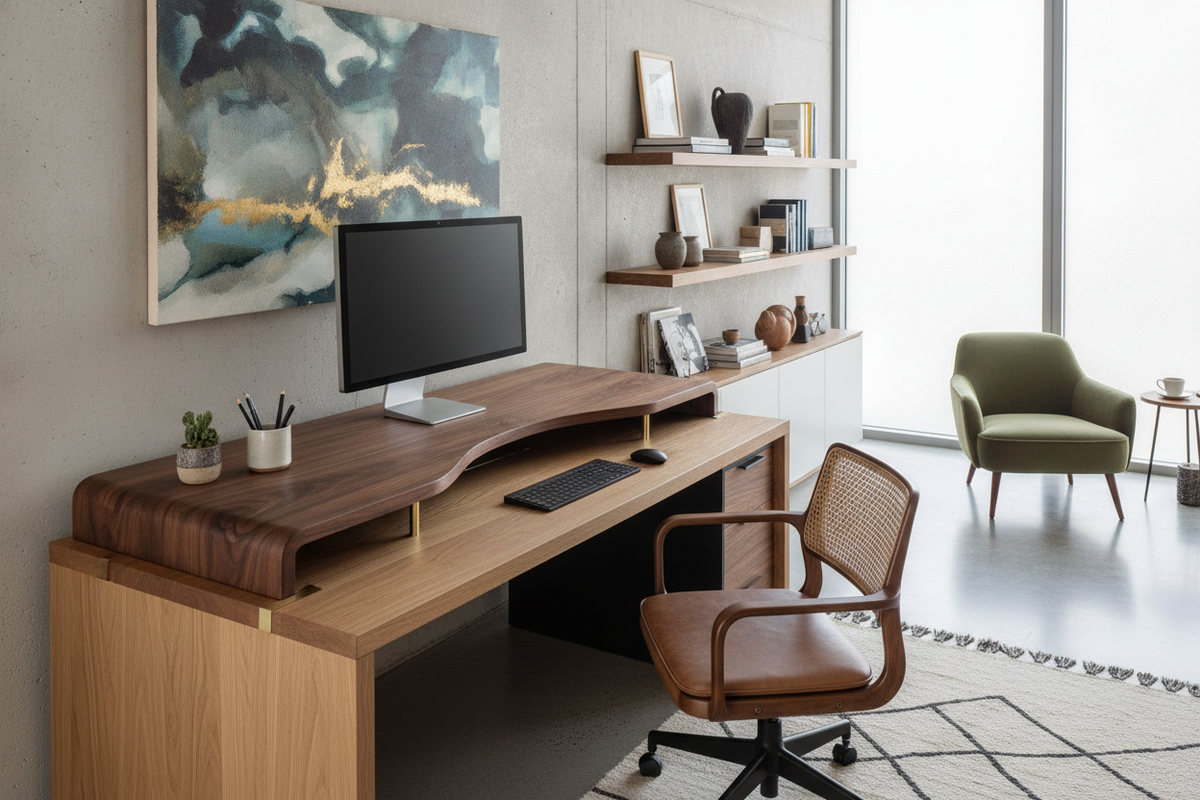
I spent three months hunting for the perfect vintage rug and a solid walnut desk, only to realize I was staring at a pile of black industrial plastic every morning. My monitor sat on one of those chunky, spring-loaded converters that looked like it belonged in a cubicle farm from 2005. I finally snapped and decided a custom desk riser was the only way to save my sanity and my decor.
Quick Takeaways
- Standard plastic risers are built for cubicles, not curated home offices.
- Customization allows for exact clearance for your specific keyboard and mouse.
- Matching wood grains is the difference between a 'hack' and a professional setup.
- A local woodworker or Etsy artisan can often build exactly what you need for less than high-end commercial brands.
The Corporate Plastic Was Ruining My Vibe
My home office isn't just a place to work; it's where I spend 50 hours a week. I invested in a gorgeous writing computer desk with tapered legs and a rich grain, but the moment I added a standard monitor stand, the whole aesthetic died. It felt like putting a plastic spoiler on a vintage Porsche. It’s a common trap: we spend thousands on the big furniture pieces and then 'cheap out' on the accessories that sit right in our line of sight.
The problem with mass-produced risers is that they are designed to be invisible in a sea of gray carpet tiles. In a home environment, they stick out like a sore thumb. Every time I sat down to write, I wasn't looking at my beautiful desk; I was looking at a textured plastic tray and a heavy-duty metal hinge that I never actually used to adjust the height. It was bulk for the sake of bulk.
What Actually Makes a Desk Riser 'Custom'?
Custom doesn't just mean 'expensive' or 'fancy.' It means my 34-inch ultrawide monitor doesn't hang off the edges like a diving board. I needed exactly 4.25 inches of clearance so my Keychron mechanical keyboard could slide underneath when I'm done for the day. Most off-the-shelf options are either 3 inches high (too low for my neck) or 6 inches high (too high for my eyes).
When you stop settling for the 'one size fits none' approach, you start realizing how much desk real estate you've been wasting. If you are tired of the clutter, you should look for a guide to custom setups to see how much better life is when furniture actually fits your gear. I chose a length of 28 inches—just enough for my monitor and a small plant—leaving me plenty of room on the sides of the desk for my coffee and notebook.
Matching Woods and Finishes (The Tricky Part)
Matching wood is the hardest part of this process. You think 'Oak' is just 'Oak' until you put two different stains next to each other and realize one looks like a basketball court and the other looks like a 70s basement. Getting that custom built-in look requires more than just a quick glance at a thumbnail image online.
I ended up sending a photo of my desk in natural afternoon sunlight to a local woodworker. We went with a clear matte oil finish on white oak to match the desk’s existing patina. If you’re buying from an Etsy creator, ask if they can send a scrap wood sample of the stain first. It’s worth the extra five bucks to ensure your riser doesn't clash with the very desk it’s sitting on. It’s that attention to detail that makes the piece feel like an extension of the furniture rather than an afterthought.
Is the Premium Price Tag Actually Worth It?
I paid $185 for my custom piece. You can get a plastic stand on Amazon for $30, or a high-end 'designer' plywood one for $150. For an extra $35, I got the exact wood species, the exact height for my ergonomics, and the satisfaction of supporting a real person's craft. I’m not going to be replacing this in two years when a spring mechanism fails or the plastic yellows. It’s a solid slab of hardwood that will outlive my current computer and probably the one after that.
My Personal Experience
I originally tried to DIY this with a shelf from a big-box store and some hair-pin legs I found online. It was a disaster. The shelf was made of particle board and started to bow under the weight of my monitor within three weeks. It looked cheap because it was cheap. Now, with the solid wood custom riser, there is zero flex, and it actually makes the whole room feel more expensive. My only regret was not doing it sooner—I spent a year staring at that plastic monstrosity for no reason.
Frequently Asked Questions
How high should a desk riser be?
Ideally, your eyes should hit the top third of your monitor screen. For most people, that means a riser between 4 and 6 inches, depending on your height and chair position.
What is the best wood for a monitor stand?
Hardwoods like walnut, oak, or maple are best. They won't sag over time like pine or plywood will, especially if you have a heavy ultrawide monitor.
Can I use a custom riser for a laptop?
Yes, but make sure you use an external keyboard and mouse. Using a laptop keyboard while it's up on a riser is a shortcut to wrist pain and poor ergonomics.



Laisser un commentaire
Ce site est protégé par hCaptcha, et la Politique de confidentialité et les Conditions de service de hCaptcha s’appliquent.