


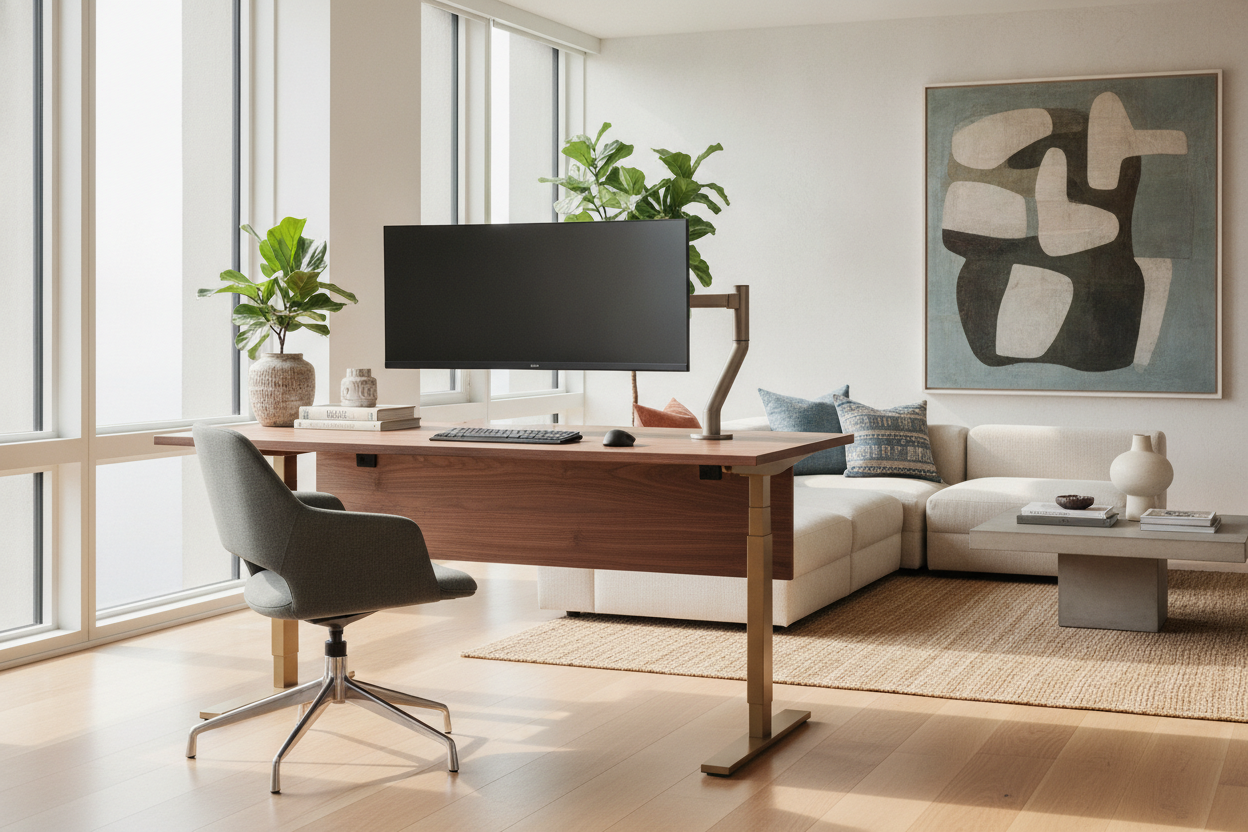
I spent three weeks staring at a $2,000 teak sideboard in my living room, only to realize my actual workspace was a $60 folding table from a big-box store. It was depressing. My search for standing desks that aren't ugly began when I realized my lower back was screaming, but my eyes refused to look at a gray cubicle desk in my home. I wanted something that felt like a piece of furniture, not a piece of equipment.
- Avoid industrial T-legs; look for tapered or rounded frames.
- Solid wood tops provide the visual weight needed to look like a real table.
- Integrated cable trays are the only way to keep the setup clean.
- Treat the desk like a design choice, not just a health tool.
Why Do They All Look Like They Belong in a Server Room?
Most ergonomic furniture is designed for massive corporate offices where the only aesthetic goal is 'neutrality.' You know the look: chunky metal T-legs, textured black laminate that feels like a cafeteria tray, and those hideous plastic grommets for cables. It is the furniture equivalent of a beige minivan.
When you bring that into a home office—or worse, a corner of your bedroom—it kills the vibe immediately. I don't want my sanctuary to look like the IT department at a mid-sized insurance firm. The problem is usually the materials. Cheap MDF wrapped in plastic and cold, industrial steel just don't play well with soft rugs and warm lighting. Finding a standing desk that isn't ugly requires looking past the 'ergonomic' labels and focusing on the silhouette.
The Secret is in the Leg Shape (Seriously)
The legs are the biggest giveaway of a cheap standing desk. Those three-stage telescopic columns usually look like heavy-duty car jacks. To avoid the 'server room' look, I started hunting for frames with softer profiles. Some brands are finally catching on, offering rounded corners or even legs encased in wood sleeves.
I also learned to look for C-frame designs rather than T-frames. A C-frame puts the support columns further back, giving you more legroom and making the desk look more like a traditional writing table from the front. If you can find a frame in a matte finish—like a soft sand or a deep forest green—it blends into the wall instead of screaming 'I am a piece of office machinery.'
Ditching Cheap Laminate for Better Finishes
The desktop surface is the most important part because it is what you actually touch all day. I’ve owned the cheap laminate stuff; it chips at the edges within six months and feels cold to the touch. If you want your office to feel like a curated space, you need a surface with some soul.
A 71 W height adjustable standing desk with a solid wood or high-quality veneer top changes everything. When you have 71 inches of real walnut or oak, the desk stops looking like a temporary workstation and starts looking like an executive piece. I prefer a 1.25-inch thick top—anything thinner feels flimsy when the motor is running, and anything thicker can look a bit too bulky for a residential room.
Hiding the Wires Like Your Life Depends on It
Nothing ruins a beautiful wood table faster than a 'rat’s nest' of black cables dangling from the underside. This is where most people fail. A desk can have the most beautiful hand-rubbed oil finish in the world, but if I can see the power brick for your monitor, it’s ugly.
I eventually settled on a standing desk with memory presets that had enough under-desk real estate to mount a massive cable management tray. The goal is to have exactly one cord—a braided power strip cable—running down one of the legs. Everything else should be tucked away. If the desk doesn't come with a tray, buy some heavy-duty Velcro and a metal mesh basket. It’s worth the two hours of labor, I promise.
My Current Setup (And Why I Actually Like Looking at It)
My final setup doesn't look like a 'standing desk' at all until it starts moving. I paired my wood-topped desk with a vintage Persian rug and a ceramic table lamp instead of a plastic LED task light. I even hung a gallery wall around the monitor so the tech feels integrated into the room's art. It’s about balance—mixing the high-tech motor with low-tech, 'slow' decor.
If you're still struggling to make your workspace feel like a home, I've got more tips on designing a standing desk setup that actually looks good. It really comes down to treating the desk like any other piece of investment furniture. Don't settle for the 'Amazon Special' just because it's cheap. You're going to spend 40 hours a week at this thing; make sure it doesn't make you sad to look at it.
Is a standing desk worth it if I only stand for an hour?
Absolutely. Even if you only stand for 20 minutes every hour, the ability to micro-adjust the height to your exact sitting posture is a massive win for your neck and shoulders.
Can I put a custom top on a standing desk frame?
Yes, and it’s actually a great way to save money. Buy a high-quality motor frame and screw on a solid wood kitchen countertop or a vintage door. Just check the weight capacity of the motors first.
How do I stop my desk from wobbling?
Wobble is usually caused by uneven floors or cheap two-stage legs. Look for a desk with a heavy steel base and adjustable leveling feet. If it's on carpet, it will always wobble slightly more than on hardwood.

Laisser un commentaire
Ce site est protégé par hCaptcha, et la Politique de confidentialité et les Conditions de service de hCaptcha s’appliquent.