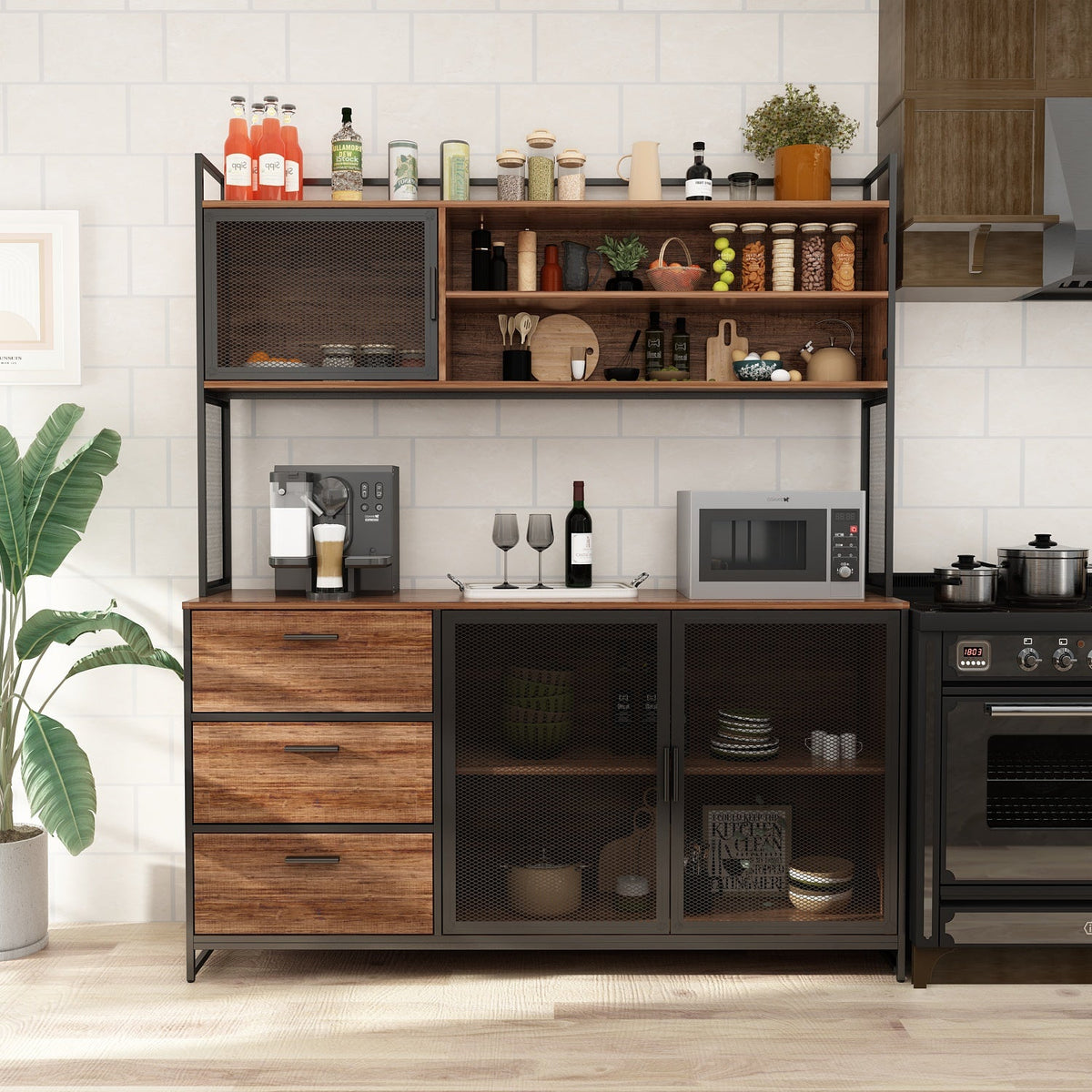
Yes, you can put a countertop microwave in a pantry cabinet if it sits in an open microwave space with the air clearance its manual requires, its vents stay unblocked, the shelf is rated for its weight, and it plugs directly into a wall outlet. What you should not do is run a countertop microwave behind closed cabinet doors. GE Appliances, for example, does not recommend installing its countertop-only models in tight or enclosed spaces like a cabinet.
Done right, moving microwave storage into a pantry frees counter space and puts the microwave next to the snacks and ingredients you heat most. This guide explains the clearance, weight and power checks to make first, using the tall units in our pantry cabinets collection as examples.
Microwave in Pantry Cabinet Setups: Open Shelf, Trim Kit or Enclosed
Microwaves work by pulling in cool air and pushing out warm air and steam through their vents. The setup decides whether that air can escape the cabinet interior.
| Setup | Suitable for a countertop model? | What to know |
|---|---|---|
| Open microwave compartment, front open | Yes, with the manual's clearances | The common microwave space on freestanding pantries and hutches |
| Behind closed cabinet doors while running | No | Vents are blocked and heat builds up |
| Cabinet cutout with a manufacturer trim kit | Only for models approved for a trim kit | Follow the kit's installation instructions |
| Built-in or drawer microwave | Not a countertop model | Designed for cabinetry; install per its manual |
Sharp explains why enclosure matters: countertop microwaves have rear vents, and inside a cabinet those vents can be blocked and unable to release steam, which it calls a fire risk. Sharp notes that trim kits let select countertop models sit in a cabinet cutout with proper ventilation (Sharp). If you want a fully built-in look, choose a microwave and trim kit designed for it rather than boxing in a countertop model.
Other options provide a sleek, flush or custom look without a pantry: over-the-range models mounted above the range in place of upper cabinets, and drawer microwaves that slide into base cabinetry for easier access. The same airflow rules apply in a walk-in pantry or closet: a microwave there still needs air circulation on every side its manual lists.
How Much Clearance Does a Microwave Need?
The most important check is your microwave's own manual, because clearances vary by brand and model. As one manufacturer example, GE Appliances lists 3" of clearance on both sides and the top and 1" at the rear for its countertop-only models, so the intake and exhaust vents can circulate air (GE Appliances).
To see whether a microwave fits the opening, add the clearances to the microwave's outside dimensions. Using GE's countertop figures as an example:
| Microwave outside size | Add clearance | Minimum open space | |
|---|---|---|---|
| Width | 20" | +3" each side | 26" |
| Height | 12" | +3" on top | 15" |
| Depth | 15" | +1" at the rear | 16" |
The microwave in this table is a hypothetical example; use the real measurements from your microwave's spec sheet and the clearances from its manual. Also measure the depth with the handle, and make sure the door can swing fully open without hitting the cabinet side or a door.
Match the Microwave's Weight to the Shelf Rating
A microwave is one of the heaviest things a pantry holds. Find the appliance's weight in its spec sheet or manual, then compare it with the rating on the cabinet's product page.
- Use the dedicated microwave space, not an adjustable shelf on pins, unless the product lists a rating for it.
- Compare per-shelf and total ratings. The 63" pantry cupboard with hutch and microwave shelf lists 33 lb per shelf and 300 lb in total. Among FUFU&GAGA pantries with a microwave shelf, listed total capacities run from 100 lb to 400 lb.
- Ask if it's not listed. If you can't find the rating, contact customer service before you load it.
- Keep the area clear. Don't stack boxes, bags or food on top of the microwave; the space above it is part of its clearance.
Power: Outlet Access and No Extension Cords
The NIH Fire Marshal's microwave safety tips are clear: plug the microwave oven directly into the wall and never use an extension cord (NIH Office of Research Services). In practice that means:
- Plan the location around power. Place the pantry cabinet so the microwave's cord reaches the wall receptacle without stretching.
- Don't pinch the cord between the cabinet and the wall, or route it where a door or drawer can crush it.
- No power strips or extension cords. If there is no receptacle where you want the cabinet, move it or have an electrician add one.
- Keep the plug reachable so you can unplug the microwave if something goes wrong.
Height, Access and Stability
The ideal height is about counter to chest level: easy to view inside, and you lift hot bowls straight out rather than reaching above your shoulders or bending to the floor. Keep a landing spot nearby, such as the cabinet's countertop, for setting hot food down.
A microwave also adds weight to the middle of a tall unit, and an open door adds leverage. Anchor the cabinet to a wall stud with its anti-tip kit; the U.S. Consumer Product Safety Commission urges families to anchor furniture securely to the wall. Most FUFU&GAGA pantries with listed specs include a tip-over restraint kit.
Pros and Cons: Valuable Countertop Space vs Clearance
| Pros | Cons |
|---|---|
| Frees valuable countertop space, especially in small kitchens | Needs a wall outlet within reach of the cabinet |
| Convenience: groups the microwave with a coffee station or snacks | Clearance takes up more room than the microwave itself |
| Helps hide clutter for a cleaner, more streamlined kitchen | Steam and heat should be kept away from stored food and ingredients |
If your kitchen has no built-in pantry or counter space to spare, our ideas for a kitchen with no pantry show where a pantry fits best.
FUFU&GAGA Pantries With a Microwave Shelf
Eleven of our pantries list a microwave shelf. A few to compare:
- 59" white/black kitchen sideboard display cupboard: 68.5" tall and 15.7" deep with 3 drawers, mesh doors and a 200 lb total rating.
- 70.9" industrial brown pantry cabinet: 68.5" tall with 6 drawers, adjustable shelves and a 300 lb total rating.
- 90.6" tall black pantry cabinet: 31.5" wide, with shelves listed at 30" W × 16" D.
- 78.7" dark gray kitchen pantry: 63" wide with 4 drawers and a 350 lb total rating.


The best way to avoid a problem is to compare the open space on the product page with your microwave plus its clearances before you order. Browse all sizes in our kitchen pantry cabinets, and see the pantry cabinet dimensions guide for fitting the cabinet itself.
FAQ
Is it safe to have a microwave in a pantry?
Yes, when it sits in an open space with the clearance from its manual, vents unblocked, on a surface rated for its weight, and plugged straight into the wall. Don't run a countertop microwave with cabinet doors closed around it.
Where should you not put a microwave in the kitchen?
Avoid enclosed cabinets without ventilation, spots where you must reach above your shoulders to lift hot food, places that need an extension cord, and shelves not rated for its weight.
Can a countertop microwave be built into a cabinet?
Only with a trim kit made for that model, or by choosing a microwave designed for built-in installation. Otherwise, keep it in an open compartment.
Can I store food on top of a microwave?
No. The space above the microwave is part of its required clearance, so keep boxes, bags and food off the top.


Laisser un commentaire
Ce site est protégé par hCaptcha, et la Politique de confidentialité et les Conditions de service de hCaptcha s’appliquent.