


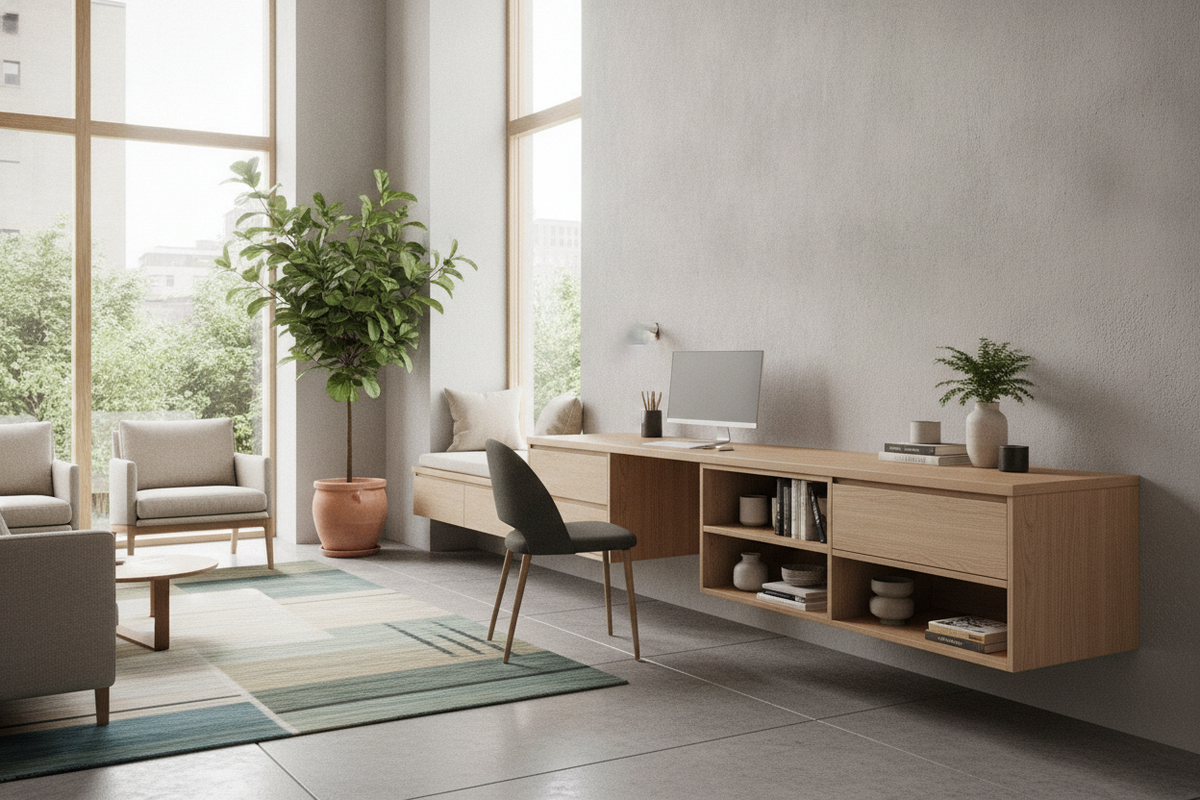
Creating an efficient workspace often comes down to how well your furniture interacts with the architectural boundaries of a room. An l shaped wall desk provides an effective way to reclaim unused corners while keeping floor space completely open. By anchoring directly to the wall rather than relying on heavy perimeter legs, a wall mounted l-shaped desk creates a lightweight visual footprint that helps compact offices, bedrooms, or multi-purpose living areas feel significantly larger.
Elevating major surfaces off the floor is a recognized design approach for expanding perceived square footage. Similar to how wall-mounted home organization concepts open up sightlines in modern living spaces, a floating desk frees the floor beneath your work area for mobile storage pedestals, footrests, or clean open air.
Understanding the L-Shaped Wall Desk: Structural Types and Floor Space Freedom
Before selecting a desk style, it is helpful to understand the primary structural variations available in corner wall furniture:
- Fully Floating Cantilevered Desks: These units mount entirely to the wall studs using heavy-duty brackets or concealed steel armatures. They leave the entire floor open, offering maximum aesthetic minimalism and unobstructed leg mobility.
- Hybrid Wall-Anchored Desks: These models mount securely to the wall along the back perimeter while utilizing one or two minimalist corner legs or a central support column for additional stabilization.
- Drop-Leaf or Foldable Corner Desks: Designed for micro-apartments or occasional workstations, these allow one or both wings to fold flat against the wall when tasks are completed.
Choosing between a fully floating l shaped desk and a hybrid design depends primarily on your intended equipment load, the internal structure of your walls, and how permanently you wish to configure the room.
Dimensions as Decision Categories: Sizing Your Corner Footprint
Rather than focusing solely on static numbers, approach desk dimensions by evaluating functional clearance categories across the entire corner zone.
When laying out your workstation, divide the surface into two distinct zones: the primary wing and the secondary return wing. The primary wing accommodates your main monitor display, keyboard, and seated posture, requiring greater depth to maintain comfortable viewing distances. The secondary return wing can be slightly shallower, serving as an ancillary landing spot for reference books, tablets, notebooks, or desktop organizers.
Before committing to an installation, reviewing critical wall mounting measurements can help clarify stud spacing, seated elbow height, and floor-to-surface vertical clearances. Ensuring that your corner features true right-angle walls is equally essential, as older drywall or plaster corners often possess slight angles that may require specialized mounting shims or trim adjustments.
Wall Mounting and Structural Planning Considerations
Proper wall mounting is the single most important factor for long-term stability and user satisfaction with a corner wall desk. Unlike standard floor-standing furniture, a wall-mounted desk directs downward and rotational torque straight into your wall structure.
Stud Identification and Anchor Placement
Mounting brackets should always anchor directly into structural wood or metal wall studs rather than hollow drywall alone. Because an L-shaped surface wraps around a corner, bracket placement must be distributed evenly along both perpendicular walls. The corner apex requires particular attention, as this intersection bears the combined rotational force of both desktop sections.
Masonry and Concrete Walls
For installations against brick, concrete block, or solid masonry, high-grade masonry sleeve anchors or concrete screws provide exceptional holding power. Regardless of wall construction, ensure that mounting hardware is rated for structural furniture suspension and that the wall surface is sound and free from moisture degradation.
Storage Architectures: Undermount Drawers, Floating Hutches, and Open Shelving
One of the primary benefits of an l shaped wall desk is that it preserves legroom. However, everyday productivity still demands practical storage for writing tools, paperwork, and technology accessories.
Traditional floor-bound options like integrated storage corner desks utilize base cabinets and floor pedestals. In contrast, a floating workstation relies on vertical and undermount storage configurations to keep surfaces clear:
- Undermount Slide-Out Trays: Shallow pencil drawers or keyboard trays mounted beneath the main desktop keep daily essentials accessible without infringing on knee clearance.
- Overhead Floating Hutches: Wall-mounted cabinets positioned directly above the secondary wing provide closed storage for files, binders, and peripheral hardware.
- Corner Floating Shelves: Tiered open shelving installed above the corner apex turns awkward upper wall space into functional display and supply storage.
Dual-Zone Workflows: Arranging Tech and Creative Tasks Across Two Wings
An L-shaped orientation naturally supports a divided workflow, allowing you to separate focused computing tasks from manual creative projects or analog paperwork.
While large floor-standing designs like spacious L-shaped corner workstations offer generous horizontal area across both wings, a wall-hung configuration allows you to establish a streamlined, ergonomic workflow tailored to your room layout.
The Primary Technology Wing
Dedicate the longer or deeper section of the desk to your core hardware setup. This includes your primary monitor or laptop stand, central input devices, and task lighting. Wall-mounting your computer monitors on articulating arms above the desk further preserves desktop real estate and keeps the working plane completely uncluttered.
The Secondary Task Wing
Use the return wing as a flexible task area. Whether you need a layout table for architectural sketches, a dedicated spot for a graphics tablet, or a clean surface for analog writing, this separation prevents physical clutter from spilling into your primary computer zone. If your room footprint is especially narrow, pairing a floating corner desk with compact writing desk solutions in an adjoining nook can create dedicated task zones throughout the home.
Material Selection, Wire Routing, and Aesthetic Profiles
Because a wall-hung corner workstation is permanently visible at eye level, material choice and cable management play major roles in the final aesthetic outcome.
- Surface Materials: High-pressure laminates and durable engineered wood finishes offer strong resistance to daily wear, scratches, and spills while maintaining a consistent weight profile. Solid hardwoods deliver rich grain texture and natural warmth, though their added weight requires robust internal wall framing.
- Integrated Cable Raceways: Managing power cables and display cords is critical on a floating desk. Surface-mount raceways painted to match your wall color, along with desk grommets placed near the corner apex, keep cords organized and hidden from view.
- Edge Profiles: Beveled or rounded desktop edges provide greater wrist comfort during extended typing sessions and soften the visual lines of the corner installation.
Wall-Mounted L-Shaped Desk Decision Checklist
Before beginning your installation, use this straightforward checklist to confirm that your space is ready for a wall hung corner workstation:
- Wall Stud Verification: Confirm that you have accessible structural studs located along both mounting walls.
- Clearance and Seating Radius: Check that your office chair can swivel freely through the corner apex without bumping adjacent walls or doors.
- Outlet Proximity: Ensure electrical wall outlets are located near the desk corner to minimize visible extension cords.
- Wing Orientation: Double-check whether your room layout favors a left-hand or right-hand primary wing configuration based on window locations and room traffic patterns.
By carefully balancing structural support, dimensional planning, and storage integration, an L-shaped wall desk transforms any neglected corner into a high-performance, clutter-free workspace.

Laisser un commentaire
Ce site est protégé par hCaptcha, et la Politique de confidentialité et les Conditions de service de hCaptcha s’appliquent.