


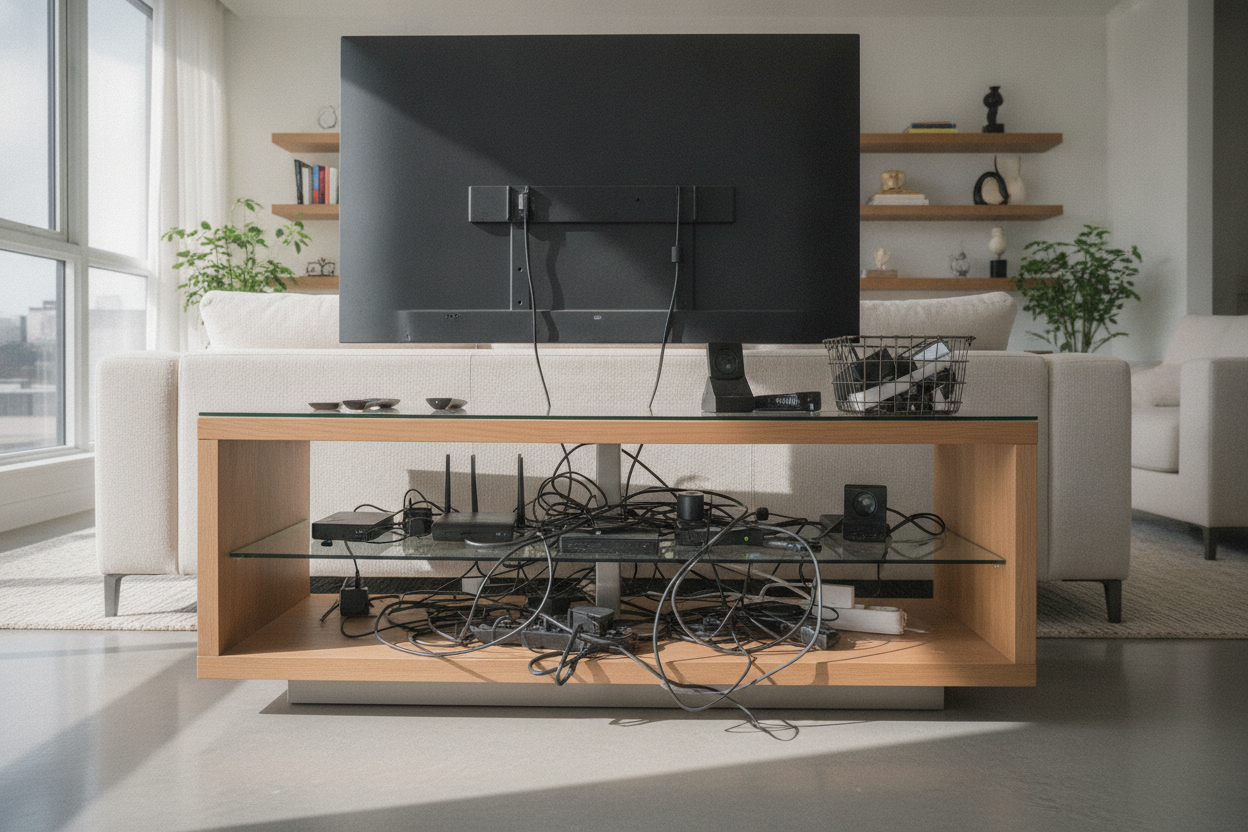
I was halfway through a high-stakes boss fight in Elden Ring when my PlayStation 5 just... died. No warning, no stuttering, just a sudden black screen and a terrifying silence. When I walked over to the console, the air coming out of the cabinet felt like a hair dryer on its highest setting. I realized then that my sleek, walnut-veneer living room under tv table was actually a high-end coffin for my electronics. It looked great in the catalog, but it was essentially a wooden box designed to bake everything inside it at 120 degrees.
Quick Takeaways
- Standard cabinets often lack the 3-4 inches of clearance required for modern console cooling.
- Glass doors are the worst offenders, trapping heat like a literal greenhouse.
- Open-back units or slatted door designs are the only way to save your hardware.
- Cable management is the price you pay for airflow, but it is easily solved with zip-ties.
The 'Hot Box' Problem Frying My PlayStation
For a long time, I bought into the idea that a clean aesthetic meant hiding everything behind solid doors. I spent a small fortune on high-end living room furniture that looked like it belonged in a museum, only to find out it was functionally useless for anyone who actually uses their TV. Most people don't realize that a modern gaming console or a high-end receiver generates as much heat as a small space heater. When you shove that into a standard living room furniture tv unit with a solid back and no vents, you are creating a 'hot box'.
My PS5 was gasping for air. The fans were spinning at max RPM, which I had ignored as 'just part of the experience,' until the system hit its thermal limit and shut down to prevent permanent damage. This isn't just about gaming, either. I have seen streaming sticks melt and DVRs fail because they were crammed into a 12-inch deep shelf with zero circulation. We need to stop treating our media centers like simple storage and start treating them like the specialized equipment racks they actually are. If your console feels hot to the touch after an hour of Netflix, your furniture is the problem, not your tech.
Why Most Living Area TV Unit Designs Fail at Ventilation
The furniture industry is currently obsessed with minimalism, which usually translates to 'solid boxes with no holes.' This is a disaster for tech. Most trendy living area tv unit designs prioritize a flush, seamless look. They give you one tiny 2-inch hole for cables and expect that to be enough for airflow. It isn't. Heat rises and expands; if it has nowhere to go, it just cycles back into the intake of your devices. I learned this the hard way and eventually ditched my low console for a taller table that actually allowed for some vertical heat dissipation.
The absolute worst offenders? Glass doors. While they look 'premium' and let your remote signals pass through, they are incredible at trapping thermal energy. It is basic physics. If you have a glass-fronted unit, you are essentially running your electronics inside a microwave that is turned off but insulated. I have seen internal temperatures inside these cabinets reach 130 degrees Fahrenheit. That kind of heat doesn't just cause shutdowns; it drastically shortens the lifespan of the capacitors and processors inside your expensive gear. If you must have doors, they need to be mesh, cane, or slatted wood.
Finding the Sweet Spot: Open Backs vs. Closed Storage
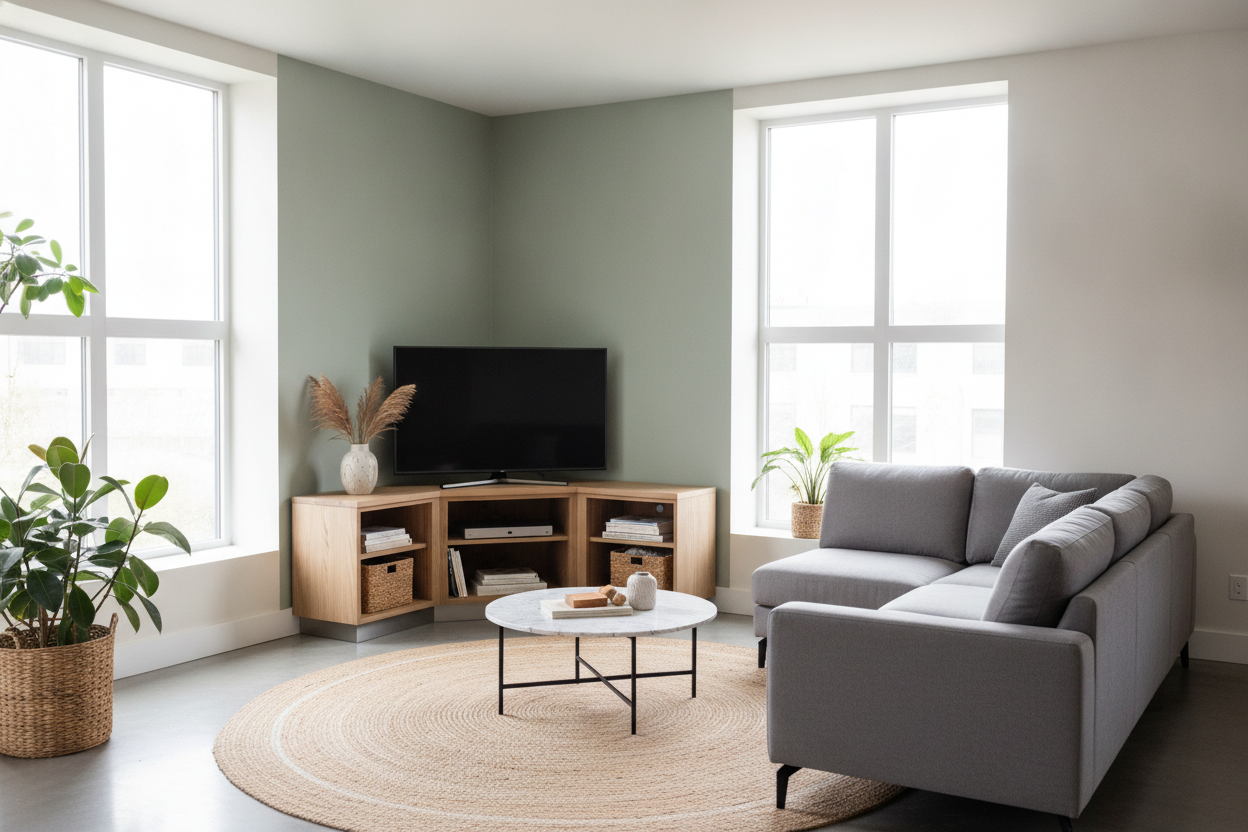
The challenge is finding balance. You want your living room to look like a home, not a server room at a data center. When shopping for tv stands for the living room, I now look for 'open-back' designs or units with removable back panels. This allows the hot air to exhaust directly against the wall where it can rise and dissipate into the room. If you are worried about seeing the wall through the furniture, look for a modern sideboard with adjustable shelves. The ability to move a shelf up or down by even two inches can be the difference between a console that breathes and one that chokes.
Slatted doors are my personal favorite compromise. They give you that mid-century modern look while acting as a giant vent. You get the visual occlusion of a solid door—meaning you don't have to see the dusty tangled mess of wires—but the air can move freely. I’ve tested units with 'breathable' cane webbing too, and while they aren't as sturdy as wood slats, they do a decent job of keeping the internal temp within 5-10 degrees of the ambient room temperature. Anything is better than a solid slab of MDF blocking the breeze.
The Zip-Tie and Basket Method for Open Consoles
The biggest fear people have with open-back or open-shelf units is the 'cable waterfall.' We've all seen it: a beautiful oak table with a disgusting curtain of black power cords hanging behind it. My solution is simple: zip-tie anchors. These are little plastic squares with adhesive backs that you stick to the underside or back of the furniture. You loop a zip-tie through them and pull your cables tight against the frame of the unit. If you have a massive power brick, don't let it dangle. Use a decorative wire basket on the bottom shelf to house the 'brain' of your cable mess. It looks intentional, like a design choice, rather than a lack of effort.
Stop Making This Clearance Measurement Mistake
When you are measuring for a new unit, you probably check if the TV will fit on top. But are you checking the internal clearance? Most people forget that cables stick out about 2 to 3 inches from the back of the device. If your cabinet is 15 inches deep and your receiver is 14 inches deep, you are going to be crushing your HDMI cables against the back panel. This puts stress on the ports and blocks the exhaust fans. I always recommend an adjustable TV stand for living room use because it lets you customize the 'headroom' above the device.
You want at least 3 inches of clear space above any console or receiver. Heat rises, and if there is no gap between the top of the PlayStation and the bottom of the shelf above it, that heat is going to soak right back into the plastic casing. I once owned a beautiful low-profile unit that only had 1 inch of clearance. My Xbox fan sounded like a jet engine taking off every time I played Halo. As soon as I moved it to a shelf with 5 inches of clearance, the fan noise dropped by half. Don't just measure for the footprint; measure for the air.
FAQ
Is it okay to keep the cabinet door open while gaming?
It helps, but it is a clunky solution. It ruins the aesthetic and usually only cools the front of the device. The back, where the actual exhaust fans are, will still be trapped against the back panel. It is better to just get a unit with a mesh front or an open back.
How much clearance do I actually need?
The golden rule is 3 inches on the sides and 4 to 5 inches on top. If you are using a high-end AV receiver, you might need even more. Always check your manual; manufacturers usually specify the 'thermal envelope' required for the warranty to stay valid.
Can I just drill holes in my current furniture?
Yes! I’ve done it many times. Grab a 2-inch or 3-inch hole saw bit and a power drill. Cut three or four holes directly behind where your consoles sit. It won't be visible from the front, and it will drop your internal cabinet temperatures significantly. Just be careful not to hit any structural supports.

Laisser un commentaire
Ce site est protégé par hCaptcha, et la Politique de confidentialité et les Conditions de service de hCaptcha s’appliquent.