


I have spent the last decade staring at 47 browser tabs at 1 AM, trying to find a coffee table that doesn't look like it was stolen from a doctor's waiting room. We have all been there: you buy the 'safe' choice, and six months later, your living room has the personality of a cardboard box. I usually tell my readers to avoid matching sets like the plague because they scream 'I bought the whole showroom floor in one go' and lack any shred of personal soul.
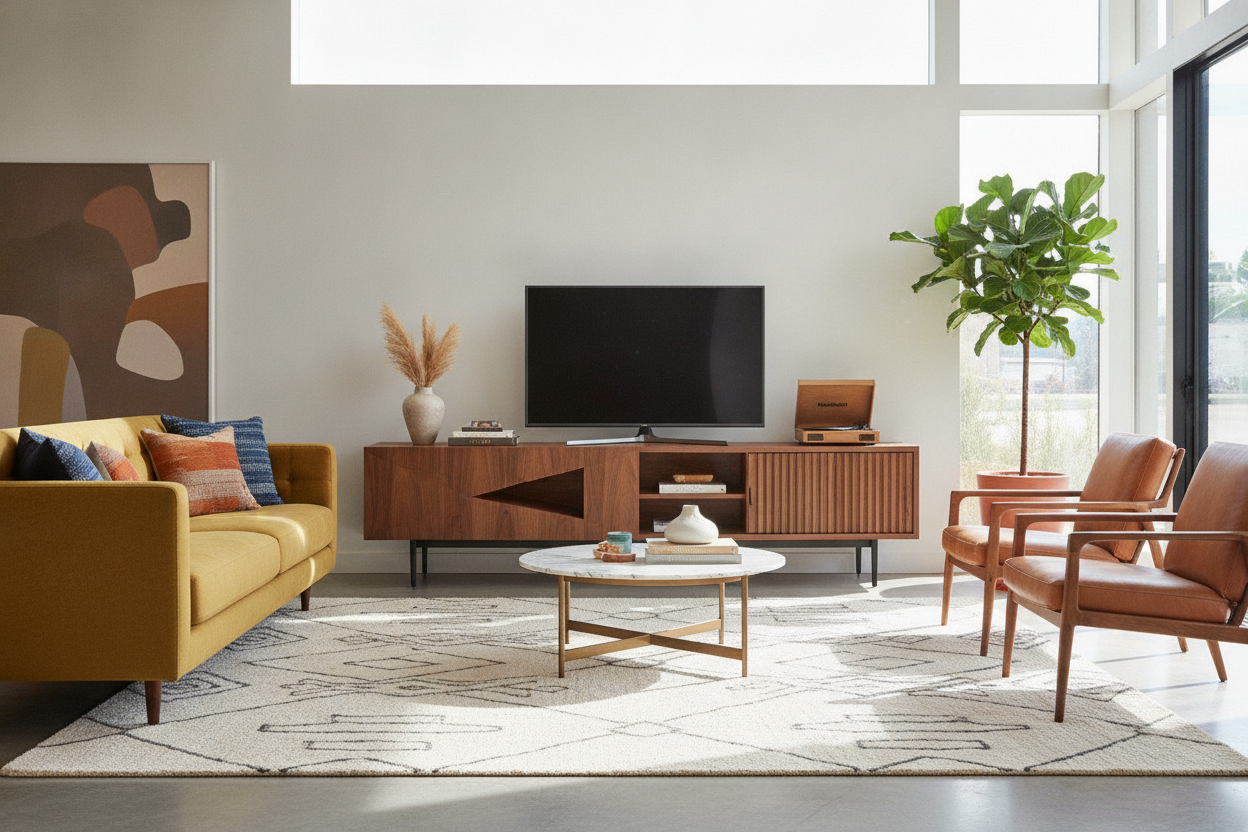
But then I came across the noah mid-century modern angular tv stand collection. I was skeptical. I am a firm believer that hunting for TV stands should involve scouring local flea markets or high-end boutiques to avoid the 'big box store' aesthetic that plagues most suburban apartments. However, the sharp, architectural lines of this collection promised something different—a way to break up the rigid, ninety-degree angles of my standard-issue rental layout without costing three months' rent.
- The walnut finish is deep and rich, avoiding the 'plastic-orange' look of cheap veneers.
- Those 15-degree angled legs create a 'floating' effect that makes small rooms feel significantly larger.
- Cable management is actually functional, featuring wide cutouts instead of tiny, useless holes.
- Assembly is a one-person job, though your knees will definitely feel it by the end.
Why I Usually Hate Furniture 'Collections'
There is a specific kind of dread I feel when I walk into a home where the TV stand, the coffee table, and the end tables all match perfectly. It is too sterile. It lacks the 'lived-in' layers that make a space feel like a home. Most collections prioritize convenience over character, resulting in chunky, uninspired blocks of wood that just sit there like dead weight. I have always advocated for the mix-and-match approach—pairing a vintage rug with a modern sofa and a weird, sculptural media unit.
The problem is that finding a unique media unit is surprisingly hard. Most of what is on the market is either a $2,000 heirloom or a $150 particle-board disaster that wobbles if you sneeze. When you are hunting for TV stands, you usually have to choose between 'boring but sturdy' or 'stylish but flimsy.' The Noah collection caught my eye because it looked like it had an actual design opinion. It was not trying to disappear into the wall; it was trying to be the most interesting thing in the room by using geometry to fight the boxiness of modern architecture.
Unboxing the Noah Mid-Century Modern Angular TV Stand Collection
The box arrived looking like it had survived a minor skirmish with a forklift, but the internal packaging was surprisingly robust. We are talking thick honeycomb cardboard and reinforced corners—none of that crumbly white foam that gets stuck in your carpet for three weeks. My first impression of the wood was a massive relief. It is a warm, matte walnut finish that actually shows some grain. It does not have that high-gloss sheen that makes furniture look like a cheap movie prop.
Assembly took me about 55 minutes with a podcast and a glass of wine. The instructions were actually written in clear English, not just vague hieroglyphics. One thing to watch out for: the weight. The main body is solid enough that you will want to assemble it exactly where you plan to put it. I made the mistake of building it in the kitchen and had to do a very awkward waddle-carry to the living room while praying I wouldn't drop it on my toes. The hardware is decent—I did not strip a single screw, which is a rare win for flat-pack furniture. The 2.0 lb density feel of the panels gives it a heft that suggests it won't sag under the weight of a heavy OLED screen.
Let's Talk About Those Angled Legs
The legs are the reason you buy this piece. While most media consoles use vertical pegs or those tired 'hairpin' legs that have been overdone since 2014, the Noah uses aggressive, tapered angles. This is not just a stylistic choice; it is a spatial hack. Because the legs flare out, they create more visible floor space underneath the unit. In a small apartment, seeing more floor makes the entire room feel less cluttered and more breathable.
It transforms the piece from a heavy box into a proper mid-century modern entertainment center. It feels anchored but light. I have had 'stylish' stands before that wobbled if the cat jumped on them, but the splayed footprint here makes it incredibly stable. I am currently rocking a 65-inch TV on top, and there is not a hint of a sag in the center—a testament to the reinforced base frame and the way those angles distribute the load.
Does It Actually Hide My Messy Cable Situation?
This is where most 'designer' furniture fails miserably. They look great in a staged photo with zero wires, but the moment you plug in a router, a PS5, and a soundbar, it looks like a tech explosion. I tested the storage capacity of the Noah by cramming my oversized surge protector and three different consoles into the side cabinets. The internal shelving is adjustable, which is a godsend if you have a taller receiver or a stack of vintage vinyl that needs a home.
I have tested units with slatted doors and open shelves before, and while those are great for ventilation, they do not hide the 'spaghetti' of wires very well. The Noah uses solid doors with a clean, push-to-open mechanism. There are dedicated cutouts in the back that are actually wide enough to pass a three-prong plug through without a struggle. My only gripe? If you are running a high-powered gaming PC or a launch-model PS5 in a closed cabinet, it might get a bit toasty. I recommend leaving the door cracked during long gaming sessions or drilling a few extra vent holes in the back panel if you are handy with a hole saw.
The storage is not just for show. The drawers glide on actual metal tracks—not just wood-on-wood friction that sticks in the summer. I have filled mine with extra HDMI cables, controllers, and a collection of coasters I never use. It feels like a piece of furniture meant for a real person who actually owns stuff, not just a minimalist who lives in a white void. The magnetic latches on the doors are a bit snappy, so you have to be careful not to let them slam, but they stay shut once they click.
The Final Verdict: Who Should Actually Buy This?
If your living room feels like a collection of boring rectangles and you are tired of the 'I just moved in' look, the Noah is a solid upgrade. It is for the person who wants the MCM aesthetic without the 'fragile antique' price tag or the 'college dorm' quality. It is heavy, it is stable, and the angles provide enough visual interest that you do not need to over-decorate the top of the stand to make it look finished.
I would skip this if you have a massive, 85-inch TV that will overhang the sides—that ruins the geometric silhouette and makes the legs look spindly. But for anyone with a standard 55 to 65-inch screen and a desire for a bit of architectural flair, it is a winner. It successfully cures the 'boxy room' syndrome without making your house look like a replica of a 1960s insurance office. It is a piece that looks like you spent weeks searching for it, even if you just clicked a button.
FAQ
Is the wood real or a veneer?
It is a high-quality wood veneer over solid MDF. This is actually a good thing for this price point; it allows for that consistent grain and those sharp, angular cuts without the $3,000 price tag of solid walnut.
Can I fit a soundbar on the shelf?
Most standard soundbars will fit in the open center shelf, but measure yours first. If you have one of those massive Sonos Arc bars, it might be too wide for the opening and will need to sit on top.
Is it hard to clean under?
Actually, it is easier than most. The angled legs give you about 6 inches of clearance, so a Roomba or a standard vacuum attachment fits under there perfectly without you having to move the whole unit.

Laisser un commentaire
Ce site est protégé par hCaptcha, et la Politique de confidentialité et les Conditions de service de hCaptcha s’appliquent.