


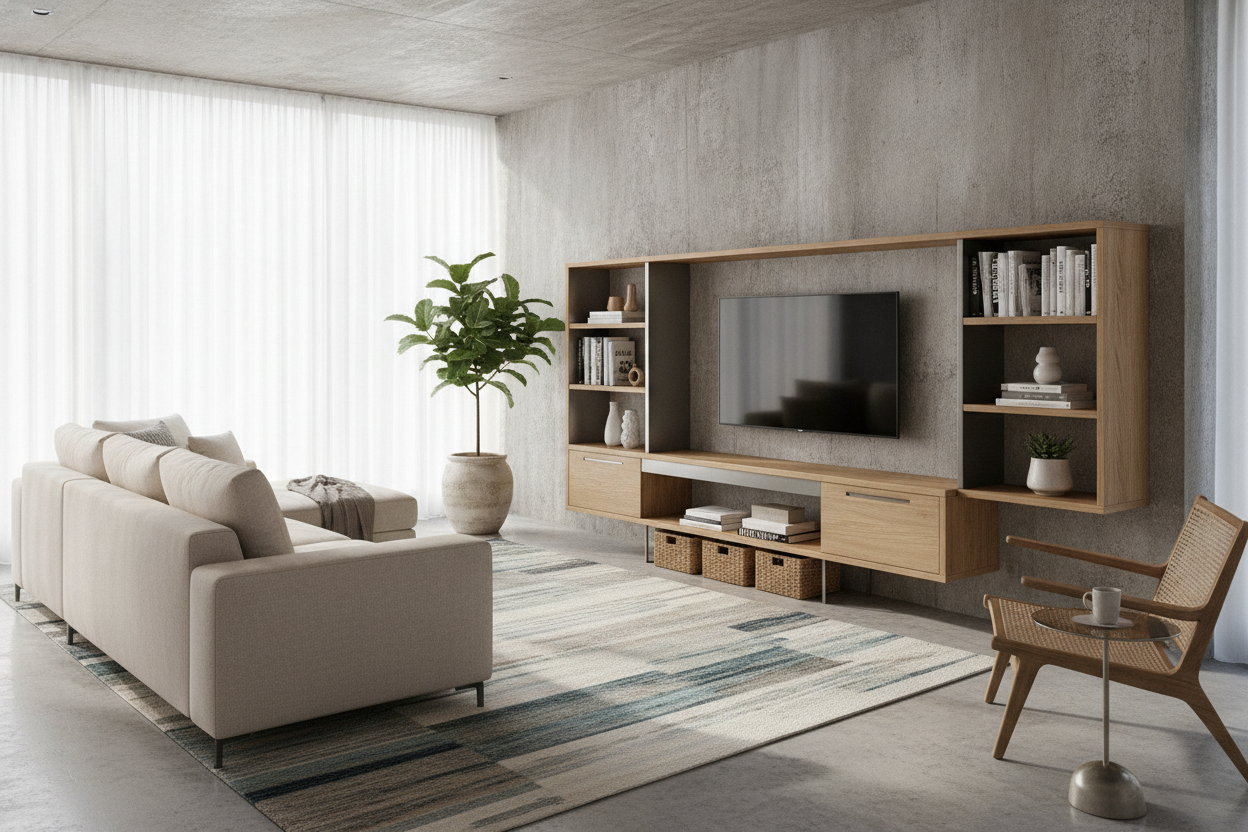
I spent three hours last Saturday with a tape measure and a roll of blue painter’s tape, trying to figure out why my living room wall felt so 'off.' It’s that classic 13-foot stretch where a standard 60-inch console looks like a postage stamp, but an 80-inch beast cuts right into the walkway. If you’ve been doom-scrolling through extendable tv stand options, you know the struggle of trying to find the 'just right' fit for a room that wasn't built with standard furniture math in mind.
- They solve the 'dead space' problem in awkward or non-standard wall lengths.
- Most models pivot to create L-shaped units for corners or studio zoning.
- Overlapping the pieces is crucial for structural integrity and weight support.
- Perfect for renters who move frequently and face different floor plans.
The 'Almost Fits' Dilemma (And Why Standard Sizes Fail)
Standard furniture sizes are a lie. You go to browse Tv Stands and realize everything is either 58 inches or 72 inches. My last apartment had this weird alcove that was exactly 65 inches wide—putting a 60-inch unit there left two awkward 2.5-inch dust-bunny traps on either side. It looked like I'd bought the wrong furniture, even though I'd measured correctly.
The extendable tv console exists because modern floor plans are messy. Whether it's a radiator in the way or a door swing that limits your depth, a fixed-width piece of wood is rarely the answer. When you have a wall that demands an 81.5-inch presence to look balanced, you don't want to settle for a 70-inch unit that leaves the room feeling unfinished.
Wait, What Exactly Is an Extendable TV Console?
It’s essentially a two-piece nesting system. One section (usually the one with drawers) sits on the floor, while a second L-shaped or flat bridge piece slides over the top of it. This extendable media console design allows you to telescope the unit to your exact desired width. Unlike a traditional dresser, you aren't locked into a single dimension forever.
The 3 Rules for Styling a Modern Extendable TV Stand
If you just pull the two pieces apart and call it a day, it can look a bit like a temporary dorm setup. To make a modern extendable tv stand look like a custom built-in, you have to be intentional about the overlap. I Traded My Mid-Century Console for a Post Modern TV Stand because I realized the fixed legs of my old West Elm piece made it impossible to adapt to my new, smaller living room.
Rule 1: Don't Stretch It to the Absolute Limit
Manufacturers love to brag about their maximum width, but don't be tempted to use every inch. If you stretch a tv stand extendable to its absolute limit, you lose the structural overlap that keeps the unit from looking flimsy. I always recommend keeping at least 12 to 18 inches of overlap. If you truly need a massive 80-inch span with zero gaps, you might be better off with a solid 78 7 W 4 Drawer Tv Stand Media Console rather than a modular one.
Rule 2: Use the L-Shape Feature for Weird Corners
One of the best hacks for an extend tv stand is its ability to pivot. Most of these units aren't attached with permanent hinges, meaning you can swing the top piece 90 degrees. This is a lifesaver for deep corners or for creating a 'half-wall' in an open-concept studio to separate your sleeping area from your 'theatre' zone.
Rule 3: Balance the Asymmetry with Decor
Because one side of the stand is naturally higher than the other, the visual weight is lopsided. I use a stack of heavy coffee table books on the lower section to 'bridge' the height gap. If you want a more polished look, a 78 7 W Tv Stand Media Console With Glass Doors And Light uses glass textures and internal glow to draw the eye away from the sliding mechanism and toward the items you're actually displaying.
Are They Actually Sturdy Enough for a Heavy Flat Screen?
This is the number one question I get. Will an extendable tv unit collapse under an 85-inch Sony? The secret is in the leg placement. You want the 'feet' of your TV to sit directly over the vertical supports of the base unit. Never bridge the TV's weight across the 'floating' gap of the extension. If you keep the heavy electronics on the grounded half, these things are surprisingly rock-solid.
My Final Verdict on the Sliding Console Trend
If you own your home and your living room wall is a standard, flat surface, buy a fixed-width unit. You'll get more storage and fewer dust-collecting crevices. But if you’re a renter, or if your house has the architectural 'character' (read: annoying corners) of a 1920s bungalow, a tv console extendable is the only way to get a custom look without a custom price tag.
FAQ
Can I hide cables inside the sliding part?
Usually, no. Because the pieces slide against each other, jamming cables between them is a fire hazard and will scratch the finish. Use adhesive cable clips on the back instead.
Is assembly harder than a normal stand?
It’s actually easier. You're essentially building two small tables instead of one giant, heavy monster. It’s much easier to move into an apartment solo.
Do the pieces lock together?
Most rely on gravity and the weight of the top piece. If you have kids or rowdy dogs, I recommend using a few strips of heavy-duty mounting tape between the layers to prevent sliding.

Laisser un commentaire
Ce site est protégé par hCaptcha, et la Politique de confidentialité et les Conditions de service de hCaptcha s’appliquent.