


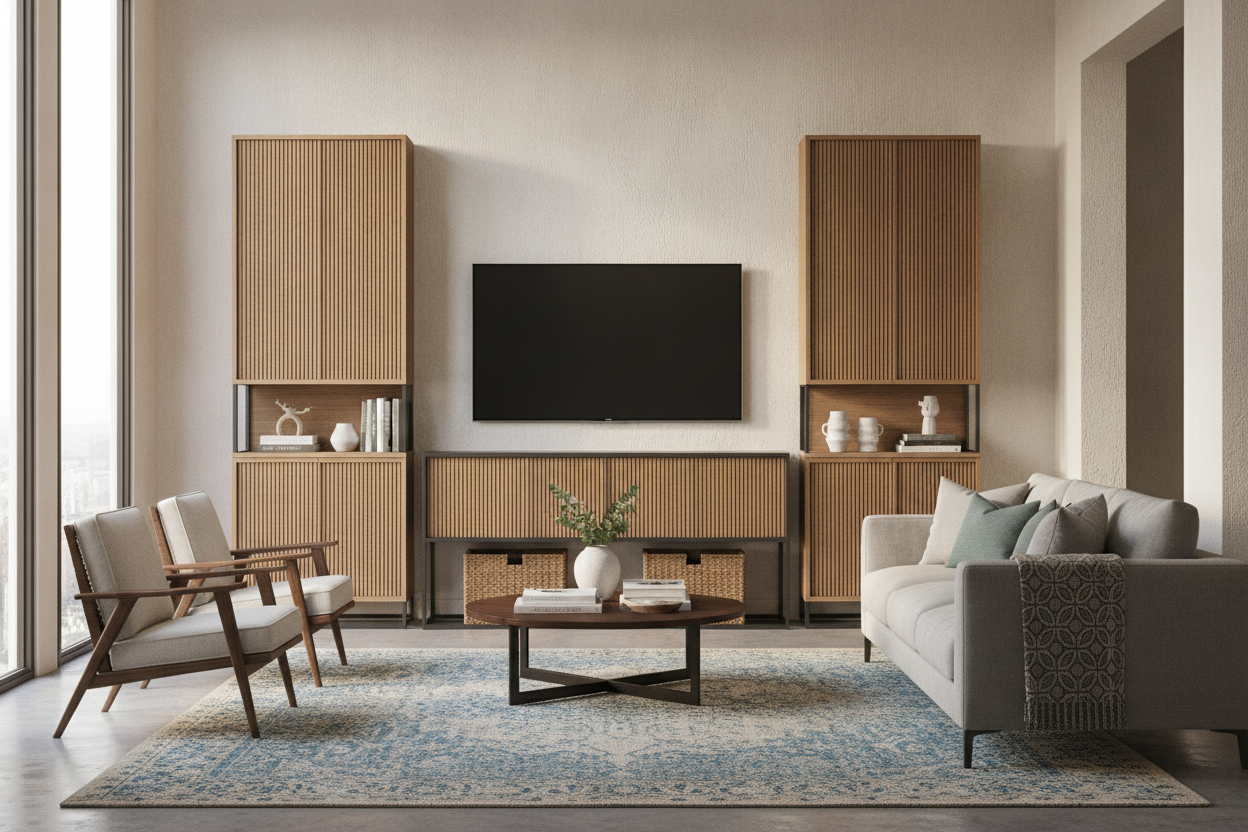
I spent three years staring at a tangle of black cords that looked like a nest of snakes behind my TV. I thought an open-frame industrial shelf was 'cool' and 'airy.' It wasn't. It was a dust magnet that made my expensive OLED look like a garage sale find. If you’re still living with exposed wires, it’s time to admit that your television consoles and stands should be doing more than just holding a screen—they should be hiding your sins.
- Closed storage hides the visual 'noise' of routers, remotes, and controllers.
- Opaque doors prevent dust buildup on sensitive electronics.
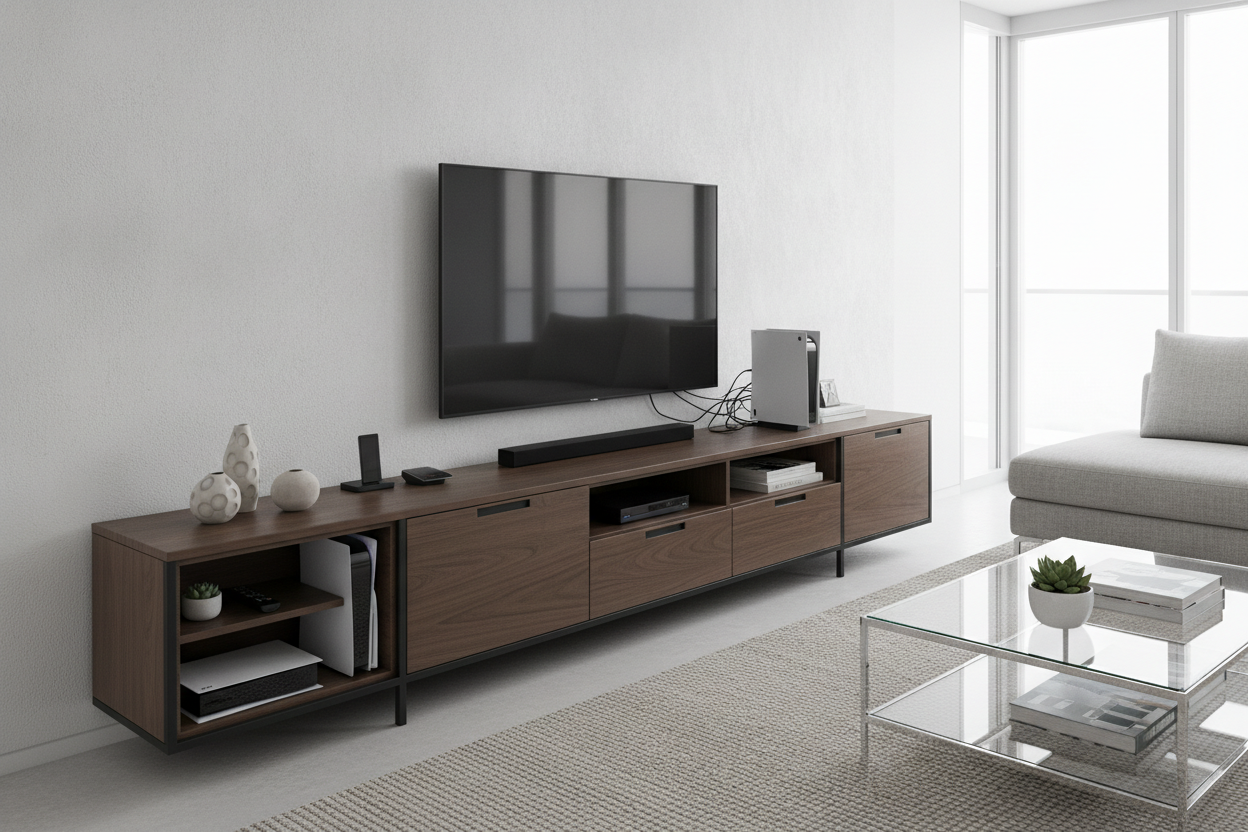
- Integrated cable management ports keep HDMI cords from dangling.
- Solid cabinetry provides a more 'finished' look that anchors a room.
The Open-Shelving Trap (And Why I Fell For It)
We’ve all seen the minimalist photos: a sleek TV sitting on a single wooden plank with nothing but a ceramic vase next to it. It’s a lie. In the real world, you have a soundbar, a PlayStation, a mesh router, and a surge protector that looks like a plastic brick. When I tried to make open shelving work, my living room never felt clean. No matter how many Velcro ties I used, the tech mess was always there, mocking my attempt at 'minimalism.'
Switching to a dedicated tv stand console was the moment my apartment finally started looking like an adult lived there. You don't need a massive entertainment center that takes up an entire wall, but you do need something with a back panel and actual doors. If you can see the wall through your furniture, you're going to see the dust bunnies too.
Why Closed Storage is the Ultimate Design Cheat Code
There is a specific psychological relief that comes with just shutting a door on a mess. When I swapped my wire rack for a proper console cabinet tv stand, the visual IQ of my room went up ten points instantly. It’s the easiest way to make a space feel intentional rather than accidental. You can browse through new TV stands and find pieces that look like high-end credenzas rather than tech furniture.
I recommend looking for units that are at least 18 inches deep. Anything shallower and you’ll find yourself struggling to fit a modern receiver or gaming console without the doors hitting the front. I once bought a 14-inch deep unit and had to leave the back panel off just so my Xbox would fit—completely defeating the purpose of buying a cabinet in the first place.
Maximizing Your TV Stand With Console Space
Once you have those doors, don't just shove everything inside and hope for the best. The key to making television console furniture work for you is internal organization. I use small wire baskets to categorize different 'zones'—one for charging cables, one for controllers, and one for those weird adapters you only use once a year.
Make sure you’re actually using the tv stand with console space for things that need to be near the TV. If you’re using it to store old magazines or board games while your router sits on top of the cabinet, you’re doing it wrong. Drill extra holes in the back panel if you have to; most cheap MDF units only have one tiny hole that won't fit more than two plugs.
The Glass Door Compromise (For Remote Control Signals)
The biggest argument against solid doors is the 'remote problem.' If your cabinet is solid wood, your infrared (IR) remote won't work unless the door is open. This is where people usually pivot back to open shelving, but there’s a better way. I eventually wrote an article about Why I Swapped My Minimalist Console for something with more utility.
The fix is fluted glass or tinted glass. It hides the clutter but allows signals to pass through. A media console with glass doors gives you that high-end look without the constant frustration of having to get up and point your remote directly at a crack in the door. Plus, if you get fluted glass, you get the benefit of 'blurred' tech—you can see a light is on, but you can't see the dust on the router.
Floating vs. Freestanding Media Units for TV
If you're in a tiny studio, a floor-standing unit can feel like a heavy anchor. This is where a wall mounted media console becomes your best friend. By keeping the floor clear, the room feels larger, and you don't have to move a 100-pound piece of furniture to vacuum the dust that inevitably settles underneath.
However, if you aren't allowed to drill into your rental walls, keep an eye out for a media center for sale that has tall, tapered legs. It gives a similar 'airy' effect as a floating unit while being totally portable. Just make sure the legs are solid wood or heavy-duty steel; those cheap plastic screw-in legs are a recipe for a tilted TV and a very bad Tuesday.
FAQ
How high should my TV stand be?
Your eyes should be level with the middle of the screen when you're sitting on your sofa. For most 18-inch high sofas, that means a stand height of 20 to 24 inches. Stop mounting your TVs above the fireplace; your neck will thank me.
Do electronics overheat inside a closed console?
They can. If you're running a high-powered gaming PC or a PS5, make sure the cabinet has at least two inches of clearance on all sides and a ventilated back. If it gets hot to the touch, you need to add a small USB-powered fan or leave the door cracked during heavy use.
What material is best for a TV console?
Solid wood is the dream, but it's expensive. If you go with manufactured wood (MDF), look for 'high-density' options. Avoid the paper-thin stuff that bows in the middle under the weight of a 65-inch television.

Laisser un commentaire
Ce site est protégé par hCaptcha, et la Politique de confidentialité et les Conditions de service de hCaptcha s’appliquent.