


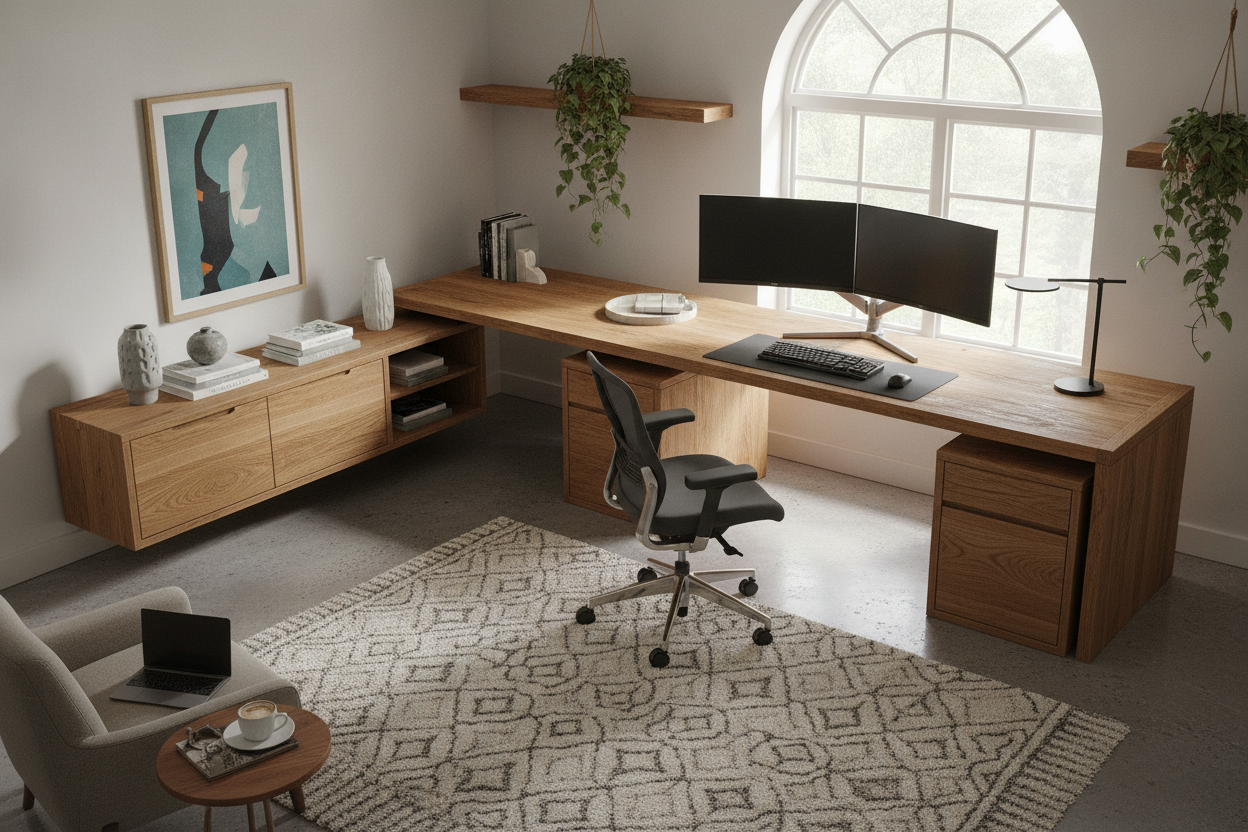
I was staring at my bay window with a tape measure and a sense of impending doom. I had already tried the 'Alex drawers with a countertop' trick twice, and both times it looked like I was trying to fit a square peg in a Victorian-era round hole. My fourth attempt involved three different brackets from the hardware store and a prayer. It still wobbled every time I typed. That is when I finally caved and looked for a custom desk builder.
- Standard 48-inch or 60-inch desks rarely fit older homes with weird alcoves.
- DIY hacks often cost more in 'fixing' materials than the furniture itself.
- Customizing depth is more important for your eyes than customizing width.
- A professional finish beats a spray-painted plywood edge every single time.
The Breaking Point: My Final Wobbly Franken-Desk
We have all been there—scrolling through Pinterest thinking we can build a $2,000 workspace for $150. My breaking point came when I realized I had spent three weekends and roughly $400 trying to 'hack' a tabletop to fit into a 53-inch gap. The standard sizes are either 47 inches (leaving an awkward 6-inch dust-bunny canyon) or 55 inches (which requires a saw and a lot of courage). I had shims under the legs to account for my uneven 1920s floors, and the whole thing felt like a house of cards.
I finally admitted that my DIY skills had hit a ceiling. I was tired of the 'good enough' aesthetic that looked like a dorm room. I needed something that actually respected the architecture of my home. If you are currently in the cycle of buying, failing, and returning, you might need an ultimate guide to custom setups that moves past the big-box basics.
What Actually Happens When You Use a Custom Desk Builder
I expected the process of using a custom desk builder to be a nightmare of CAD drawings and confusing terminology. Instead, it felt like playing a video game. You start with a base shape and then start sliding the dimensions. Being able to specify 52.75 inches instead of settling for 48 inches is a level of control that is genuinely addictive. You are the custom desk maker without having to own a single power tool.
The interface usually lets you toggle between wood species like walnut, oak, or maple. I could see the grain patterns change in real-time. I spent way too long debating between a live edge or a clean square cut. The best part? The price updates instantly. There is no 'request a quote' button that leads to a week of sales emails. You know exactly what that extra two inches of solid wood is going to cost you before you hit buy.
You Stop Compromising on Depth
Everyone talks about width, but depth is the silent killer of productivity. Most big-box retailers sell desks that are 24 inches deep. If you have a 27-inch monitor and a keyboard, you are basically pressing your face against the screen. It is a recipe for eye strain and a cluttered workspace. When I customized my top, I went for a 30-inch depth. That extra six inches changed my life. I finally had room for a notebook and a coffee mug without knocking over my monitor. A standard writing computer desk is often too shallow for a serious desktop setup, so being able to dictate that footprint was the real win.
Sneaking in the Sit-Stand Feature
I have always wanted a standing desk, but I hate the way most of them look. They usually have those thin, industrial-looking tops that feel like they belong in a corporate cubicle, not a home. By using a builder, I chose a thick, 1.5-inch solid wood slab and paired it with a high-end motorized frame. I got a home office sit stand up desk that actually looks like a piece of heirloom furniture. It has memory presets that don't glitch out, and it handles the weight of my dual-monitor setup without that terrifying 'struggling motor' sound.
Is Hiring a Custom Desk Maker Actually More Expensive?
Let's talk numbers. My failed IKEA hack cost me $250 for the parts, $60 for a circular saw I’ll never use again, $40 in gas and hardware store runs, and about 15 hours of my life. Total: $350 plus a lot of frustration. The custom desk was $700. While the upfront cost is higher, the 'cost per year' is significantly lower. This is kiln-dried hardwood, not particle board held together by hope. It won't sag in the middle after six months of holding a monitor arm. When you factor in the time saved and the fact that it fits the room perfectly, the premium is worth every penny.
How I Styled My Ultra-Specific Setup
Once the desk arrived and fit into the bay window with literal millimeters to spare, I had to make it look intentional. Since the desk was a custom fit, I paired it with adjacent shelving to create a cabinet desk combo effect. It looks like the desk was built into the house when it was first constructed. I added a leather desk mat to protect the finish and some cable management trays underneath to keep the 'spaghetti' off my nice new wood. My one mistake? I forgot to measure the height of my baseboards, so I had to adjust the leg placement slightly. Always check your floor-level obstacles before you finalize those specs.
FAQ
Is solid wood better than veneer for a desk?
Yes. Veneer is just a thin slice of wood over MDF. If you chip it, it is ruined. Solid wood can be sanded down and refinished in ten years if you get bored of the color or scratch it up.
How do I know if the desk will be stable?
Look for the thickness of the top. Anything less than 1 inch is prone to bowing. A 1.5-inch or 1.75-inch top provides the mass needed to keep the desk from vibrating while you type.
Can I use my own legs with a custom top?
Most builders give you the 'top only' option. Just make sure you use threaded inserts rather than just wood screws if you plan on taking the desk apart when you move.

Laisser un commentaire
Ce site est protégé par hCaptcha, et la Politique de confidentialité et les Conditions de service de hCaptcha s’appliquent.