


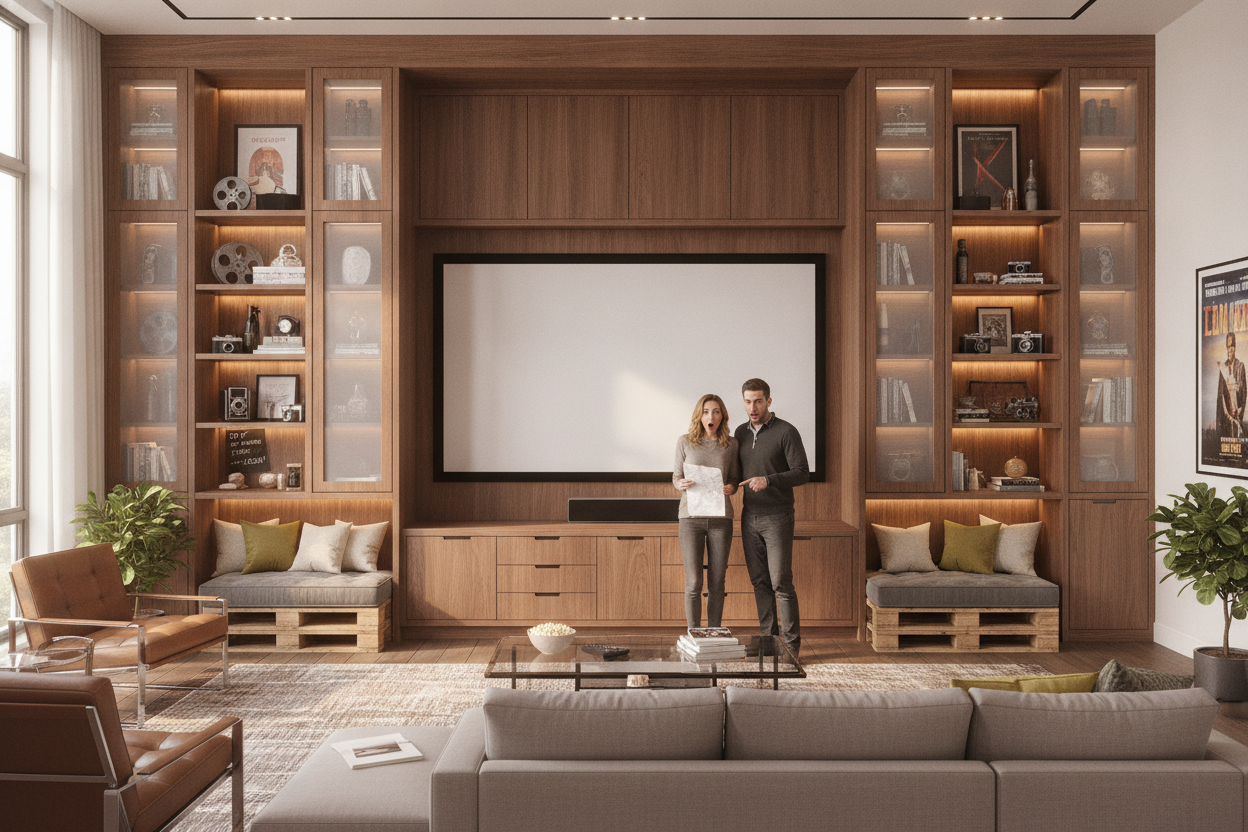
I remember sitting on my basement floor surrounded by a literal bird's nest of tangled HDMI cables and power strips, staring at a blank, sad-looking wall. I wanted that sleek, wall-to-wall look you see in high-end design mags. I finally called a local millwork shop to quote some home theatre built-in cabinets, and the number they sent back made me wonder if I had accidentally asked for solid mahogany encrusted with diamonds.
Quick Takeaways
- Custom millwork for media rooms typically starts at $5,000 and can easily hit $15,000.
- Standard kitchen cabinets are often too shallow for high-end A/V receivers.
- Ventilation is the most ignored factor in DIY builds, leading to dead hardware.
- You can achieve a custom look for 20% of the cost by 'framing in' modular furniture with trim.
The $10,000 Quote That Broke My Brain
The carpenter was a nice guy. He took measurements, nodded at my gear, and told me he’d have a quote over by Monday. When the PDF hit my inbox, I thought it was a typo. $10,400. For some wood boxes and a few shelves? I realized then that specialized theatre room cabinets aren't treated like storage; they are treated like fine furniture.
The sticker shock was real. I wanted a 'grown-up' space, but I didn't want to spend the equivalent of a used Honda Civic on a place to put my Xbox. It sent me down a rabbit hole of figuring out why these things cost so much and how I could cheat the system without it looking like a cheap DIY disaster.
Why Custom Media Millwork Costs So Much More
Here is the thing: your local big-box store cabinets are designed for plates and cereal boxes. They are usually 12 inches deep for uppers and 24 inches for lowers. A beefy home theater receiver is often 17 inches deep, and once you plug in the cables, you need at least 19 or 20 inches of clearance. If you try to use standard cabinets, your $2,000 amp is going to hang out the front like a sore thumb.
Then there is the heat. If you stuff a high-powered system into a tight, unventilated box, you might be cooking your tech before you even finish the first movie. Custom builders charge a premium for routing internal wire channels and installing silent cooling fans. They also use thicker shelving—usually 1-inch ply—because a stack of vintage vinyl or a massive power amp will make cheap 5/8-inch particle board sag in about six months.
Hacking the Look: Pre-Fab Boxes Meet Custom Trim
I decided to pivot. Instead of full custom, I went with a 'semi-custom' hack. I realized the best place for a home storage cabinet is actually the living room when you're trying to save five figures. I bought three high-quality modular units that had the 20-inch depth I needed and lined them up against the wall.
The secret sauce? I built a 2x4 'riser' to lift them off the floor so the bottom of the cabinets cleared my baseboards. Then, I bought thick MDF crown molding and side 'fillers' to bridge the gap between the cabinets and the walls. Once I caulked the seams and added the trim, those three separate boxes suddenly looked like one continuous piece of built-in furniture. It cost me about $1,200 in materials and a very dusty Saturday.
Getting the Home Theater Cabinet Design Right
If you're going the DIY or semi-custom route, your home theater cabinet design needs to be smart about aesthetics. I chose a moody, dark charcoal paint for the entire structure. Dark colors are a cheat code—they hide the tiny gaps and imperfections where the pre-fab boxes meet the custom trim.
I also swapped the solid wood doors for glass. If you don't want to spend your life painting, buying a black cabinet with glass doors is a massive shortcut. Glass doors are essential because they allow your IR remote signals to pass through while keeping the dust (and toddlers) away from your expensive gear. Just make sure the back of the cabinet is either removed or drilled out with a hole saw for cable management.
Was the Weekend of DIY Actually Worth It?
Looking back, I’m glad I didn't write that $10,000 check. My DIY version isn't perfect—if you get down on your hands and knees with a flashlight, you can see where I slightly messed up a miter cut on the baseboard. But from the comfort of my recliner, it looks like a high-end custom install.
The 'sweat equity' was high, but the savings were higher. That $8,000 difference didn't just stay in my bank account; it paid for a 120-inch ALR screen and a projector that actually does the room justice. If you have basic power tool skills and a little patience, skip the custom millwork and build the 'faked' version instead.
FAQ
How deep do my cabinets actually need to be?
Measure your deepest piece of gear and add 3 inches for cables. Most modern receivers need at least 18-20 inches of total depth to avoid putting stress on the HDMI ports.
Can I use IKEA Billy bookcases for this?
Not really. They are only 11 inches deep, which won't fit a receiver. Look for their kitchen base cabinets or the Besta line instead, but check the weight ratings before stacking heavy amps on them.
How do I stop my gear from overheating?
Leave the back off the cabinet if it's against a wall, or use a 120mm USB fan to pull hot air out of the back. Heat is the number one killer of home theatre gear.

Laisser un commentaire
Ce site est protégé par hCaptcha, et la Politique de confidentialité et les Conditions de service de hCaptcha s’appliquent.