


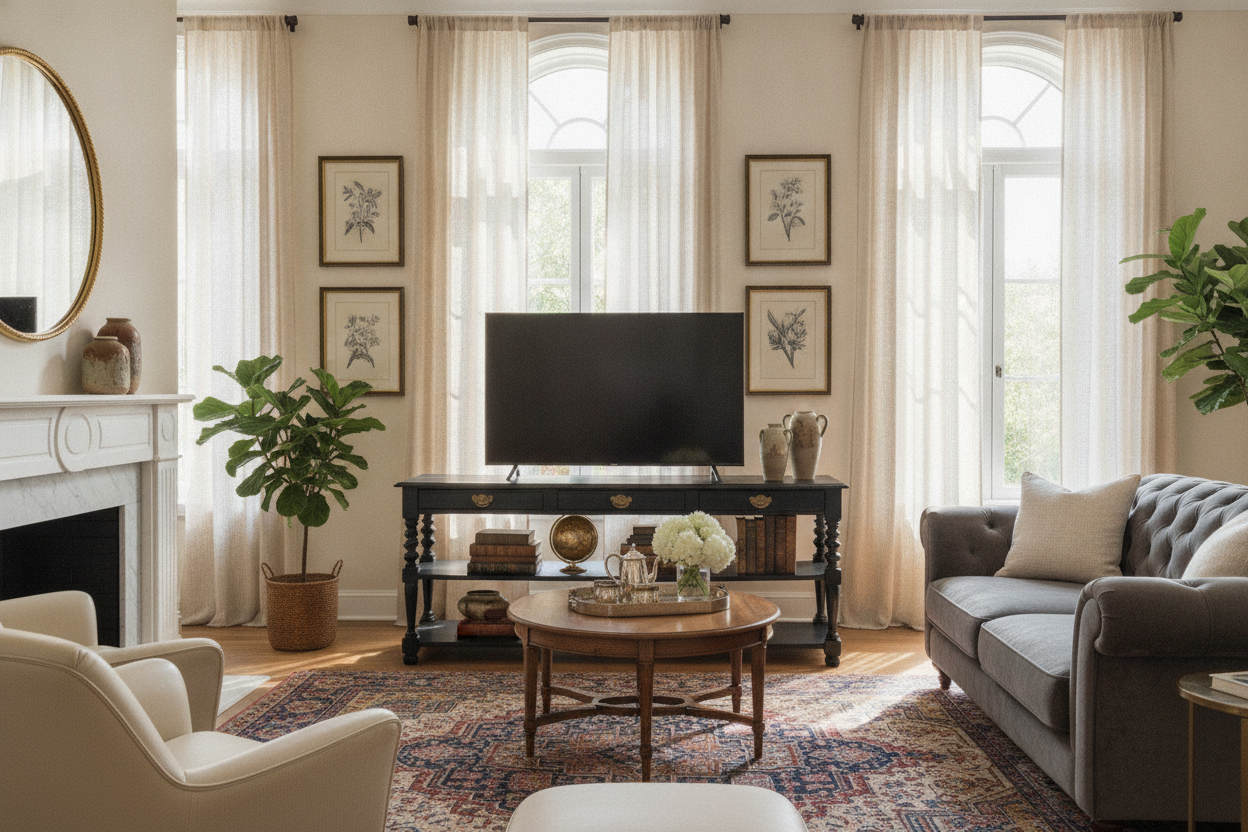
I spent three years hunting down the perfect 1920s bungalow, obsessing over original glass door knobs and stripping paint off crown molding. Then I bought a 65-inch OLED TV. Suddenly, my living room didn't look like a curated historic gem; it looked like a Best Buy showroom that had crashed into a museum. The 'black mirror' effect of a giant screen is real, and it kills the vibe of an older home faster than a fluorescent light bulb.
The fix wasn't hiding the TV behind a motorized painting or inside a massive armoire that would take up half the floor plan. It was finding an antique black tv stand. By choosing a piece that shared the visual weight and 'shadow' of the screen, the tech finally stopped screaming for attention and started acting like part of the furniture.
Quick Takeaways
- Visual Camouflage: A black antique finish absorbs the black rectangle of the TV, making the screen feel less like a void.
- Scale Matters: Older homes have high ceilings and thick trim; you need a heavy, substantial piece to ground the room.
- The Cord Problem: Real antiques require a drill; reproductions offer the look with built-in cable management.
- Styling is Key: Use brass and greenery to keep the dark wood from feeling too heavy or 'haunted.'
The Blazing Black Mirror Problem in Old Houses
There is nothing more jarring than a sleek, ultra-thin 4K TV sitting on a spindly, mid-century modern peg-leg console in a room filled with heavy oak trim and vintage textiles. Most modern TV stands are designed to be invisible. They are low-profile, minimalist, and usually made of some sort of grey-washed laminate that looks like it belongs in a dorm room.
In a historic space, that minimalism actually creates more friction. The TV becomes a floating black slab. When I tried a 'modern' console, the contrast between the light wood and the dark screen made the TV the only thing you saw. It felt cheap. It felt temporary. I needed something with the 'gravitas' of a piece that had been in the house since the Coolidge administration.
Why I Pivoted to an Antique Black TV Stand
The 'aha' moment came when I realized that black furniture acts as a visual anchor. When you place a massive black screen on top of a black antique tv stand, the two elements merge into a single vertical unit. The TV stops being a 'tech item' and starts being the top half of a dark, stately cabinet. It’s a trick of the eye that designers use all the time: if you can't hide it, blend it.
A dark, distressed finish—think rubbed-through paint or charcoal-stained oak—bridges the gap between the 1920s architecture and the 2024 technology. The ornate details, like turned legs or raised panel doors, provide enough visual interest to compete with the screen. It feels intentional, not like you just threw a TV on whatever was available at the local big-box store.
3 Ways to Soften a Black Antique TV Stand
I get it—going all-black with a heavy furniture piece can feel a bit 'haunted mansion' if you aren't careful. You want it to look classic, not dated. The goal is to style a vintage piece without looking dated by introducing textures that catch the light. Black absorbs light; you need things that reflect it.
First, swap out the hardware for unlacquered brass. The gold tones pop against the black and tie in with vintage light fixtures. Second, add a trailing plant like a Pothos or String of Pearls. The organic green leaves breaking over the hard edges of the dark wood softens the whole look. Finally, if you are struggling with a weird room layout, an antique corner TV stand can tuck that 'tech shadow' into a corner, making it even less obtrusive while still maintaining that high-end, heavy-wood aesthetic.
The Great Debate: Buying Reproductions vs. Painting Authentics
I’m a purist at heart, but I’ll be the first to admit that actual 19th-century sideboards are a nightmare for electronics. They don't have holes for cords, and the shelves are rarely deep enough for a modern receiver. I once spent four hours with a hole-saw bit, sweating and apologizing to a 150-year-old buffet just so I could plug in my Xbox. It felt like a crime against history.
This is where a high-quality reproduction or a 'new-antique' piece wins. Buying a stylish black TV stand that is built with modern tech in mind—meaning pre-drilled cable ports and ventilated backs—saves you the guilt and the manual labor. You get the crown molding and the distressed finish without the 'why won't my router fit in here' headache. Just make sure it’s solid wood or high-density MDF; cheap particle board will sag under the weight of a large TV in six months.
The Unexpected Joy of Solid Wood Doors
Beyond the looks, the best part of a heavy antique-style console is the silence. Modern media centers often have glass doors or open shelving that puts your tangled web of HDMI cables and blinking blue router lights on full display. It’s visual clutter that stresses me out.
Thick, solid wood doors act like a 'mute' button for your tech. You close the doors, and the chaos disappears. There is a tactile satisfaction in swinging shut a heavy door with a real latch at the end of the night. It signals that the 'screen time' is over and the 'living room time' has begun. It’s a small detail, but in a house that’s survived a century, those small details are what make it a home.
FAQ
Is a black TV stand too dark for a small room?
Actually, no. Because black recedes from the eye, a dark stand against a darker wall or in a dim corner can actually make the room feel larger by blurring the boundaries of the furniture.
How do I keep it from looking like a 'blob' of black?
Contrast is your friend. Use a light-colored rug underneath or place bright ceramic vases on top to break up the dark surface area.
Are these stands hard to clean?
Black furniture is a magnet for dust. If you hate cleaning, look for a 'distressed' or 'antique' finish rather than a high-gloss black. The texture hides dust and fingerprints much better than a flat, matte surface.

Laisser un commentaire
Ce site est protégé par hCaptcha, et la Politique de confidentialité et les Conditions de service de hCaptcha s’appliquent.