


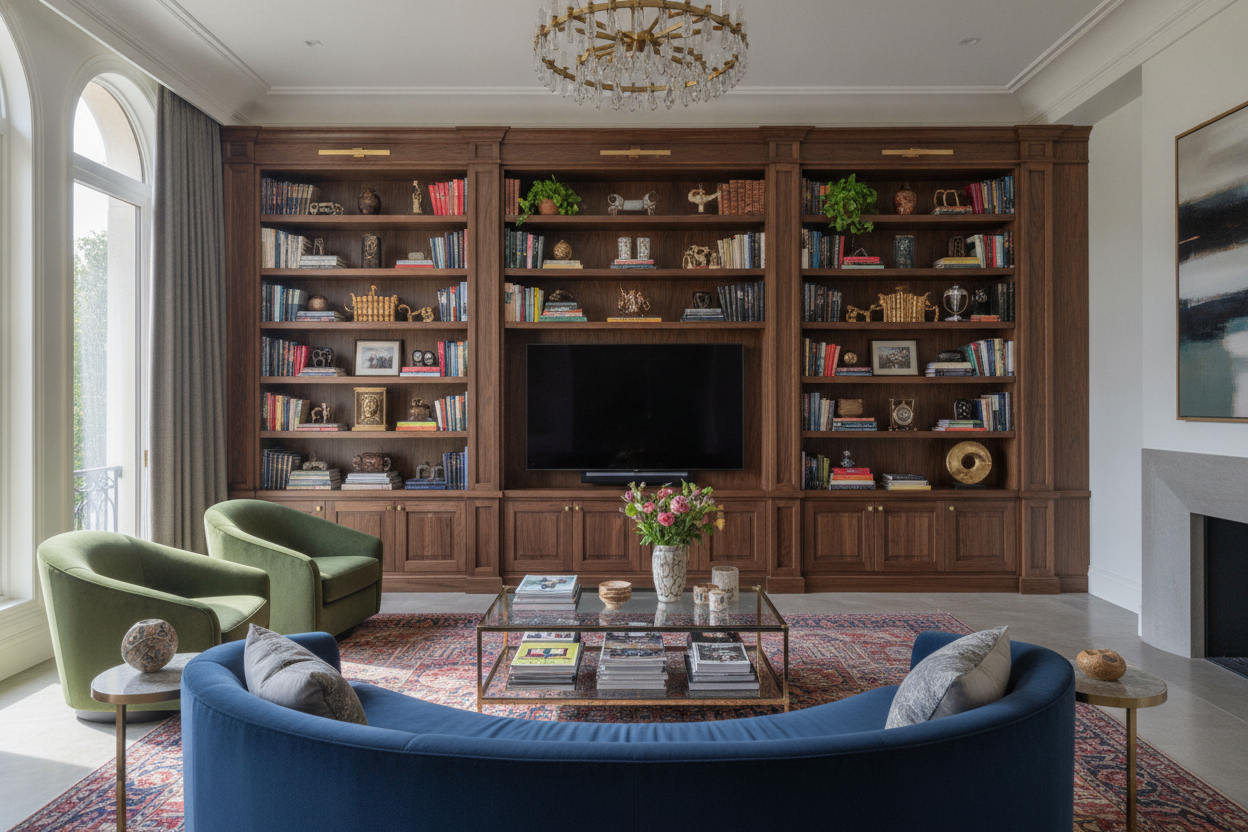
I spent three months staring at a 65-inch screen that looked like a monolith in a desert. My living room had no soul, just a 'floating black rectangle' on a beige wall that made me feel like I was living in a tech showroom. I finally broke down and bought a tv and bookcase wall unit, and it was the smartest move I've made for my sanity.
- Vertical height draws the eye up, making ceilings feel taller.
- Surrounding a TV with books softens the 'tech-heavy' look.
- Modular units offer the built-in look for a fraction of the cost.
- Adjustable shelves are non-negotiable for weirdly shaped decor.
The 'Floating Black Rectangle' Problem
We’ve all been there. You buy the biggest TV you can afford because movie night is sacred. Then you mount it on a vast, empty wall or plop it on a low-profile console. Suddenly, your living room isn't a cozy retreat anymore; it's a shrine to a piece of plastic and glass.
That empty space above and around the TV is a design killer. It creates a 'blank stare' effect where the room feels unfinished, no matter how many throw pillows you toss on the sofa. I tried gallery walls, but the frames just looked cluttered and tiny next to the screen. The scale was all wrong. You need something that competes with the size of the glass, not something that cowers under it.
Why I Finally Embraced the Wall Unit Bookcase With TV
I used to think massive wall units were for 1980s dens, but I was wrong. By choosing a wall unit bookcase with tv, I effectively 'buried' the electronics in a sea of texture. When you surround that screen with stacks of vintage paperbacks, ceramic vases, and framed photos, the TV stops being the main character.
It’s about visual weight. A heavy, floor-to-ceiling piece anchors the room. My living room actually feels warmer now because the wood grain and the varied colors of my book spines absorb the light rather than bouncing it off a bare wall. It turned my tech zone into a library that happens to have a screen in it. I went from feeling like I was in a waiting room to feeling like I was in a curated home.
Faking the Custom Built-In Look on a Budget
You don't need to hire a carpenter and spend $6,000 on custom millwork. I achieved the look by using a modular TV wall shelf unit. The trick is to find pieces that sit flush against each other and extend as far across the wall as possible.
I bought three separate units and bolted them together. If you want to go the extra mile, add a bit of trim at the bottom or top to bridge the gap to the floor or ceiling. It looks permanent, but I can still take it with me if I move. Just make sure you anchor everything to the studs — falling bookshelves are only romantic in movies. I used three-inch lag bolts because I don't trust those flimsy plastic anchors with my collection of heavy art books.
How to Style a TV Wall Unit With Bookshelves (Without Making It Cluttered)
The biggest mistake people make is cramming every inch of a tv wall unit with bookshelves full of 'stuff.' It ends up looking like a thrift store basement. I follow a strict 70/30 rule: 70% of the space is for your actual items, and 30% is 'negative space' where the eye can rest.
I also highly recommend looking for adjustable shelf storage. My first unit had fixed shelves, and I spent an entire weekend frustrated because my tallest coffee table books wouldn't fit. You want the flexibility to move a shelf up two inches to accommodate a tall vase or a weirdly shaped speaker. If you're stuck with fixed heights, you're stuck with a boring grid.
Mix your orientations. Lay some books flat and stand others up. Use 'bridge' objects like a small bowl or a piece of driftwood to break up the vertical lines of the book spines. It keeps the unit looking curated, not just packed. I also like to group colors together — not in a rainbow way, which feels a bit dated, but in tonal clusters to keep the visual noise down.
Counterintuitive Truth: Why Big Furniture Works in Small Rooms
I live in a space where every square foot is a battle. My friends thought I was crazy for putting a massive wall unit tv bookcase in a 12x14 room. But here is the secret: many small pieces of furniture make a room feel busy and cramped. One large, intentional piece makes it feel grand.
In my previous apartment, a TV wall shelving unit actually saved me floor space because it replaced three separate cabinets and a standalone bookshelf. It used the vertical real estate that was otherwise wasted. By taking the furniture all the way to the ceiling, you're tricking your brain into seeing the full height of the wall.
For those who are renting or just hate the idea of a bulky box, a freely arranged TV stand can give you that wide, expansive look without the footprint of a traditional armoire. It’s about creating a horizontal line that stretches the room visually. I've found that as long as you keep the colors light or matched to your wall, even a massive unit won't 'eat' the room.
FAQ
Will a wall unit make my room feel dark?
Only if you choose a very dark finish without enough lighting. I suggest choosing a light oak or white finish, or adding battery-powered puck lights to the top shelves to wash the unit in warm light. It makes the whole room feel expensive at night.
How do I hide all the messy wires?
Most modern units have cable management holes. If yours doesn't, a simple 2-inch spade bit and a drill can create a hidden path behind the shelves. Use zip ties to bundle the cables so they don't look like a bird's nest behind your PlayStation.
Is it hard to assemble?
I won't lie — it’s a project. Expect a full afternoon, a solid power drill (don't rely on those tiny Allen wrenches), and at least one friend to help you lift the heavy panels. My first one took four hours and half a bottle of wine, but the result was worth the sore back.

Laisser un commentaire
Ce site est protégé par hCaptcha, et la Politique de confidentialité et les Conditions de service de hCaptcha s’appliquent.