


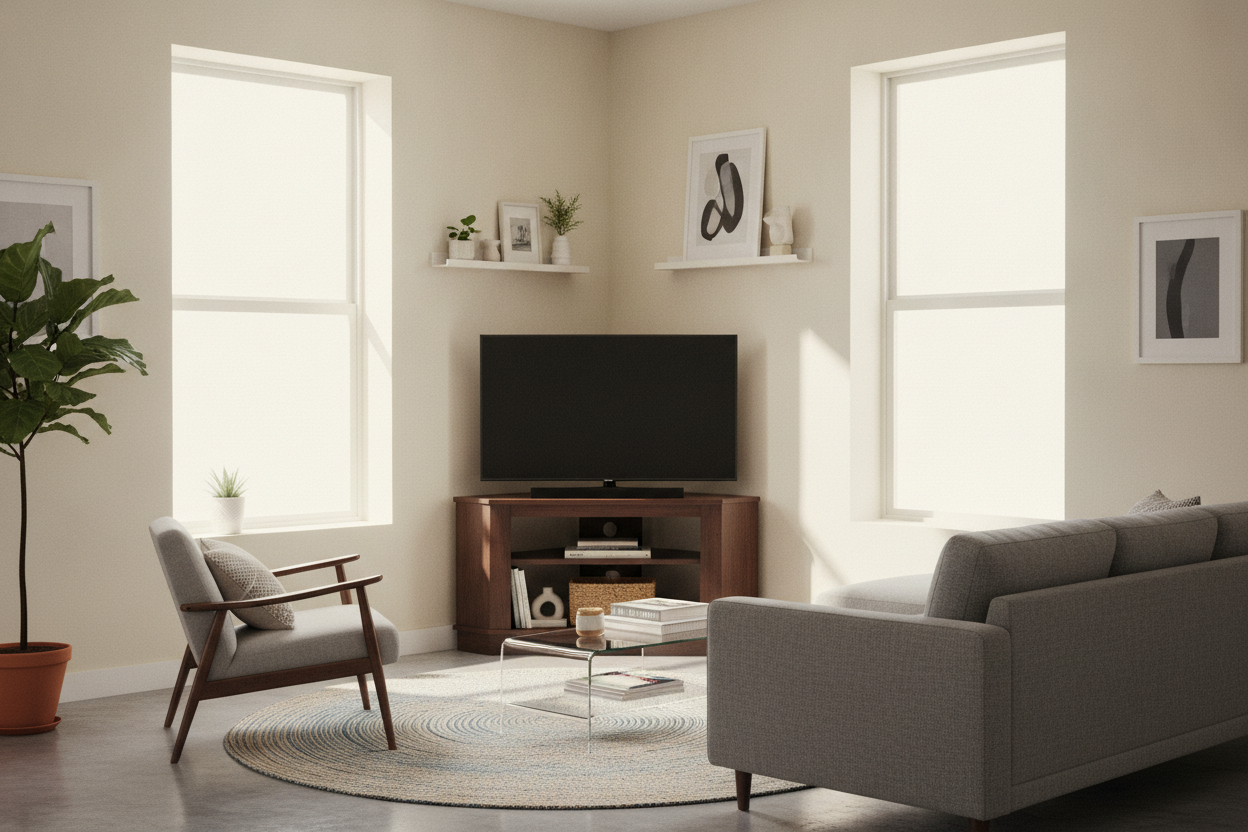
I spent three weeks staring at my 1920s bungalow living room, trying to figure out why every layout felt like a waiting room. Between the cast-iron radiator that hums like a jet engine and a fireplace that sits exactly three inches off-center, my 65-inch screen looked like a total accident. I almost gave up and moved the TV to the bedroom until I finally considered a lowes corner tv stand.
Quick Takeaways
- Corners are the most underutilized real estate in older homes with weird architectural quirks.
- Angling the TV creates a natural focal point that doesn't fight with an off-center fireplace.
- Big-box hardware store units are often sturdier than the flimsy 'fast furniture' found on discount sites.
- Cable management is significantly easier when you have a built-in 45-degree gap behind the unit.
The Curse of the 'Unfurnishable' Living Room
Living in an old house is a charm-fest until you try to buy furniture. You have these grand visions of standard flat-wall tv stands anchoring the room, but then reality hits. You realize the only long wall is interrupted by a giant window, a floor-to-ceiling radiator, or a swinging door that hits anything within a three-foot radius.
In my case, the radiator took up the prime 'flat' spot, leaving me with a weird 4-foot gap in the corner. For months, I tried to make a straight console work, but it stuck out into the walkway like a sore thumb. I was constantly bumping my shin on the corner of the wood. It felt like the room was fighting me, and the room was winning.
The Hardware Store Epiphany
I was at Lowes for a box of deck screws and a new HVAC filter when I wandered into the home decor aisle out of pure curiosity. I usually skip this section because I assume it's all generic farmhouse signs. But there it was: a heavy-duty, espresso-finish corner unit that didn't feel like it was made of balsa wood.
Unlike the stuff I'd seen on trendy sites, this thing was built for actual weight. It had a weight capacity that didn't make me nervous about my expensive OLED screen. It was a utilitarian solution hiding in plain sight between the power drills and the lumber yard. I realized I didn't need a designer piece; I needed a piece of furniture that understood geometry.
The Geometry of Reclaiming Your Floor Plan
Putting your TV in a corner isn't just about saving space; it's about fixing awkward living room layouts that feel cramped. By tucking the screen into the corner, you widen the 'viewing triangle' of the room. Suddenly, you can fit a full-sized sofa and an accent chair without blocking the primary walkway to the kitchen.
The math is simple: a corner unit uses depth that is otherwise wasted. It also kills that annoying window glare because the screen is naturally angled away from the primary light source. In my 12x14 room, moving the TV to the corner literally doubled the amount of usable floor space for my dog to sprawl out on. It turned a chaotic pass-through into an actual lounge.
Wait, Does It Actually Look Good?
Let's be honest: hardware store furniture can sometimes look a bit 'office park' if you aren't careful. It’s not always going to have the tapered, elegant legs of a high-end mid-century modern tv stand. However, the bones are usually solid, which gives you a great base to work with.
With the right styling—think heavy ceramic vases, a stack of linen-bound books, and maybe swapping the generic hardware for some brushed brass knobs—you can make it look surprisingly expensive. I replaced the stock plastic handles on mine with leather pulls, and now visitors ask me which boutique I ordered it from. It’s all about the layers you put on top of the utility. I also added some LED bias lighting behind the TV, which glows against the corner walls and adds a lot of depth.
Should You Switch to an Angled Setup?
If you're on the fence, ask yourself these four questions. Do you have more than two doorways in your living room? Is your fireplace the 'wrong' height for a TV mount? Does your current setup force your sofa into the middle of a walkway? Is your TV currently blocking a window?
If you answered yes to any of those, ditch the straight-wall dream. Moving to the corner isn't a compromise; it's a strategy. It’s about working with your home’s quirks instead of pretending they don’t exist. I once bought a 'designer' corner stand online that arrived in a box the size of a pizza and wobbled if someone walked too fast. The Lowes unit I eventually settled on weighed 80 pounds and used actual cam-locks that didn't strip the second I tightened them.
How big of a TV can a corner stand hold?
Most are rated for up to 55 or 65 inches, but always check the weight limit. It's the width of the TV's feet that usually matters more than the screen size, so measure your TV's footprint before buying. If you have a center-pedestal stand, you can usually go a bit larger.
Does it make the room look smaller?
Actually, it's the opposite. By clearing the long walls, the room's perimeter feels more open and the ceiling often feels higher because the visual clutter is tucked away into a single point of focus.
Is assembly difficult?
It's standard flat-pack construction. If you can handle an Allen wrench and have 45 minutes, you're fine. Just don't use a power drill or you'll risk cracking the finish or stripping the MDF. One tip: leave the back panel off if you have a lot of hot electronics to help with airflow.

Laisser un commentaire
Ce site est protégé par hCaptcha, et la Politique de confidentialité et les Conditions de service de hCaptcha s’appliquent.