


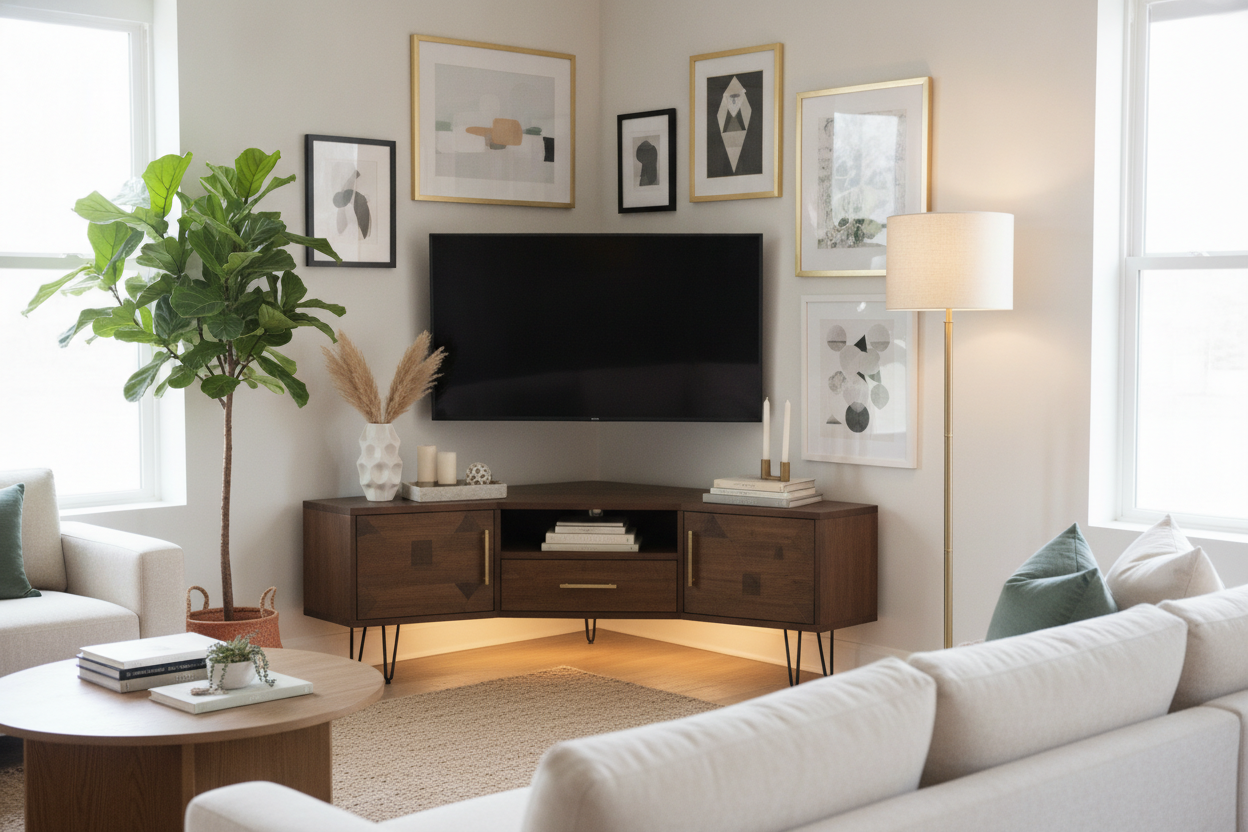
I was standing in the garden center at 8:00 AM on a Saturday, clutching a flat white and looking for a specific type of organic fertilizer, when I took a wrong turn into the furniture aisle. I usually skip this section because big-box stores have a reputation for selling stuff that looks like it belongs in a dorm room. But there it was: a corner tv stand lowes had on display that didn't immediately scream 'I was mass-produced in a factory next to the power drills.'
- Check the Weight: If the box weighs less than 40 pounds, it is basically cardboard; aim for heavier units.
- Hardware Swap: Generic silver knobs are the enemy of high-end design.
- Mind the Gap: Corner units create a 'triangle of doom' behind them that needs specific styling.
- Material Matters: Look for 'engineered wood' over 'particle board' for a better finish.
Yes, You Can Buy Good Furniture at a Hardware Store
For years, my furniture shopping was strictly limited to high-end boutiques or the occasional vintage find that required three weekends of sanding. The idea of buying a console where I buy my plywood felt wrong. But the landscape has shifted. Big-box hardware stores have realized that people who are DIY-ing their floors also need something to put their 65-inch OLED on. They’ve stepped up their game, sourcing pieces that mimic the lines of mid-century modern or industrial farmhouse brands without the four-month shipping delay.
The secret is knowing how to filter through the noise. Most people walk past these aisles because they expect flimsy laminate. While that definitely exists, there are hidden gems tucked between the lighting fixtures and the kitchen cabinets. These pieces are designed for utility, which is actually a plus. They are built to hold weight and withstand the chaos of a real home. If you approach it with a critical eye, you can find a foundation piece that looks incredibly chic once it's out of the box and styled correctly.
I’ve found that the 'pro' section of the store often stocks items with cleaner lines. They aren't trying to be trendy; they’re trying to be functional. And in the world of interior design, functionality often translates to a timeless look. You just have to be willing to look past the 'Some Assembly Required' sticker and see the potential in the silhouette.
Rule 1: Inspect the Materials Before You Load the Cart
Before you commit to that corner tv stand lowes has in stock, you need to perform a literal heavy lift. The biggest giveaway of cheap furniture isn't the design; it's the density. If you can slide the box across the floor with one finger, leave it there. You want something with heft. High-density fiberboard (HDF) or engineered wood with a thick veneer will always look more expensive than the hollow-core particle board that chips if you look at it too hard.
I always check the edges of the display model. If the 'wood' grain is peeling at the corners like a cheap sticker, that’s a red flag. You want a finish that feels slightly textured, not slick and plastic-y. If you really want to ensure longevity, searching for a solid wood corner tv stand is the ultimate move, but even in the hardware store world, you can find high-quality composites that mimic the weight and feel of real timber.
Don't be afraid to read the fine print on the side of the box. Look for weight capacities. A stand rated for 150 lbs is built much differently than one rated for 50 lbs. The sturdier the build, the less likely it is to sag in the middle after six months—a common 'tell' that your furniture came from a big-box store. A sagging console is the fastest way to make a living room look sad and neglected. I’ve made the mistake of buying the light-weight 'easy carry' box before, and I regretted it the second I tried to tighten the cam locks and the wood crumbled like a dry biscuit.
Rule 2: Immediately Ditch the Factory Hardware
This is the single most important rule for making budget furniture look custom. The hardware that comes in the box is almost always an afterthought. It’s usually those tiny, brushed nickel knobs or thin, stamped-metal pulls that look like they cost five cents to manufacture. Because they did. Swapping these out is a ten-minute job that yields a thousand-dollar aesthetic.
Go two aisles over to the actual hardware section. Look for solid brass pulls, matte black knurled handles, or even leather tabs. By adding hardware with some weight and personality, you trick the eye into thinking the entire piece is a high-end find. I recently swapped the generic silver knobs on a charcoal-colored console for oversized, aged brass pulls, and guests literally asked me which high-end boutique I ordered it from. They were shocked when I told them I bought it while picking up a new showerhead.
Make sure you measure the 'center-to-center' distance between the screw holes before you buy new pulls. If the piece uses single knobs, you're golden—you can pick anything. If it uses handles with two screws, you need to match that distance exactly or you'll be stuck filling holes and painting, which defeats the purpose of an easy upgrade. Stick to heavy materials. If the handle feels cold and heavy in your hand, it’s going to make the cabinet door feel more substantial when you open it.
Rule 3: Style the Dead Space Around It
Corner furniture is notoriously difficult because it creates a weird, triangular void behind the unit. If you just shove the stand into the corner and call it a day, it looks like an awkward afterthought. To make it look like a built-in part of the room, you have to address the space around and above it. This is how you fix an awkward living room layout without hiring an architect.
First, deal with the cords. Nothing says 'hardware store special' like a tangled mess of black cables spilling out from behind the unit. Use cord clips or a cable management box to hide everything. Next, use the vertical space. A tall, floor-standing plant (like a Dracaena or a large Fiddle Leaf Fig) placed slightly to the side can soften the sharp angles of the corner. The greenery breaks up the 'boxy' feel of the console and helps it blend into the room's architecture.
Lighting is your best friend here. A small, warm-toned lamp placed on one side of the stand—or even a battery-powered puck light hidden behind the TV to create a soft glow on the walls—adds depth. It eliminates the harsh shadows that usually congregate in corners. I also like to lean a piece of art on the wall behind the TV if there's room, or hang a gallery wall that 'wraps' the corner. It anchors the piece. Without these layers, the TV stand is just a lonely island of laminate; with them, it’s a curated media center.
The Final Verdict on Hardware Store Consoles
Is a hardware store console going to be a family heirloom passed down for three generations? Probably not. But if you are looking for a functional, sturdy piece that doesn't break the bank, it's a brilliant move. The assembly is usually straightforward—though I highly recommend using your own screwdriver rather than the tiny L-shaped wrench they provide. Your wrists will thank you.
The durability is surprisingly high if you choose the heavier models. I’ve had a Lowes-sourced console in my high-traffic den for three years, and with the hardware swap and proper styling, it still looks brand new. The money you save by not buying from a 'designer' brand can be funneled into a better TV or a really nice rug, which arguably has a bigger impact on your daily life. Just remember: shop by weight, kill the cheap knobs, and don't let the corner become a graveyard for dust and cables. Treat it like a custom piece, and it will act like one.
Is assembly actually difficult?
It's usually a 45-minute job. If you can follow Lego instructions, you can build this. Just don't use a power drill on the high setting or you'll strip the holes and ruin the structural integrity.
Will my large TV actually fit?
Check the 'actual width' of the stand versus the 'screen size' of the TV. A 65-inch TV is the diagonal measurement; the actual width is usually around 57 inches. Make sure the stand is at least 2-4 inches wider than the TV base so it doesn't look top-heavy.
How do I clean the 'wood' finish?
Avoid heavy polishes or waxes. A slightly damp microfiber cloth is all you need. Since it's likely a veneer or laminate, soaking it with liquid can cause the edges to swell and peel.

Laisser un commentaire
Ce site est protégé par hCaptcha, et la Politique de confidentialité et les Conditions de service de hCaptcha s’appliquent.