


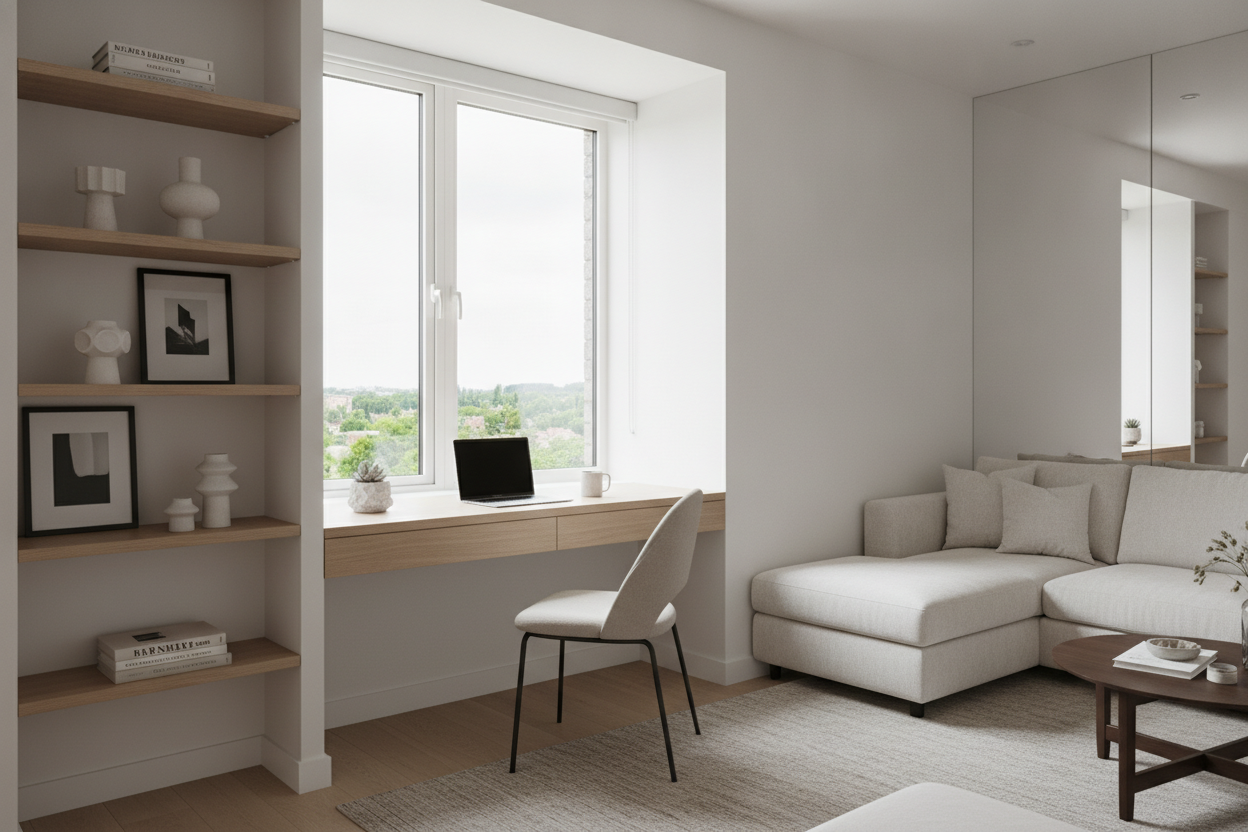
I spent three months working from a 4x4 nook that felt more like a broom closet than an office. Every time I pushed my chair back, I’d snag a leg on my chunky IKEA table or trip over the mess of cables tucked behind the radiator. I finally realized the problem wasn't the room's square footage—it was the footprint of the furniture. Installing a floating desk under window was the only way to get my sanity back.
- Floor space is the most valuable currency in a small room.
- Wall-mounted brackets offer more legroom than any four-legged table.
- Stud-finding is the difference between a functional workspace and a hole in your drywall.
- Window placement maximizes natural light but requires a plan for glare.
The problem with four-legged desks in tiny rooms
Standard desks are space hogs. Even the slim ones have four points of contact with the floor that break up the visual flow of a room. When you're dealing with a 10x10 bedroom that doubles as an office, those legs are obstacles. They block your vacuum, they sit awkwardly against baseboards, and they usually prevent you from putting furniture over a radiator or near a low window sill.
I used to have a basic Parsons desk. It looked fine in the showroom, but in my apartment, it felt like a heavy anchor. The visual weight of furniture legs makes a small space feel cluttered and claustrophobic. It creates these 'dead zones' of dust and tangled cords that you can't easily reach. By the time I added a chair and a small trash can, the floor was a graveyard of metal and wood. It didn't feel like a place to create; it felt like a storage closet I happened to sit in for eight hours a day.
Why I went with a wall-mounted setup
The decision to move to the wall was about reclamation. By mounting a solid wood slab directly to the studs, I freed up every single inch of carpet beneath my feet. I started by placing a desk in front of window to take advantage of the 'dead space' right against the glass. Most people avoid this because they think it blocks the view, but a floating shelf actually frames it.
Keeping the floor clear creates an optical illusion. When you can see the baseboards and the floor stretching all the way to the wall, the room feels significantly larger. I chose a 1.5-inch thick butcher block top—kiln-dried maple, not that hollow-core particle board that bows after two weeks. It’s sturdy enough to hold my 27-inch monitor and a heavy lamp without a hint of wobble. The result? I have a 60-inch workspace that feels like it’s barely there.
Dealing with the reality of screen glare
I know what you're thinking because I thought it too: won't the sun kill my eyes? There is a lot of debate about putting a desk in front of window, and most of it centers on glare. If you’re staring directly into the south-facing sun at 2 PM, you’re going to have a bad time. I solved this with a set of top-down, bottom-up cellular shades. They let me block the direct sun hitting my monitor while keeping the top of the window open for sky views.
A floating desk in front of window also means you have to be smart about your monitor height. I use an articulating arm clamped to the back of the wood. This lets me tilt the screen slightly downward to kill any remaining reflections. If you have a glossy screen like an iMac, you might need a matte screen protector, but for most matte office monitors, a simple set of blinds is plenty.
Getting the height and hardware exactly right
This is where most DIY projects fail. If you mount a floating desk at the wrong height, you can't just 'adjust' it like a regular table. Standard desk height is 29 inches, but I’m 6-foot-1, so I bumped mine to 30.5 inches. Sit in your chair, measure from the floor to your elbows, and make sure your knees have at least 10 inches of clearance from the bottom of any support brackets. Speaking of brackets, do not buy those flimsy decorative ones from the craft store.
I used heavy-duty steel L-brackets rated for 300 lbs each. You must—and I cannot stress this enough—bolt these directly into the wall studs. Drywall anchors are a recipe for a 3 AM disaster where your expensive gear ends up on the floor. Use a magnetic stud finder to locate the 2x4s, usually spaced 16 inches apart. I used 3-inch lag bolts to bite deep into the wood. Once it was up, I could literally sit on the desk without it budging. That’s the level of security you want when you're resting a $2,000 laptop on a piece of floating wood.
What if your landlord won't let you drill?
I get it. Some landlords act like a 1/4-inch hole in the drywall is a structural crime. If you can’t go full floating, you can still get that airy look. Look for a minimalist writing computer desk with a 'C-frame' or 'T-frame' leg design. These put the support at the back or sides, leaving the front area open for your legs and keeping the visual profile low.
Another trick is the ladder desk. It leans against the wall and usually only requires one or two small safety screws at the top. It gives you that same 'off-the-floor' vibe without the industrial-grade drilling. It won't be as rock-solid as a bolted butcher block, but it beats a bulky four-legged beast any day of the week. The goal is to keep as much of your flooring visible as possible.
Is a floating desk sturdy enough for a PC?
Yes, provided you hit the studs. If you use heavy-duty steel brackets and lag bolts, a floating desk can easily support 200+ pounds. I keep a mid-tower PC, two monitors, and a pair of studio speakers on mine with zero flex.
How deep should a desk under a window be?
Aim for 20 to 24 inches. Anything deeper than 24 inches starts to eat into the room too much, defeating the purpose of a small-space hack. Anything shallower than 18 inches won't give you enough room for a keyboard and a monitor stand.
Will a floating desk damage my walls?
Only if you miss the studs or overload it. When it's time to move out, you'll just have a few bolt holes to fill with spackle and a dab of paint. It's a ten-minute fix that is well worth the years of extra floor space you gain.

Laisser un commentaire
Ce site est protégé par hCaptcha, et la Politique de confidentialité et les Conditions de service de hCaptcha s’appliquent.