
A heavy duty dog crate is worth it when your dog is already calm in a crate and you need something sturdier than a light wire or soft crate: steel bars, solid latches and a frame that stays put. Size it from your dog, not from the label: the crate has to let your dog stand up, turn around, lie down and stretch out. Then use it humanely, for short periods and never as punishment, because no crate, however strong, makes it fine to leave a dog shut in for a workday or to contain a dog that panics.
This guide covers what "heavy duty" should mean, how to measure your dog, doors, latches and dividers, escape attempts, how long a dog can stay crated, and three crates from the FUFU&GAGA dog furniture collection.
Key takeaways
- Size: measure your dog standing (floor to top of head) and lying stretched out, then compare with the crate's interior, not its overall size.
- Strength: "heavy duty" is a description, not a rating; check what the listing states about bars, doors and latches.
- Chewing: furniture-style crates with wood or particleboard panels are for crate-trained dogs, not for dogs that chew their way out.
- Escape attempts: dogs can injure themselves trying to get out; talk to your veterinarian or a certified behaviorist rather than buying a stronger cage.
- Time: humane groups put adult limits at roughly three to five hours at a time, less for puppies, and never all day.
What makes a dog crate heavy duty?
Treat "heavy duty" as a claim to check rather than a standard. In practice it should mean steel bars or tubes, a rigid frame, doors that close flush and latches a dog cannot nose open. A solid crate is also heavy, which helps stability but makes it hard to move.
| Type | What it is | Suits | Watch out for |
|---|---|---|---|
| Wire crate | Wire panels, often folding | Training and storage | Check the door and latch |
| All-metal kennel | Steel tubes or bars on every side | A sturdier build, if your vet or behaviorist agrees a crate suits your dog | Not a fix for anxiety or panic |
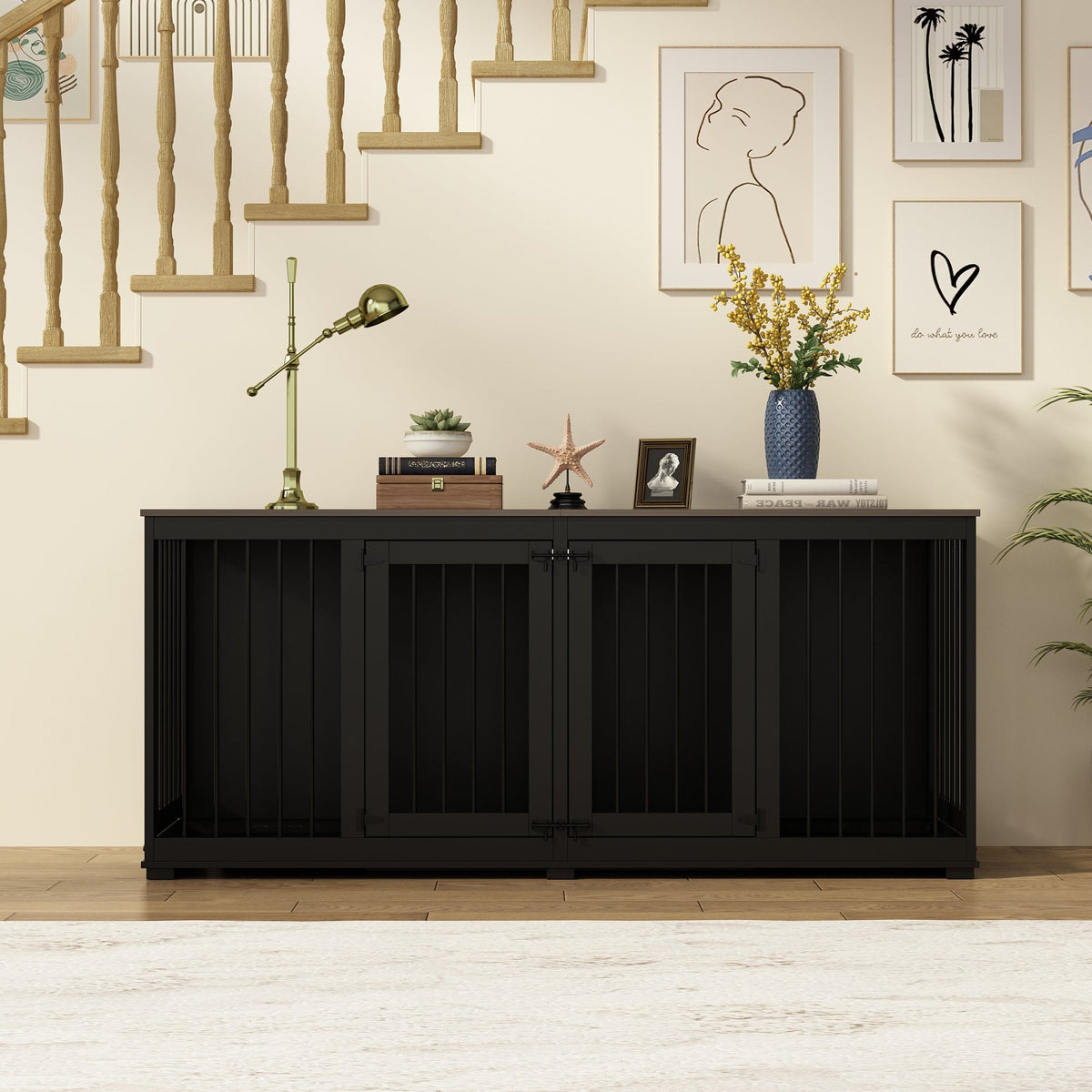
| Furniture-style crate | Wood or particleboard cabinet with steel bars | Crate-trained dogs in a living room | Panels are not meant to be chewed |
The UC Davis veterinary school notes that wire crates may fold for storage and that plastic crates can be used for airline travel (UC Davis crate training handout). A furniture-style crate does neither: it stays in one room and doubles as a table or TV stand. Our broader dog crate furniture buying guide covers single versus double crates and styles; this post focuses on strength, fit and safe use.
Dog crate size chart: how to measure your dog
Welfare sources describe fit the same way. The RSPCA says a crate should be big enough for your dog to stand, turn around, lie down and stretch in (RSPCA). The ASPCA says that at minimum the dog should be able to stand up, turn around and lie down (ASPCA). The UC Davis handout adds the other limit for puppies: not so big that the puppy can use one end as a separate toilet area.
To turn that test into numbers you can compare with a listing, measure your dog in the positions the test describes:
- Standing height: with your dog standing square, measure from the floor to the top of the head (or ear tips, if they stand up). The crate's interior height must be more than this, with headroom to spare.
- Lying length: while your dog lies on its side stretched out, measure from nose to the back of the hindquarters. The interior length must be more than this.
- Turning room: the interior depth has to let your dog turn around without squeezing.
- Door height: compare the door opening with your dog's standing height so your dog does not crouch to get in.
Compare them with the listed interiors of the crates below:
| Crate | Interior H x W x D (in) | Door height | Your dog must fit |
|---|---|---|---|
| 71" double-door pet cage | 28.9 x 33.5 x 22 per side | 25 in | Standing height under 28.9 in with headroom; lying length within 33.5 in per side |
| 64.6" crate with side table | 24.6 x 29.5 x 21.8 (listed) | 25.6 in (listed) | Standing height under 24.6 in with headroom; lying length within 29.5 in |
| Solid pine end-table crate | 22.4 x 22.4 x 30.9 | 22.4 in | Standing height under 22.4 in with headroom; lying length within 30.9 in (front to back) |
For a growing puppy, Humane World for Animals advises choosing a crate that will fit the adult dog (Humane World for Animals), and UC Davis suggests blocking off the back until the puppy grows. A removable divider does that job in a double crate. The RSPCA also says not to travel with a puppy in its adult-sized crate.
Double door dog crates, latches and dividers
On a long crate, two front doors let you reach either end, and with a divider in place each dog gets its own room and door. Look for:
- A latch on every door. All three picks below list a latch on each door; the pine crate lists a stainless steel latch.
- Divider sizing. With the divider in, each room must fit its dog's own measurements. Two halves of a 70.9-inch crate are each about 33.5 inches wide inside, not 70.9.
Is any dog crate escape-proof?
For a dog that panics, a stronger crate is the wrong tool. The ASPCA says escape attempts by dogs with separation anxiety are often extreme and can cause self-injury such as broken teeth, cut and scraped paws and damaged nails, and that if a dog shows signs of distress in a crate, such as heavy panting, excessive salivation or frantic escape attempts, crate confinement isn't the best option for that dog (ASPCA on separation anxiety).
Humane World for Animals says a crate will not solve separation anxiety and a dog may get injured trying to escape. The UC Davis handout warns that crating may make an anxious dog even more anxious and says to consult your veterinarian.
What to do instead:
- Talk to your veterinarian first; UC Davis notes your vet may be able to refer you to a behaviorist or trainer.
- Work with a qualified professional. The ASPCA recommends a Certified Applied Animal Behaviorist (CAAB or ACAAB) or a board-certified veterinary behaviorist (Dip ACVB).
- Ask about alternatives. The ASPCA mentions confining a dog to one room behind a baby gate, and its crate page mentions an exercise pen or dog-proof room for dogs with a bad past crate experience.
For a calm, crate-trained dog, "escape-proof" should simply mean latches and doors a curious nose cannot push open. Using a crate to contain distress is a different thing.
How long can a dog stay in a crate?
Welfare groups give different numbers, so use the shortest one that fits your dog and treat it as a ceiling, not a target:
| Source | Adult dogs | Puppies |
|---|---|---|
| RSPCA | Well crate-trained adults are normally happy for about three hours; never shut in all day while you work | Cannot hold bladder and bowels as long as adults |
| ASPCA | No more than four hours at a time | Young puppies an hour or two at a time, except at night |
| Humane World for Animals | No more than 4 to 5 hours during the day | Under 6 months: no more than three or four hours at a time |
| Texas A&M vet school | Not for excessive amounts of time | About one hour for each month of age |
For a full workday, plan a midday break or a dog walker instead of a longer crate stretch. A sturdy crate changes none of these limits.
Using a crate humanely
- Never as punishment. The RSPCA says crates must never be used as a punishment or to prevent unwanted behaviors such as destroying furniture, and Humane World and UC Davis say the same.
- Build up slowly. The RSPCA lists whining, panting, excessive barking, cowering or aggression as signs you may have increased crate time too quickly.
- Bedding and water. Humane World says the crate should always have a comfortable bed. The RSPCA suggests soft bedding, access to water and a clip-on bowl so it cannot tip over.
- Collar. Tufts University's veterinary school, writing about play, says a collar or harness should stay on only while dogs are closely supervised and otherwise be removed. A dog left alone in a crate is not supervised.
- Location. The RSPCA advises a spot out of direct sunlight and drafts, in an area where the family spends a lot of time, and notes that covering part of the crate can help nervous dogs.
Wheels, trays and travel
None of the three picks below lists wheels, and two weigh about 127 pounds, so place them where they will stay. The 64.6-inch crate lists a floor grate; if you need a pull-out tray, confirm it on the product page. These are not travel crates: all three listings say Portable: No and Airline Approved: No, so use a crate made for travel and check your airline's rules.
Heavy duty dog crate buying checklist
- Interior height: more than your dog's standing height to the top of the head, with headroom.
- Interior length: more than your dog's stretched-out lying length.
- Door height: close to or above your dog's standing height.
- Two dogs: each room sized for its own dog, with its own door.
- Latches: one on every door, easy for you and hard for a nose.
- Frame: steel bars or tubes as listed; check whether the listing says chew-proof (the furniture-style crates below say they are not).
- Weight and wheels: heavy is stable; check before you plan to move it.
- Your dog: crate-trained and calm inside; if not, talk to your vet before you buy.
Our picks: heavy duty and furniture-style dog crates
All three are flat-packed, indoor crates with steel bars and latching doors. Sizes and features are as listed; none of the listings call these crates chew-proof.
71" Modern Black Double Door Large Pet Cage with Steel Reinforced Design
The pick closest to a heavy-duty cage: a steel-reinforced front with P2-grade particleboard panels, two front doors with latch locks, and a divider that turns one long room into two. Each side is 28.9" H x 33.5" W x 22" D inside, with a 25-inch door, which suits one large dog or two dogs that each fit a half. Overall it is 31.3" H x 70.9" W x 23.6" D and 127.38 lb; the top works as a TV stand or display shelf. Finishes are black, tiger skin or dark tiger skin; a screwdriver is needed for assembly. The listing calls it chew-resistant but says it is not chew-proof and is made for crate-trained dogs.
Best for: one large, crate-trained dog or two dogs that need separate rooms, in a living room where the top doubles as a TV stand.
Skip it if: your dog chews or tries to break out, you need to move the crate often (127.38 lb, no wheels listed), or you need a travel crate.

64.6" Modern Minimalist White/Black Wooden Dog Crate with Divider And Side Table
A shorter double crate with two drawers in the top for leashes and treats. Two lockable front doors, a divider, ventilation windows and steel bars give two dogs separate spaces or one dog the whole length; felt foot pads protect the floor. The listing gives a 64.6-inch width, 23.6-inch depth, an interior of 24.6" H x 29.5" W x 21.8" D, a 25.6-inch door height, 126.61 lb and a listed weight capacity of 200 lb. A floor grate and handles are included; finishes are white, black or tiger skin. Like the others, it is designed for crate-trained dogs, not chewers.
Best for: shorter crate-trained dogs in a room that also needs drawer storage.
Skip it if: your dog stands close to 24.6 inches tall, or you need exact numbers: the listing gives no overall height and does not say whether the interior size is per side, so confirm before ordering.

Solid Pine Wood Dog Crate with Stainless Steel Latch
A single-dog end table in gloss-finished solid pine with powder-coated steel bars, a stainless steel latch on the front door, ventilation holes on the sides and smooth, rounded corners. It is 24.2" H x 23.6" W x 31.5" D outside and 22.4" H x 22.4" W x 30.9" D inside, with a 22.4-inch door, so your dog walks in at the narrow end and lies along the 30.9-inch depth. At 41 lb it is the lightest pick, with a listed weight capacity of 110 lb; wipe it with a damp cloth.
Best for: one smaller, crate-trained dog beside a sofa or bed, where the crate also serves as an end table.
Skip it if: your dog's standing height is near 22.4 inches, you have two dogs, or you want a heavy, all-steel cage: this is a wood crate with a barred door.

Picks compared
| Pick | Overall H x W x D (in) | Interior H x W x D (in) | Doors and latches | Divider | Weight |
|---|---|---|---|---|---|
| 71" double-door pet cage | 31.3 x 70.9 x 23.6 | 28.9 x 33.5 x 22 per side | 2 front, latch | Yes | 127.38 lb |
| 64.6" crate with side table | Height not listed x 64.6 x 23.6 | 24.6 x 29.5 x 21.8 | 2 front, latch | Yes | 126.61 lb |
| Solid pine end-table crate | 24.2 x 23.6 x 31.5 | 22.4 x 22.4 x 30.9 | 1 front, stainless steel latch | No | 41 lb |
All three need assembly; our flat-pack assembly guide helps doors hang square so latches line up.
FAQ
What size crate does a large dog need?
One your dog can stand up, turn around, lie down and stretch out in. Measure standing height to the top of the head and stretched-out lying length, and choose an interior that beats both with room to spare.
Is a heavy duty crate good for a dog with separation anxiety?
No. The ASPCA, Humane World for Animals and the UC Davis veterinary school all warn that anxious dogs can hurt themselves trying to escape; Humane World and UC Davis add that a crate does not fix the anxiety. Ask your veterinarian for help and a referral to a certified behaviorist.
How long can I leave my dog in a crate?
Guidance for adult dogs ranges from about three hours (RSPCA) to four hours at a time (ASPCA) or four to five hours during the day (Humane World for Animals), and less for puppies. None of them supports leaving a dog crated all day.
Can two dogs share a double door dog crate?
Yes, with the divider in, so each dog has its own room and door. Size each room for the dog in it: in a 70.9-inch crate, each half is 33.5 inches wide inside.
Ready to compare sizes and finishes? Browse the full dog furniture collection, measure your dog first, and choose a crate your dog can stand, turn and stretch out in.

Laisser un commentaire
Ce site est protégé par hCaptcha, et la Politique de confidentialité et les Conditions de service de hCaptcha s’appliquent.