
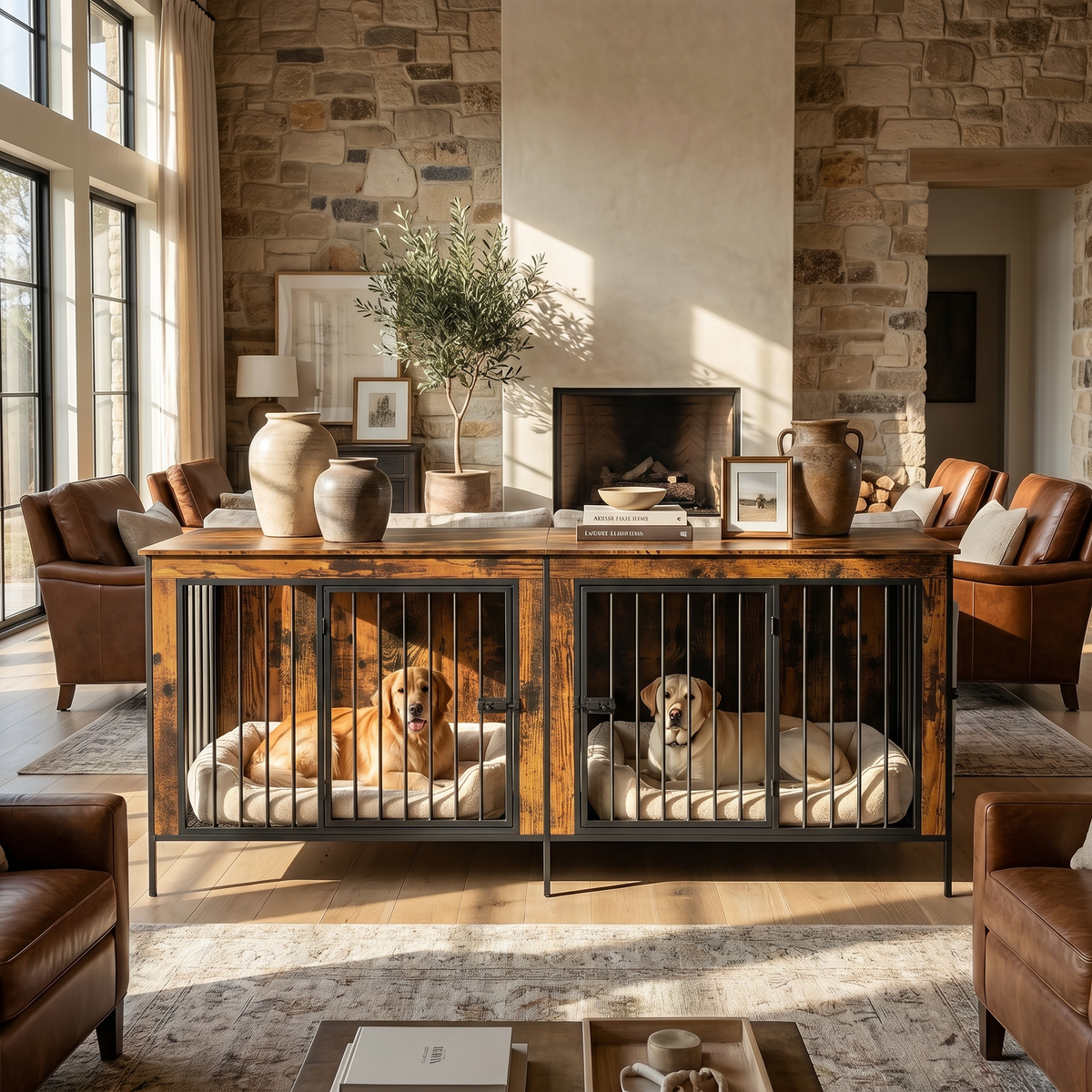
Dog crate furniture is worth it when your dog is crate-trained, doesn't chew its crate, and the crate has to live in a room you use every day. The right one has an interior 3 to 4 inches longer and taller than your dog, steel bars for air and visibility, secure latches, and a top that can work as an end table, TV stand or buffet. Heavy chewers and teething puppies are better off in a metal wire crate.
This guide covers sizing, single vs double crates and dividers, materials, doors, cleaning and placement, then compares five crates from the FUFU&GAGA dog furniture collection.
Key takeaways
- Size from the dog: measure your dog standing, nose to tail tip and floor to top of head, then add 3 to 4 inches to each.
- Two dogs need two full-size rooms: with a divider in, each compartment must fit its dog on its own.
- Check door height: a door lower than your dog's head means a crouch every time.
- Know the limits: wood and manufactured wood panels aren't built for chewing.
- Use the top: a 55 to 93 inch crate can replace a console table, TV stand or sideboard.
What is dog crate furniture, and is it worth it?
Dog crate furniture, also called dog kennel furniture or a furniture-style dog crate, is a crate built like a cabinet: wood or manufactured wood panels, a flat top you can use, and steel or iron bars that let air in and let the dog see out. It is a dog crate that looks like furniture, so your dog's den and a useful piece of furniture share one footprint.
For most crate-trained dogs it is worth it when floor space is tight or the crate sits in a shared room. You get a cozy den plus surface space for lamps, books, plants or a TV, and some models add drawers for leashes, treats and toys.
It isn't right for every dog. The American Kennel Club notes that wood dog crates are usually the most attractive option but are heavier and harder to clean, and that metal crates are best for dogs who tend to chew through other materials (AKC). The crates in our range are designed for crate-trained dogs, not for chewing.
What size dog crate furniture do you need?
The AKC's method: with your dog standing, measure from the top of the head to the bottom of the feet for height, and from the tip of the nose to the tip of the tail for length. Add 3 to 4 inches to each. In a furniture-style crate the door is on the long side, so your dog's length compares with the interior width.
Example: a dog that measures 33 inches nose to tail and 24 inches to the top of its head needs about 36 to 37 inches of interior width and 27 to 28 inches of interior height. Humane World for Animals (formerly the Humane Society of the United States) adds the practical test: the crate should be large enough for your dog to stand up and turn around in (Humane World for Animals).
Bigger isn't always better. The AKC warns that a crate that is too big can encourage a dog to eliminate inside it. For a growing puppy, it suggests a crate sized for the breed's adult size with a divider you move as the puppy grows.
Compare interior sizes, not overall dimensions, because panels and legs take up space. Here are real interior sizes from our crates:
| Crate | Interior (H x W x D) | Door height | Dog size in the specs |
|---|---|---|---|
| Barn-door double crate, 78.7" | 28.3" x 37.6" x 20.9" per room | 25.6" | Large, 50 to 95 lb |
| Farmhouse crate with drawers, 92.9" | 29.3" x 43.8" x 24.7" (listed) | Not listed | Large, 50 to 95 lb |
| Corner crate, 58.7" | 29.1" x 38.9" x 20.8" | 25.2" | Medium, 20 to 50 lb |
| Rustic double crate end table, 78.7" | 25.7" x 38" x 25.5" (listed) | 23.3" | Not listed: measure your dog |
| Bed bench crate, 47.2" | 20.9" overall height | 15.2" | Medium, 20 to 50 lb |
Single vs double dog crate furniture: do you need a divider?
A single crate gives one dog one long room. Double dog crate furniture has two compartments, usually with a door each, so two dogs can rest side by side. Dog crate furniture with a divider gives you both options.
| Layout | Best for | Watch out for |
|---|---|---|
| Single room | One dog, especially a long one | No way to split the space later |
| Removable divider | Two dogs now, one large dog later, or a growing puppy | Each half must still fit each dog |
| Fixed divider | Two dogs that need their own space | Can't open it up for one big dog |
For two dogs, size each compartment to the dog in it. A fixed divider keeps dogs fully apart, which helps when they don't settle well together. A removable divider is more flexible: open, it gives one large dog a long room; closed, two smaller rooms.
Which materials are best?
- Manufactured wood (MDF or P2-grade particleboard): the most common panel material. It takes wood-grain or painted finishes well but should be kept dry and isn't meant to be chewed.
- Solid wood: warm looking and sturdy, but heavier and harder to clean.
- Steel or iron bars: the parts that face the room, giving ventilation and visibility. Rust-resistant, coated metal wipes clean easily.
- Mesh or fabric: found on soft crates, which the AKC recommends only for small dogs that won't chew them.
Ventilation, doors and latches
Look for bars on at least the front and one more side, or ventilation windows in solid panels, so air has a path through the crate even against a wall. Bars also let your dog watch the family and let you check on them at a glance. If your dog is small, check bar spacing; on our bed bench crate the bars are about 3 inches apart.
- Barn-style doors: a pair that swings open from the center for a wide opening; needs floor clearance in front.
- Single swing door: simple; make sure it opens toward the room.
- Front and side doors: give each dog in a double crate its own entrance and keep a corner crate reachable.
- Sliding doors: save swing space; check that the track stays clean and the door locks shut.
Choose a latch on every door that you can open with one hand while holding a leash, and compare door height with your dog's head height.
How do you keep dog crate furniture clean?
Helpful features are a slide-out tray, a removable floor grate and raised legs for vacuuming underneath. Our 71" crate with a slide-out tray and divider is built around quick tray cleanup, and the rustic double crate below has raised legs that leave room for a robot vacuum. Wipe manufactured wood with a dry or lightly damp cloth and dry spills quickly. Humane World says a crate should always have a comfortable bed that is washable and suits your dog's size and chewing habits.
Can it work as an end table, TV stand or buffet?
Yes, and that is the main reason to choose it. A crate 24 to 35 inches tall works as an end table beside a sofa or bed. Crates 55 to 93 inches long have a top wide enough for a TV, lamp and decor, or for serving dishes like a buffet, and drawers hide food scoops, leashes and toys. Check the top's load rating where one is given: our barn-door double crate's top shelf is rated for 66 lb.
Where should you put a dog crate?
Humane World suggests a room where the family spends a lot of time, such as the family room, in a calm spot where your dog can relax without constant noise. Keep the crate out of direct sun and away from heating vents, leave room for the doors to open fully, allow a few inches behind it for airflow, and choose a corner crate or a side door if it has to go in a corner.
Who should choose a metal wire crate instead?
- Dogs that chew their crate or bedding: the AKC says metal crates are best for chewers.
- Puppies still teething: they chew whatever is in reach, including panel edges.
- Dogs not yet crate-trained: start with a wire crate and move to furniture once your dog rests calmly inside.
- Dogs that panic when left alone: talk to your veterinarian or a trainer first.
Plan time out of the crate, too. Humane World advises that puppies under 6 months shouldn't stay in a crate more than three or four hours at a time, adult dogs not more than 4 to 5 hours during the day, and that a crate should never be used for punishment.
Dog crate furniture buying checklist
- Interior length: nose-to-tail length plus 3 to 4 in.
- Interior height: standing height plus 3 to 4 in.
- Door height: close to your dog's head height.
- Two dogs: each compartment sized for its dog; fixed or removable divider.
- Ventilation: bars or vents on at least two sides.
- Latches: a lock on every door.
- Cleaning: tray, floor grate or raised legs.
- Top use: a load rating that covers your TV or decor.
- Room fit: width, depth and door swing clearance.
Our picks: dog crate furniture from FUFU&GAGA
78.7" Rustic Wood Double Dog Crate End Table with Divider and Raised Legs

One of our most-ordered dog crates, it pairs a rustic wood-look top with black iron bars and raised legs that clear a robot vacuum. Doors on the front and sides let two dogs that are still getting used to each other use their own entrance, and a removable divider makes one large space or two.
Key facts: 33.5" H x 78.7" W x 27.6" D, listed interior 25.7" H x 38" W x 25.5" D, door 23.3" H, latch locks, floor grate, iron and manufactured wood, about half an hour for two people to assemble.
Best for: two dogs in a living room, used as a console or TV table.
78.7" Brown Dog Crate with Barn Doors and Double Separate Rooms

Two fully separate rooms behind barn-style doors, with a fixed divider and a latching door for each dog. The rooms suit many large breeds, but measure first: they are 28.3" tall inside.
Key facts: 33.9" H x 78.7" W x 23.6" D, each room 28.3" H x 37.6" W x 20.9" D, door 25.6" H, large dogs 50 to 95 lb, top shelf rated 66 lb, steel, iron and MDF.
Best for: two large dogs that need their own space.
92.9" Farmhouse Dog Crate Furniture with 4 Drawers and Divider
The longest pick adds four drawers for food, leashes and toys, so it works like a buffet with a dog den in the middle. A steel divider switches between one room and two, both front doors latch, and felt foot pads protect floors.
Key facts: 39.4" H x 92.9" W x 27.6" D, listed interior 29.3" H x 43.8" W x 24.7" D, large dogs 50 to 95 lb, white, black or black/tiger skin, 210 lb.
Best for: large dogs and homes that need storage too.
58.7" Rustic Black Corner Dog Crate with Steel Divider

Shaped to tuck into a corner, with a flat top for a plant or lamp. One door on the front and one on the side, both latching, keep your dog reachable however it's placed, and a removable steel divider splits the inside in two.
Key facts: 35.7" H x 58.7" W x 41.1" D, interior 29.1" H x 38.9" W x 20.8" D, door 25.2" H, medium dogs 20 to 50 lb, felt foot pads, black.
Best for: corners and medium dogs.
47.2" Black Bed Bench Dog Crate with Cushion
A bench for the foot of the bed with a dog den inside. The thick gray cushion is a place to sit or put on shoes. At 20.9 inches tall it is the lowest pick, so check your dog's height first.
Key facts: 20.9" H x 47.2" W x 19.7" D, door 15.2" H, medium dogs 20 to 50 lb, bench rated 300 lb, removable cushion, floor grate.
Best for: bedrooms and shorter medium dogs.
Compare the picks
| Product | Size (H x W x D) | Standout feature | Best for |
|---|---|---|---|
| Rustic double crate | 33.5 x 78.7 x 27.6 in | Front and side doors, raised legs | Two dogs |
| Barn-door double crate | 33.9 x 78.7 x 23.6 in | Two fixed rooms | Two large dogs |
| Farmhouse crate | 39.4 x 92.9 x 27.6 in | Four drawers | Large dogs plus storage |
| Corner crate | 35.7 x 58.7 x 41.1 in | Corner footprint, side door | Medium dogs |
| Bed bench crate | 20.9 x 47.2 x 19.7 in | Cushioned bench top | Foot of the bed |
Mistakes to avoid
- Comparing overall size: a 78.7" crate with a divider gives each dog well under half of that.
- Ignoring door height: a tall dog behind a low door has to duck every time.
- Buying furniture for a chewer: use a metal crate until chewing stops.
- Blocking airflow: don't cover the bars with throws or push a solid back tight to the wall.
FAQ
Is dog crate furniture safe for dogs?
For crate-trained dogs that don't chew, yes. Choose bars or vents on more than one side, secure latches and an interior your dog can stand up and turn around in. Dogs that chew their crate, and teething puppies, should use a metal crate until that phase passes.
How much bigger than my dog should the crate be?
The AKC recommends adding 3 to 4 inches to your dog's length (nose to tail tip) and height (floor to top of head, standing). That leaves room to sit, stand, turn and lie down. Much more space can encourage a puppy to use one end as a bathroom.
Can two dogs share one crate?
Yes, in a double crate where each dog has its own compartment. Use a divider and make sure each room fits its dog's own measurements. Separate doors let you take one dog out without disturbing the other.
Is a wooden dog crate better than a wire crate?
It depends on the dog. A wooden crate looks like furniture and gives you a usable top, but it is heavier and harder to clean. A wire crate is the sturdier choice for chewers and puppies, so many owners start with wire and switch once the dog is reliably crate-trained.
Ready to compare more sizes and finishes? Browse our full dog furniture collection. Orders ship free to the contiguous US, and unused, unassembled items can be returned within 35 days.

Laisser un commentaire
Ce site est protégé par hCaptcha, et la Politique de confidentialité et les Conditions de service de hCaptcha s’appliquent.