


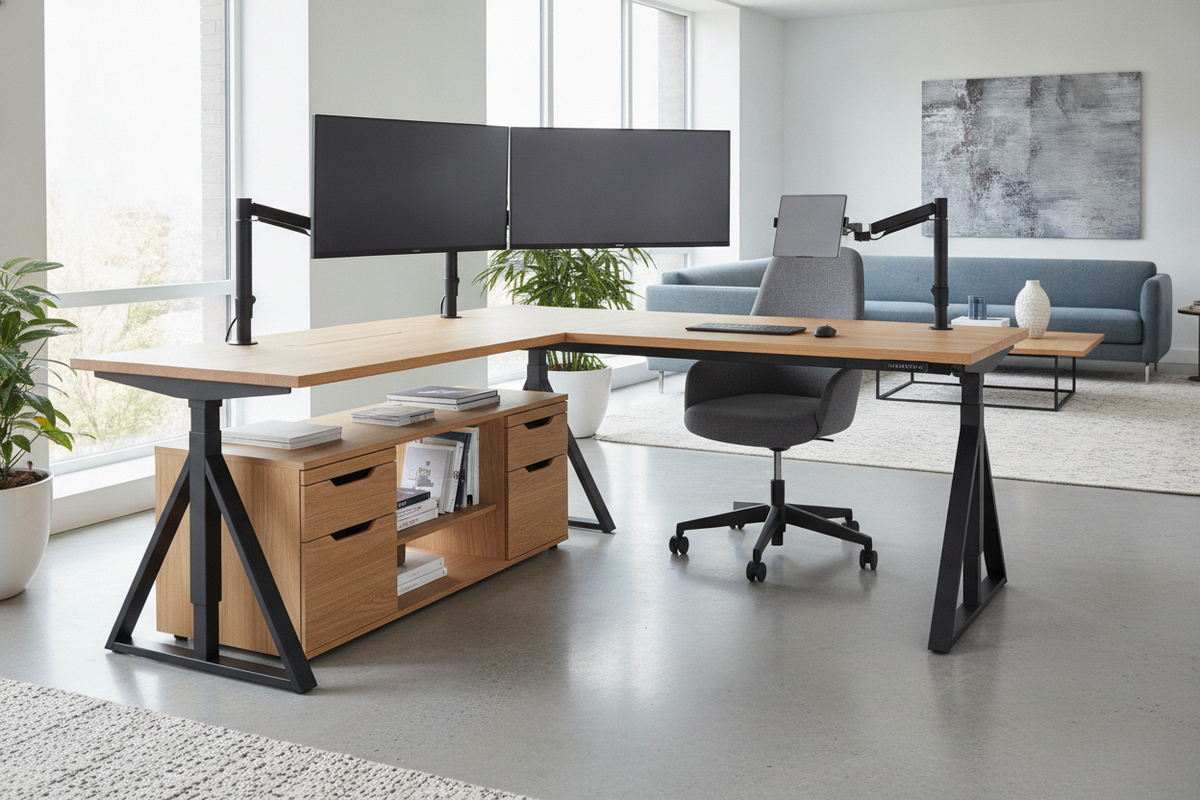
Designing an expansive executive workstation requires balancing spatial footprint, structural stability, and daily ergonomic versatility. Corner standing workstations such as the fully jarvis l-shaped desk represent a significant evolution in ergonomic planning, transitioning the standard sit-to-stand dynamic into a dual-surface command center. Unlike traditional single-span desks, a corner workstation introduces perpendicular planes, complex weight distributions, and expansive movement envelopes that require deliberate spatial orchestration.
Architectural Geometry and Spatial Footprints for L-Shaped Standing Desks
Integrating a jarvis l-shaped standing desk into an executive suite or open-plan home office demands a clear understanding of task zones and clearance boundaries. An L-shaped footprint fundamentally divides your desktop into a primary working span and a secondary perpendicular return wing. The primary span typically accommodates primary task input and centered visual displays, while the return wing provides dedicated real estate for analog note-taking, peripheral hardware, or collaborative discussions.
When orienting an L-configured workstation within a room, layout planners generally choose between two primary configurations:
- Corner Wall Alignment: Placing both exterior spans against intersecting walls maximizes open floor area in smaller offices and neatly conceals dynamic vertical cable channels.
- Peninsula Projection: Directing the primary surface against a wall while extending the return wing outward into the room establishes an executive room divider. This layout creates an open boundary between private work focus and general room circulation.
Achieving fluid room flow requires factoring in chair travel radius and sit-to-stand perimeter clearance. To explore broader zoning strategies for active workspaces, study practical standing desk layouts to visualize how surface geometry influences everyday movement. In tighter spaces where a full kinetic system is unnecessary, a dedicated static piece like a white L-shaped corner desk can provide a comparable corner footprint without motorized spatial clearance demands.
Three-Leg Structural Architecture and Kinetic Lift Dynamics
The core structural differentiator of the fully jarvis l shaped standing desk is its synchronized triple-column frame. While standard sit-to-stand tables rely on two lifting columns, an expansive corner frame incorporates three synchronized motorized legs situated at each outer terminal and the central geometric apex. This structural architecture supports wide desktop spans and minimizes the cantilever deflection inherent in extended corner returns.
During kinetic height transitions, the central lifting column bears a significant portion of the structural pivot load. Proper frame calibration ensures that all three columns lift at identical rates, preventing rotational torque or lateral stress across the desktop mounting plates. To maintain long-term stability and smooth kinetic movement, consider these structural factors:
- Center of Gravity Management: Concentrating heavy hardware near the apex column stabilizes the frame throughout vertical adjustments.
- Independent Floor Leveling: Fine-tuning the adjustable glides beneath all three footplates eliminates base wobble caused by uneven floorboards or carpet transitions.
- Joint Rigidity: Ensuring robust cross-support fastening between the primary desktop and the return surface prevents micro-shifting at the surface seam.
Monitor Arm Geometry and Dual-Zone Surface Ergonomics
Mounting multiple monitors or heavy ultrawide displays on a fully l desk introduces dynamic rotational forces that must be balanced alongside the table's kinetic lift. Because an L-shaped surface provides both a direct frontal view and an angled return sightline, screen positioning dictates overall posture and neck rotation.
For optimal ergonomic harmony, consider mounting monitor arms using reinforced clamp or grommet fixtures:
- Apex Mounting: Clamping an articulating monitor arm near the interior junction allows an ultrawide screen to float centrally, creating an immersive panoramic focal point across both wings.
- Primary Span Alignment: Mounting dual displays straight along the wider desk wing establishes a conventional digital cockpit, leaving the perpendicular return entirely free for documents, drawing tablets, or auxiliary laptops.
Creating an aesthetic standing desk setup relies heavily on balancing hardware weight evenly across the surface rather than overloading a single outer edge. This prevents uneven structural strain on the lifting columns during daily height adjustments.
Dynamic Cable Management and Kinetic Envelope Planning
Managing power, video, and peripheral cabling across a multi-segment fully l-shaped desk requires an articulated routing plan. Because the entire workstation moves vertically, wire pathways must accommodate dynamic height ranges without pinching, tangling, or pulling connections loose.
An effective dynamic cable routing strategy includes:
- Under-Desk Perpendicular Raceway Trays: Mounting horizontal cable trays beneath both the main surface and the return segment channels cords cleanly to a centralized junction point.
- Apex Power Distribution: Securing a surge protector beneath the inner junction minimizes wire length requirements for hardware on both wings.
- Vertical Kinetic Cable Spine: Utilizing an articulated vertical cable spine or flexible braided sleeve from the apex column to the floor outlet maintains slack and eliminates snagging hazards throughout the full range of movement.
Auxiliary Storage Integration and Companion Cabinetry Pairing
While an expansive jarvis l-shaped desk offers generous surface area, integrated storage must be planned carefully to avoid obstructing the motorized lift mechanism. Fixed cabinetry installed directly beneath the lifting perimeter can cause structural collisions during downward travel.
To supplement a corner standing workspace with practical storage, consider these pairing strategies:
- Low-Profile Mobile Pedestals: Mobile filing carts positioned beneath the return wing must maintain sufficient overhead clearance when the desk descends to its lowest sitting height.
- Freestanding Lateral Credenzas: Placing a dedicated credenza along an adjacent wall creates secondary document organization without encroaching on the desk's kinetic envelope.
- Built-In Static Alternatives: For setups where continuous motorized elevation is secondary to maximum integrated filing, a dedicated L-shaped desk with storage provides extensive built-in cabinetry in a unified structure.
- Hybrid Writing Zones: In spacious multi-purpose home offices, positioning an auxiliary writing desk adjacent to the standing workstation offers a quiet, static area for focused analog tasks and offline study.
Strategic Selection Framework: Customizing Your Corner Workstation Build
Selecting and configuring the optimal jarvis l desk build involves matching desktop materials, return handedness, and spatial volume to your daily operational patterns. Reversible frame assemblies allow you to configure the return on either the left or right side, ensuring seamless alignment with natural daylight sources, room entrances, and wall power points.
Before finalizing your layout, verify that your room includes adequate electrical outlet access, clear clearance paths for desk movement, and compatible surrounding modular storage. By harmonizing structural lift geometry, monitor ergonomics, and perimeter cabinetry, an L-shaped standing desk transforms your workspace into an organized, high-performance office ecosystem.

Laisser un commentaire
Ce site est protégé par hCaptcha, et la Politique de confidentialité et les Conditions de service de hCaptcha s’appliquent.