


1. Architectural Foundations of L-Shaped Standing Desks
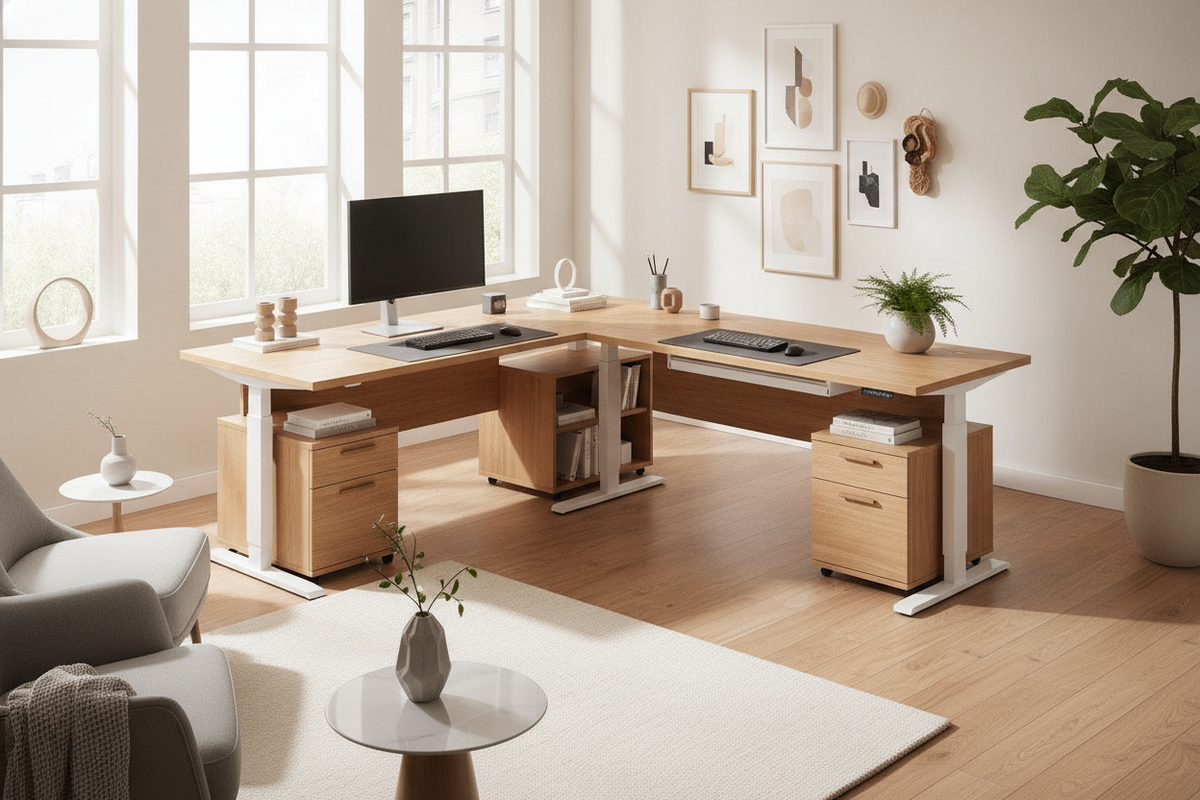
Modern hybrid workstations demand versatile surface territory, prompting many workspace planners to evaluate the flexispot l-shaped standing desk. Unlike conventional dual-column rectangular frames, an L-shaped motorized frame like the flexispot e7l relies on a triple-column architectural configuration. This layout supports two intersecting desktop planes—a main desk surface and an orthogonal return wing—distributing mechanical lift across three synchronized lifting columns.
By spreading vertical travel across three dedicated drive points, a flexispot l-shaped desk maintains structural rigidity through transitions between seated and standing heights. The corner junction requires coordinated synchronization to prevent torque across the joint where the two tabletop sections meet. Evaluating this foundation helps ensure your primary equipment and secondary tasks remain level and stable throughout dynamic daily movement.
2. Corner Geometry and Wing Orientation Strategies
Positioning a flexispot l desk within a room requires careful attention to spatial geometry. Selecting between a left-hand or right-hand return is not merely an aesthetic choice; it governs perimeter circulation paths, ambient light angles, and reach zones. In a compact office, aligning the inner apex of a flexispot corner desk against the corner walls maximizes floor efficiency while maintaining clear sightlines toward room entryways.
When assessing spatial proportions alongside dedicated fixed alternatives, such as a traditional shaped corner desk product, consider how the motorized flexispot l shape interacts with window sills and baseboard heaters. Placing the longer primary wing along the wider wall segment provides ample depth for primary screen placement, while keeping the secondary return accessible for peripheral hardware or analog writing tasks without obstructing door swings.
3. Dual-Wing Workflow Zoning and Multi-Monitor Ergonomics
The primary advantage of the pro l-shaped standing desk e7l is the ability to establish distinct workflow zones across two continuous planes. A well-planned flexispot e7l review of personal workflow reveals that segregating digital focus from peripheral activities reduces visual clutter and cognitive fatigue. Consider configuring your desk space into two operational zones:
- Primary Focus Zone: Centered on the main wing, supporting multi-monitor display arms, centered keyboard trays, and primary task lighting.
- Secondary Utility Wing: Dedicated to secondary peripherals, audio interfaces, reference notebooks, or tablet docks. Those designing specialized creative spaces can consult our pro desk guide for complementary surface planning insights.
Maintaining ergonomic focal depth across an angled desk surface prevents excessive cervical rotation. By angling secondary displays inward along the return wing, you establish an ergonomic arc that matches natural head and eye tracking.
4. Kinetic Clearances and Dynamic Cable Management Envelopes
Operating a flexispot corner standing desk or a dual-leg configuration such as the flexispot e2l introduces kinetic movement into your room plan. Because the entire desktop surface shifts vertically, you must maintain clear kinetic envelopes between the desktop edges and adjoining walls, trim, or electrical outlets.
Dynamic cable management across an L-shaped frame requires structured wire routing. Because cords must travel along both perpendicular horizontal beams before descending to wall outlets, tension must be managed at several key points:
- Center Apex Articulation: Allow sufficient cable slack near the central motor housing to accommodate vertical travel without snagging desktop brackets.
- Perimeter Wall Offsets: Maintain a small boundary gap between the desktop edge and walls to prevent scuffing during elevation adjustments, especially when compared with integrated storage desks like a standard shaped corner desk product.
- Undermount Cable Trays: Route display, data, and power lines through dual under-desk channels to keep the leg area clear for unrestricted knee movement.
5. Storage Synergy: Integrating Credenzas, Lateral Files, and Corner Units
Because sit-stand desks feature open undercarriages without integrated drawers, pairing an entry model like the flexispot e1l or higher-tier corner frame with surrounding storage furniture is essential. To maintain fluid height adjustments, avoid anchoring storage pieces directly to motorized components.
Instead, integrate freestanding perimeter furniture that complements your desk without creating collision hazards. For broader spatial inspiration on managing enclosed storage in compact footprints, review our corner review guide. You can also flank your motorized station with modular complementary pieces like a standalone shaped corner desk product or low-profile rolling pedestals that slide neatly underneath when the desk is set to standard seated height.
6. Assembly Sequencing, Leveling Protocols, and Long-Term Maintenance
Assembling a triple-column corner standing desk requires systematic sequencing to achieve a level surface across both desktop wings. Begin by assembling the main structural frame upside down on a soft, protective surface. Fasten the central corner bracket before securing the extension crossbeams to prevent frame misalignment.
Once inverted into its operational position, adjust the individual leveling glides on each of the three floor feet before calibrating the electronic motor control box. Periodically inspect structural joint fasteners along the crossbeams and tabletop mounting plates, ensuring that natural daily use and height adjustments do not loosen mechanical connections over time.


Laisser un commentaire
Ce site est protégé par hCaptcha, et la Politique de confidentialité et les Conditions de service de hCaptcha s’appliquent.