
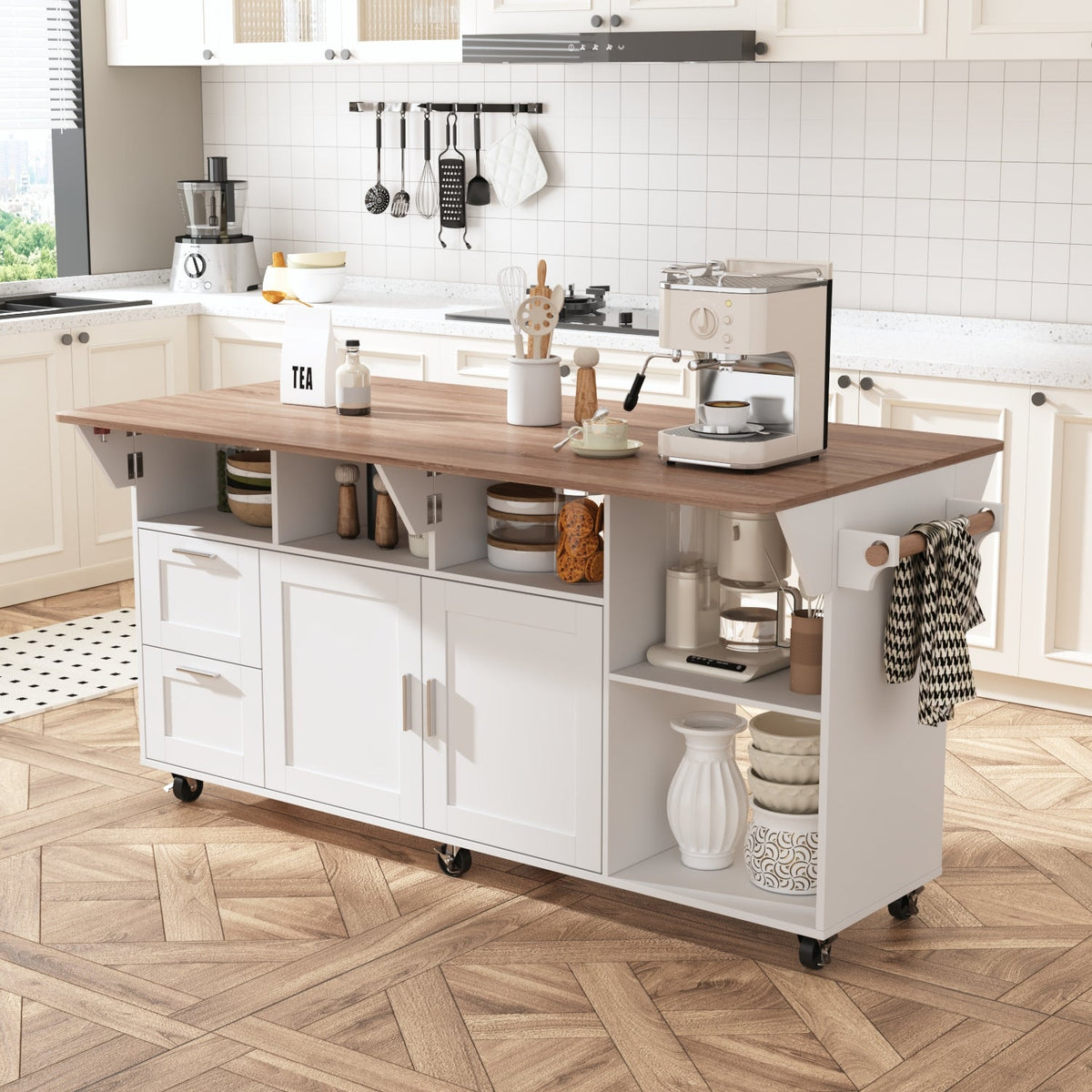
A kitchen island with a drop leaf gives you a seating or prep surface when you need it and folds it away when you don't, so a small kitchen gets its aisle back between meals. Before you buy one, check four things: the open and closed depth, the knee space under the raised leaf, how the leaf is held up, and whether the wheels lock if the island rolls.
This guide covers leaf types, floor space with the leaf up and down, and stools under a leaf. It ends with three islands from the FUFU&GAGA kitchen islands collection: two with a leaf and one fixed island with a seating side.
Key takeaways
- Measure both footprints. Plan everyday cooking around the closed depth and mealtimes around the open depth.
- Knee space sets the seating. The NKBA recommends a knee space 24 inches wide per diner, 15 inches deep at a 36-inch counter and 18 inches deep at a 30-inch table.
- Aisles still apply with the leaf up. The NKBA recommends a 42-inch work aisle for one cook and 36 to 44 inches behind a seated diner when people pass.
- Check the support and the casters. A leaf is only as steady as what is under it, and a rolling island needs casters that lock.
What is a kitchen island with a drop leaf?
A drop leaf is a hinged section of the top that hangs down against the side of the island and lifts up to make the surface deeper or longer. Wikipedia's entry on the drop-leaf table describes the same idea on tables: a fixed center with a hinged leaf, held up by a bracket when raised. When legs swing out from the center to hold the leaf instead, the piece is called a gateleg table.
On an island, the leaf usually sits on the back or one end, away from the drawers and doors. Down, the island is a slim prep counter or cart. Up, the extra depth becomes a breakfast bar for two, a buffet ledge or more room to roll out dough.
| Type | How it works | Watch for |
|---|---|---|
| Drop leaf with brackets | A hinged leaf rests on fold-out or swing-out brackets | Brackets can sit where knees go |
| Drop leaf with a swing leg | A leg swings out to hold the leaf from the floor | The leg takes floor space and can catch feet |
| Extendable or flip top | The top slides or unfolds to add depth | Read how it opens and what holds it up |
| Fixed overhang | Part of the top always projects past the base | Takes the full depth all the time |
Listings don't always use these words the same way. One of our picks is titled "extendable tabletop" while its spec lists a drop leaf, so read the description and photos, not only the title.
Open and closed sizes: why both numbers matter
The closed depth decides whether the island fits your kitchen every day; the open depth decides whether you can still walk around it at mealtimes. When a listing gives only one depth, check the photos to see whether it was measured with the leaf raised, and ask if it isn't clear.
Height matters too. The NKBA seating guideline uses three reference heights: 30-inch tables, 36-inch counters and 42-inch counters. A leaf at about 36 inches takes counter stools, a leaf near 30 inches suits dining chairs, and anything in between means checking your seats against it.
How much aisle space do you need with the leaf up?
The NKBA Kitchen Planning Guidelines recommend a work aisle of at least 42 inches for one cook (48 for more than one) and a walkway of at least 36 inches. Behind a seated diner, they recommend 32 inches from the counter edge to a wall if nobody passes, 36 inches to edge past and 44 inches to walk past.
The table applies those numbers to the islands in this post, placed between a counter run (the cooking side) and a wall, with stools on the leaf side when the leaf is up. Each row adds a 42-inch work aisle, the island depth and the clearance on the far side.
| Island and position | Arithmetic | Room width needed |
|---|---|---|
| 63-inch rolling island, leaf down, walkway behind | 42 + 15.7 + 36 | 93.7 in (about 7.8 ft) |
| 63-inch rolling island, leaf up, stools, people walk past | 42 + 31.7 + 44 | 117.7 in (about 9.8 ft) |
| 63-inch rolling island, leaf up, stools, no traffic behind | 42 + 31.7 + 32 | 105.7 in (about 8.8 ft) |
| 59.1-inch island, leaf down, walkway behind | 42 + 15.8 + 36 | 93.8 in (about 7.8 ft) |
| 59.1-inch island, leaf up, stools, people walk past | 42 + 31.5 + 44 | 117.5 in (about 9.8 ft) |
| 61-inch fixed island, stools, people walk past | 42 + 29.5 + 44 | 115.5 in (about 9.6 ft) |
The gap between the leaf-down and leaf-up rows is the point of a drop leaf: about two feet of floor you get back between meals. If your kitchen falls between those widths, a drop leaf gives you seating without blocking the room all day. The 59.1-inch island's closed depth of about 15.8 inches is our arithmetic (its listed 31.5-inch depth minus its 15.7-inch leaf; the photos show the leaf raised). For standard heights and lengths, see our kitchen island dimensions guide.

Can you sit at a drop leaf island?
Yes, if the leaf reaches far enough past the base to clear your knees. The NKBA seating guideline asks for a knee space 24 inches wide for each diner, 18 inches deep at a 30-inch table, 15 inches at a 36-inch counter and 12 inches at a 42-inch counter.
On a drop leaf island, the knee space is the distance from the edge of the raised leaf back to the base, minus anything in the way, such as brackets, a swing leg or a door on that side. A leaf only a few inches deep is a serving ledge, not a place for meals.
For width, divide the leaf length by 24: a 63-inch leaf gives 2.6 and a 59.1-inch leaf gives 2.5, so two stools each. If a leaf sits between table and counter height, use the 18-inch table figure as the safer target and check that your stools leave room for thighs under the leaf.
How is the leaf supported?
A raised leaf hangs off its hinge and rests on whatever is under it. On islands that is usually fold-out or swing-out brackets fixed to the base, which hide when folded but can sit where knees go, or a swing leg that reaches the floor and carries more load at the cost of a leg in the seating area.
When you compare islands, look for a description or photo of the support and how far it reaches under the leaf. None of the listings in this post gives a separate load rating for the leaf; the capacities they list are for the island. Treat a leaf as a place for plates, elbows and a laptop, and keep a stand mixer or other heavy equipment on the fixed part of the top. Check the hinge side too: a leaf that hangs over doors or shelves when down may need raising before you can reach them.
Rolling or fixed: locking casters matter
A rolling island can sit against a wall with its leaf down and move into the room when you cook or host; a fixed island is steadier because it sits on its base. Our kitchen island vs kitchen cart guide compares the two, so this section covers only the brakes.
CasterHQ's guide to caster brake types explains that a tread brake locks only the wheel, so the caster can still swivel, while a total lock (wheel-and-swivel) brake locks both. For an island you lean on, prep on or sit at, look for at least two locking casters and lock them every time it stops. If a listing doesn't say whether the casters lock, ask before you buy.
Keeping a freestanding island steady
People leaning on a raised leaf put weight on one side, which is when a light island is most likely to shift. Store heavy pots low, level the base, and keep the leaf down when nobody is using it. Our guide on how to secure a freestanding kitchen island covers anti-slip pads and brackets. All three islands below are flat-packed and need assembly; our flat-pack assembly guide can help.
Is a drop leaf island right for a small kitchen?
Often, yes. A small kitchen rarely has room for a full-depth island plus its aisles, so an island that is slim most of the day fits more easily.
- Put the leaf on the side facing the dining or living area, not where you open the oven or dishwasher.
- Choose stools that tuck fully under the leaf, so they leave the aisle clear.
- If the island rolls, park it against a wall with the leaf down and roll it out for meals.
Our small kitchen island ideas post covers more compact layouts and alternatives when no island fits.
Kitchen island with drop leaf buying checklist
- Get the closed and open depth, and confirm which one the listed overall depth means.
- Leaf down: add a 42-inch work aisle and a 36-inch walkway to the closed depth.
- Leaf up: add 32 to 44 inches behind the stools, depending on traffic.
- Check the knee space under the leaf: about 15 inches at a 36-inch counter, 18 at a 30-inch table.
- Count one seat per 24 inches of leaf length.
- Find out how the leaf is supported and whether the casters lock.
- Compare the listed weight capacity with what you keep on top and inside.
Our picks: drop leaf and seating islands
Two islands from our range have a leaf, and one fixed island has a seating side. Sizes and features are as each FUFU&GAGA listing states them.
63" Rolling Kitchen Island Cart with Drop Leaf and Storage Cabinet
The rolling option. The listing gives 31.7" H x 63" W x 31.7" D with the leaf up and a top 15.7" deep with the leaf down, so it parks as a slim cart and opens for meals or prep. It rolls on six universal casters, which the spec says are not removable. Storage is two drawers, a double-door cabinet, five open shelves rated 22 lb each and stemware storage, with louvered side panels for ventilation. The brown woodgrain laminate top is listed as water- and scratch-resistant, on a white MDF base with silver hardware. Weight capacity is 300 lb; the island weighs 127 lb.
The photos show fold-out brackets under the raised leaf and what look like brake tabs on some casters, but the listing text describes neither, so ask how the leaf is supported and whether the casters lock. The spec table also gives a leaf measurement that doesn't match the open and closed depths in the description; confirm the leaf depth if you plan stools around it.
Best for: a small kitchen that wants a slim cart most of the day and a deeper top for breakfast, serving or baking, with plenty of mixed storage.
Skip it if: you want a standard counter-height prep surface (it is listed at 31.7 inches tall, below a typical counter), confirmed locking casters, or a confirmed leaf depth for daily seating.
59.1" Kitchen Island with Extendable Tabletop, Storage Cabinet and Adjustable Shelves
The counter-height option. The title says extendable tabletop and the spec lists a drop leaf: a 59.1" W x 15.7" D leaf that lifts for prep or casual meals and folds down to save floor space. The listing gives 36.2" H x 59.1" W x 31.5" D overall. Storage is an open section, a drawer with an interior of 7.9" H x 22.7" W x 12.4" D, and a two-door cabinet with three adjustable shelves. The natural wood-tone top sits on a white base and is listed as UV- and chip-resistant. Weight capacity is 150 lb; the island weighs 120 lb, and two people are recommended for assembly.
At 36.2 inches the leaf is at counter height, so counter stools suit it, and its 15.7-inch depth slightly exceeds the NKBA knee space for that height. The listing lists no wheels and doesn't describe how the leaf is supported.
Best for: a breakfast bar for two in a small kitchen, at standard counter height, on a base that stays put.
Skip it if: you want to roll the island, need more than 150 lb of capacity, or want the closed depth confirmed in writing (the listing gives only the overall depth).

61" Modern Black Kitchen Island With 2 Swing Doors and 4 Pull-out Drawers
The fixed alternative, for kitchens with room for the full depth every day. The listing gives 37.4" H x 61" W x 29.5" D and a 2-inch-thick, 61" x 29.5" manufactured wood top. The front has drawers and two cabinets with adjustable shelves rated 33 lb each; the back is left open so chairs or stools tuck under. A power outlet and USB ports sit on the side, and the hand-painted finish is listed as water- and scratch-resistant. Weight capacity is 300 lb, the island weighs 220 lb, and it comes in black or white.
Best for: everyday seating with nothing to raise, plus closed storage and a place to charge a phone.
Skip it if: your room can't spare the full depth all day, or you need the knee-space depth under the open back, which the listing doesn't give.
Compare the picks
| Island | Size as listed | Leaf or seating | Wheels | Capacity |
|---|---|---|---|---|
| 63" rolling island | 31.7 H x 63 W x 31.7 D in (leaf up); top 15.7 in deep with leaf down | Drop leaf; support not described | 6 casters; locking not stated | 300 lb |
| 59.1" island with leaf | 36.2 H x 59.1 W x 31.5 D in; leaf 59.1 x 15.7 in | Drop leaf at counter height; support not described | None listed | 150 lb |
| 61" fixed island | 37.4 H x 61 W x 29.5 D in | Open back for seats; knee depth not given | None | 300 lb |
FAQ
How deep should a drop leaf be for seating?
Deep enough for the knee space the NKBA recommends: about 15 inches at a 36-inch counter and 18 inches at a 30-inch table, measured from the leaf edge back to the base or to anything in the way. A leaf of only a few inches works as a serving ledge, not a place to eat.
What is the difference between a drop leaf and an extendable kitchen island?
A drop leaf is hinged: it hangs down against the side and lifts onto brackets or a leg. An extendable top slides or unfolds to add depth. Sellers use the terms loosely, so read how the top opens and what holds it up rather than relying on the title.
Does a rolling kitchen island need locking wheels?
If you prep, lean or sit at it, yes. Lock at least two casters whenever it is in use. A total-lock brake stops both the wheel and the swivel, while a tread brake stops only the wheel. Confirm the brake type in the listing or ask before buying.
How much space do you need around a drop leaf island?
With the leaf down, plan a 42-inch work aisle on the cooking side and at least 36 inches on the walkway side. With the leaf up and stools in use, allow 32 inches behind the seats if nobody passes, 36 to edge past and 44 to walk past.
Compare sizes, leaves and storage across the full kitchen islands collection to find the island that fits your kitchen with the leaf up and down.


Laisser un commentaire
Ce site est protégé par hCaptcha, et la Politique de confidentialité et les Conditions de service de hCaptcha s’appliquent.