



The 60-Inch Executive Desk Archetype: The Balance of Authority and Spatial Economy
In executive workplace design, desk scale establishes the architectural tone of the entire room. Among classic formats, 60 executive desks occupy a strategic middle ground. A standard five-foot span delivers an authoritative presence without demanding the sprawling footprint of traditional boardroom-scale furniture. While larger corporate suites may incorporate a specialized commercial unit such as a modern executive reception counter, a dedicated private workspace benefits from the proportional refinement of a 60-inch executive desk.
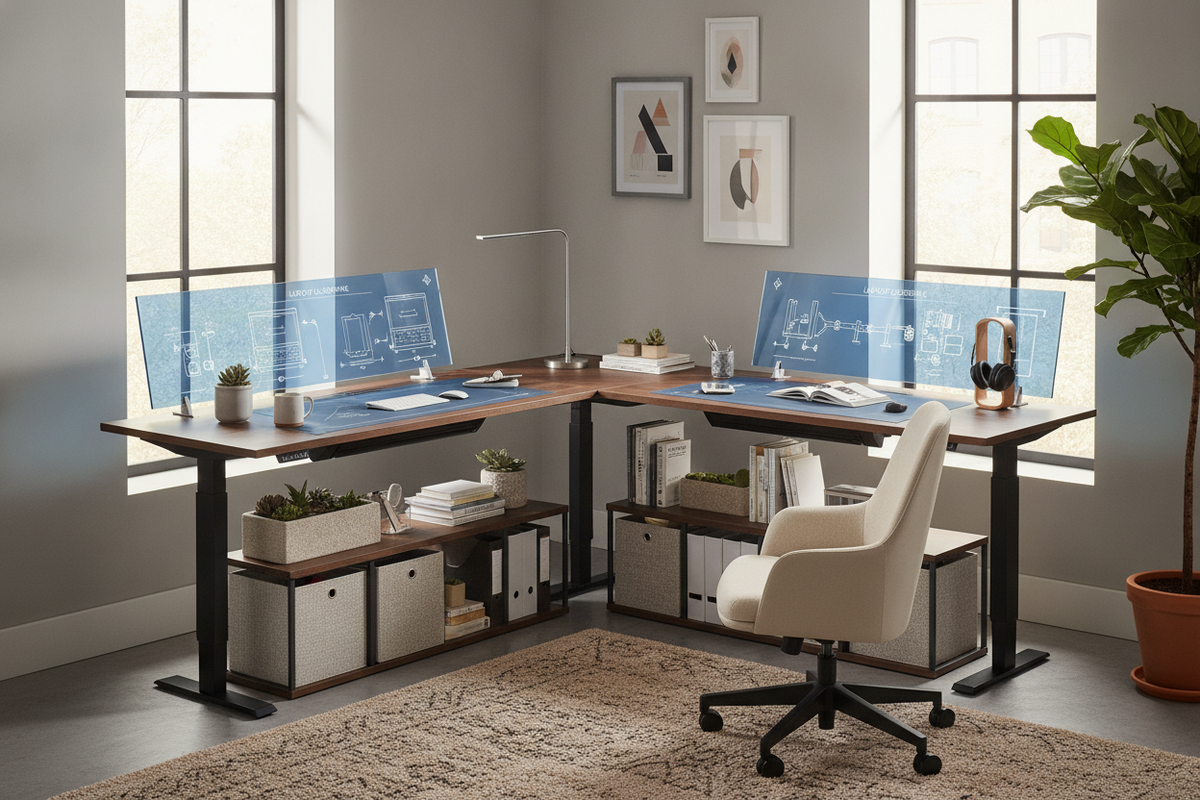
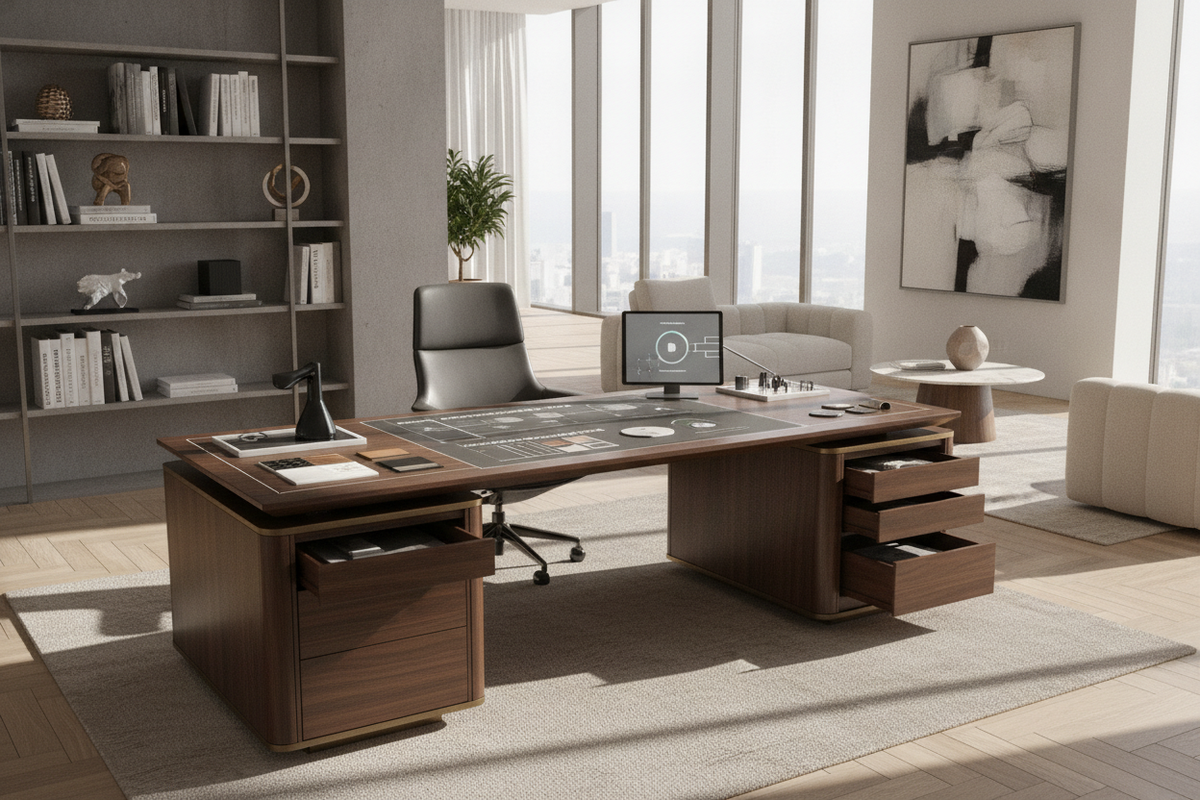
Traditional executive desks often project visual weight through substantial pedestals, deep modesty panels, and thick-edged desktop crowns. The 60-inch footprint provides sufficient lateral breadth for dual pedestal banks while maintaining an open knee well. For professionals evaluating layout trade-offs between linear silhouettes and angled workstations, comparing a classic rectangular desk with a 55-inch L-shaped corner desk with storage demonstrates how a linear five-foot profile preserves continuous sightlines across executive suites.
Workstation Geometry: Surface Depth, Reach Zones, and Multi-Display Layouts
Surface architecture on an executive desk 60 inch platform accommodates layered digital and analog tasks. Ergonomic planning categorizes desktop space into primary, secondary, and peripheral reach envelopes:
- Primary Reach Zone: The central span directly in front of the seated professional accommodates the primary keyboard, mouse, and active document signing area.
- Secondary Reach Zone: Flanking areas within forearm reach house task lighting, writing utensils, active project binders, and reference materials.
- Peripheral Horizon: The rear edge provides stable placement for dual-monitor arms, ultrawide curved displays, or elevated laptop docking stations.
A 60" executive desk typically pairs its width with substantial depth, creating comfortable focal distances for large displays. This depth separates technical peripherals from visitor-facing sightlines, ensuring the front facade presents a clean, professional aesthetic during face-to-face meetings.
Spatial Clearance Framework: Room Placement, Sightlines, and Flow
Successful office design requires balancing furniture volume with perimeter movement corridors. While fitting compact 36-inch desk layouts requires tight boundary planning in micro-studios, integrating a 60-inch executive desk calls for generous clearance zones to maintain effortless movement.
Command Positioning and Wall Distances
Command positioning places the desk facing inward toward the entrance while backing up to a solid wall or integrated credenza. To ensure ergonomic comfort and unrestricted task chair mobility, allow adequate clearance between the rear edge of the desktop and any rear obstruction. This clearance ensures fluid chair rotation, seamless standing transitions, and unobstructed access to rear credenza storage.
Visitor Clearances and Approach Pathways
When positioning guest seating directly across the front modesty panel, maintain an open corridor between the desk facade and the visitor chairs. Ensuring secondary circulation paths along the sides of the desk preserves visual symmetry and prevents the office layout from feeling congested.
Storage Archetypes: Double Pedestals, File Drawers, and Cable Integration
Storage architecture distinguishes a true executive workstation from an open writing table. Within 60 executive desks, functional internal storage typically adopts one of three common archetypes:
- Symmetrical Double Pedestals: Balanced storage towers on either side of the central knee well, often combining utility supply drawers above with deep lateral file drawers below.
- Asymmetrical Storage with Open Credenza Niches: A configuration pairing an enclosed file pedestal on one side with an open CPU bay or tech tower on the other.
- Integrated Wire and Utility Routing: Modesty panels equipped with concealed raceways, wire grommets, and power hub access for streamlined technology management.
For detailed planning on managing dedicated hardware and integrated cable management within executive furniture, our executive desk with computer storage buying guide provides comprehensive structural comparisons.
Material Craft, Structural Rigidity, and Aesthetic Coordination
The visual impact and longevity of a 60-inch executive desk depend on core construction techniques and exterior surfacing materials. Modern executive desks typically leverage durable engineered wood cores, high-pressure laminates, rich wood veneers, and reinforced steel sub-frames.
When curating a unified executive suite, harmonize the desk finish with surrounding architectural elements. In expansive executive suites where the desk serves as the central focal point, coordinating its finish alongside large-scale pieces like a 90.6-inch wide computer desk with glass cabinets creates cohesive visual hierarchy across the room.
Assembly Logistics, Staging Strategies, and Executive Office Harmony
Due to solid modesty panels, dual pedestal cases, and thick tops, executive desks require systematic assembly and placement workflows:
- Workspace Staging: Clear a perimeter wide enough to lay out side panels, pedestals, and the desktop face-down on a protective rug or foam blanket.
- Sub-Assembly of Pedestal Cores: Assemble each pedestal tower individually, securing drawer glides and lock mechanisms prior to attaching the central structural spine.
- Modesty Panel and Top Alignment: Fasten the modesty panel between the two pedestal towers before lowering the main desktop into place, ensuring all cam locks and dowels seat fully.
- Leveler Calibration: Adjust the base levelers beneath each corner to compensate for uneven flooring, preventing drawer misalignment and surface deflection.
By harmonizing surface geometry, dedicated pedestal storage, and spatial planning, a 60 executive desk delivers an optimal balance of commanding aesthetics and everyday utility for modern professional environments.

Laisser un commentaire
Ce site est protégé par hCaptcha, et la Politique de confidentialité et les Conditions de service de hCaptcha s’appliquent.