


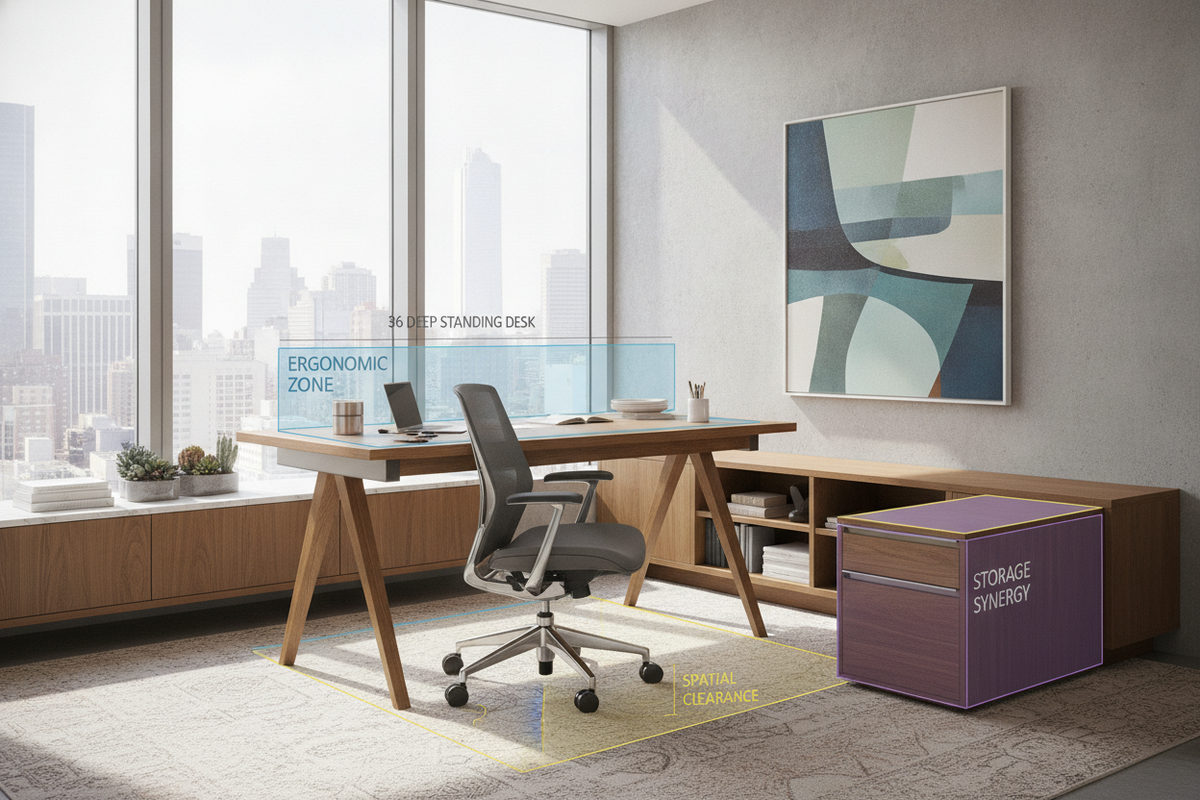
Standard commercial office furniture often centers around standardized depths, leaving creative professionals, technical power users, and multi-monitor operators constrained by limited surface area. Opting for a 36 deep standing desk provides the substantial footprint required to support expansive digital equipment alongside physical, tactile workflows. However, scaling up desk depth introduces distinct mechanical, architectural, and ergonomic considerations that require deliberate planning before installation.
The Demand for Extra-Deep Workstations: Why Standard Desks Fall Short
Modern professional workflows have evolved beyond single laptop displays and compact accessories. An extra-deep surface accommodates oversized hardware configurations without sacrificing essential working space.
Accommodating Multi-Display Arrays and Large Monitors
Ultrawide curved screens and multi-display setups require adequate viewing distance to prevent visual crowding. When large screens are placed on standard shallow desks, the display stands often sit directly in the user's active keyboard zone, forcing awkward typing postures. A 36-inch depth profile allows screens to sit far enough back to maintain comfortable sightlines while leaving unobstructed space for desktop peripherals, audio gear, and input tablets.
Creative Envelopes: Drafting, Hardware Racks, and Analog Workspaces
Hybrid creative roles frequently demand both digital input tools and physical media. Graphic designers, architects, and studio producers benefit from deep desktop surfaces that accommodate synthesizers, drawing tablets, paper schematics, or reference materials behind primary input devices. Rather than merely expanding linear width, increasing depth creates layered zones that keep tools within eyesight without cluttering the primary typing area.
Structural Mechanics of Deep Sit-Stand Frames
Selecting an oversized top requires careful attention to the underlying motorized frame. Standard height-adjustable bases are often engineered for narrower tops, making proper frame matching essential for balanced operation.
Cantilever Force and Foot-to-Top Dimensional Matching
When a desktop extends significantly beyond its underlying support brackets, cantilever force increases. If heavy equipment sits toward the back or front edge of an oversized top paired with shallow frame feet, the desk can experience noticeable front-to-back sway or mechanical strain during height adjustment. Pairing deep worksurfaces with extended top support rails and elongated floor feet ensures the center of mass remains stable throughout the entire lift path.
Two-Leg vs. Four-Leg Lift Configurations for Deep Surfaces
While high-grade dual-column frames with elongated feet can effectively manage deep tops, four-leg lift systems offer enhanced rigidity across extra-deep profiles. A sturdy multi-motor frame provides balanced lifting power, mitigating flex and ensuring smooth transitions whether loaded with heavy reference materials or multiple screen arms. When exploring wide, expansive configurations like a super-sized standing desk, choosing heavy-duty frame mechanics helps maintain long-term stability.
Spatial Clearance and Room Circulation Planning
Integrating a deep workstation requires careful mapping of room circulation and architectural clearances to ensure the piece enhances the space without obstructing movement.
Aisle Clearance and Seating Recess Envelopes
Because an extra-deep desk extends further into the room, planning adequate clearance behind the seating position is critical. An ergonomic task chair requires ample push-back room for seamless transitions between sitting and standing modes. Position the desk so that primary room pathways, doorways, and nearby storage units remain completely unhindered when the chair is pushed out or when the user is actively standing.
Visual Weight and Layout Aesthetics in Modern Rooms
A 36-inch deep workstation carries substantial visual mass within home offices and open-plan studios. Placing deep furniture against feature walls or floating it deliberately within dedicated workspace zones keeps the room feeling balanced. Utilizing thoughtful design approaches from designer standing desk layouts helps integrate large-scale functional surfaces into residential decor without overwhelming ambient lighting or spatial proportions.
Ergonomic Reach Zones and Surface Organization
An expansive worksurface offers major organizational benefits, but it also demands disciplined surface layout to avoid repetitive overextension.
Primary, Secondary, and Reference Work Zones
To optimize an extra-deep workstation, divide the top into three functional tiers:
- Primary Zone: The immediate forearm radius reserved for keyboards, mice, and active writing tasks.
- Secondary Zone: The natural arm-reach area for frequently accessed items like notepads, reference documents, or headphones.
- Reference Zone: The rear portion of the 36-inch depth, ideal for monitor arms, desktop risers, audio monitors, and ambient task lighting.
Structuring your workspace in this manner supports an intuitive ergonomic standing desk setup that keeps essential tools accessible without excessive leaning.
Cable Articulation and Kinetic Wire Management
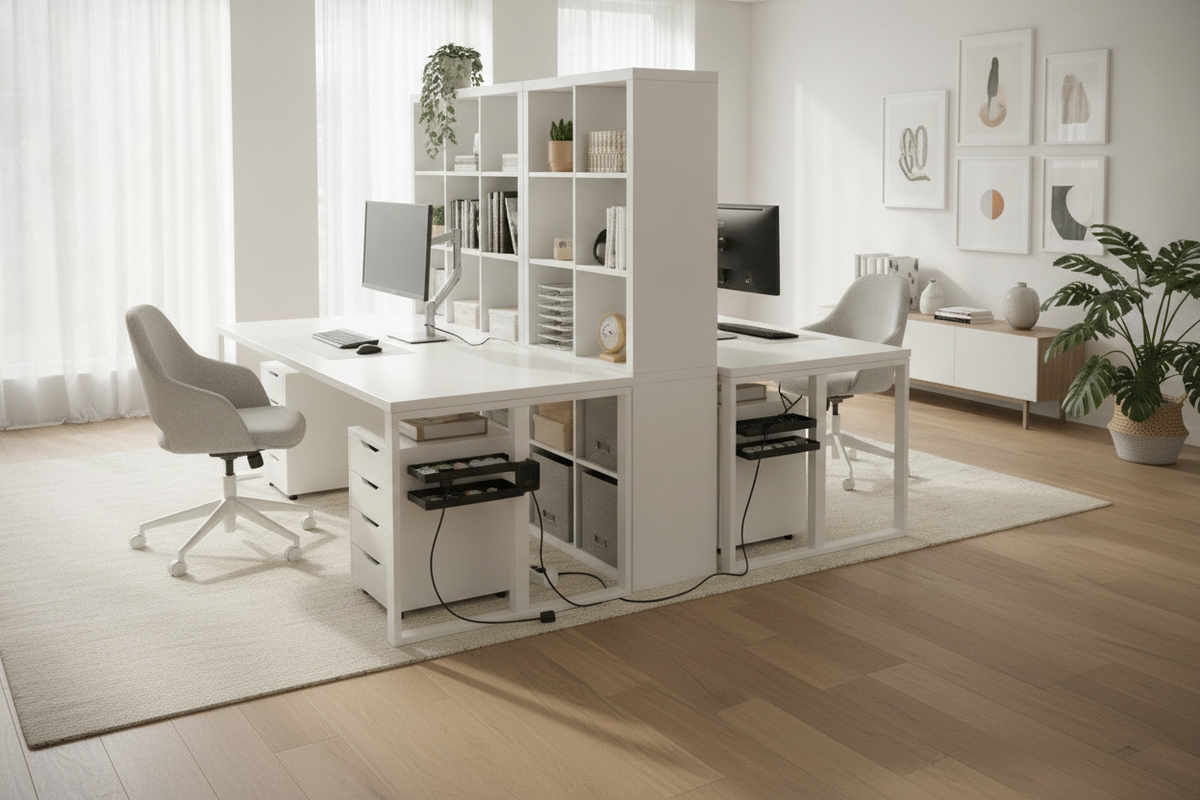
Deeper desk tops create longer cable runs between rear-mounted peripherals and floor-level power outlets. During sit-stand transitions, unmanaged cables can easily snag or stretch. Installing high-capacity under-desk cable trays and flexible articulation spines keeps power cords, video leads, and USB conduits organized securely across the full range of vertical motion.
Under-Desk Storage Synergy and Footroom Optimization
The extended cavity beneath a deep standing desk presents prime opportunities for modular storage integration without compromising seated comfort.
Mobile Pedestals and Low Credenza Integration
With 36 inches of depth, the space beneath the rear half of the desktop can host low-profile filing pedestals, modular organizers, or power distribution units while still leaving generous knee room up front. When pairing auxiliary cabinetry with an adjustable height standing desk with presets, verify that under-desk cabinets do not obstruct the lowest downward travel height of the motorized frame.
Long-Term Material Durability and Assembly Best Practices
Expansive worksurfaces experience structural load across a broader span. High-density composite boards, durable laminates, and solid hardwood slabs offer resilient resistance against long-term bowing. When mounting custom or oversized tops to a 71-inch height adjustable standing desk base, using threaded metal inserts or precisely pre-drilled pilot holes ensures solid anchoring that maintains structural integrity through years of daily adjustments.

Laisser un commentaire
Ce site est protégé par hCaptcha, et la Politique de confidentialité et les Conditions de service de hCaptcha s’appliquent.