



I spent three years hunched over a desk that was essentially a glorified shelf. My dual-monitor setup was so close to my face I could practically see the individual pixels, and every time I needed to sign a physical document, I had to move my keyboard onto my lap just to find a flat surface. It was a miserable, cramped existence that made me hate my home office.
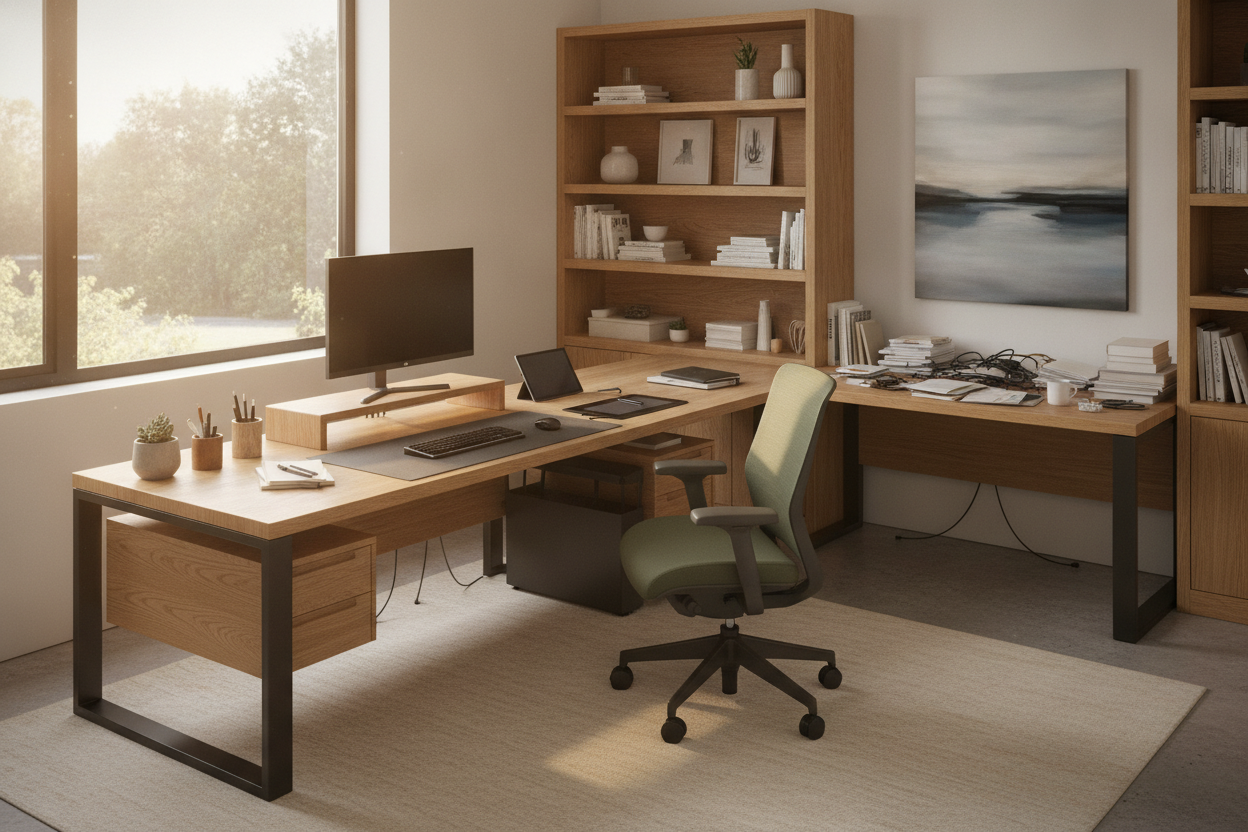
Everything changed when I stopped looking at 'office furniture' and started looking at tables. Swapping a narrow workstation for a big table desk was the single best decision I made for my productivity. It turns out, you don't need more drawers; you just need more square footage to breathe.
- Standard desks are often too shallow (24 inches) for modern, large monitors.
- A large table provides the depth needed to protect your eyesight and posture.
- Dining or conference tables offer a cleaner, more residential aesthetic than corporate furniture.
- Cable management is the biggest hurdle, but easily solved with under-mount trays.
The Problem With 'Ergonomic' Corporate Desks
Most desks sold as 'ergonomic' are actually designed for corporate real estate efficiency, not your actual comfort. They want to cram as many bodies as possible into a floor plan, so they stick to a 24-inch depth. In a world where we use 27-inch or 32-inch monitors, that depth is a recipe for eye strain and a cluttered mind.
When your screens are that close, you lose all your 'landing space.' There is no room for a notepad, a cup of coffee, or even a reference book without hitting your keyboard. These desks also tend to look like they were salvaged from a mid-level accounting firm in 1998. They scream 'work' in a way that kills the vibe of a carefully curated home.
What Actually Qualifies as a Big Table Desk?
A true large desktop table should be at least 60 inches wide, but the real secret is the depth. You are looking for 30 to 36 inches of clearance from front to back. This is why I always suggest looking at dining tables or small conference tables instead of searching for 'desks' specifically.
Repurposing a solid wood dining table gives you a massive, continuous surface. There are no weird grommet holes in the wrong places and no flimsy keyboard trays. You get a piece of furniture that feels substantial. I currently use a 72-inch oak table, and the ability to spread out three different projects at once without them overlapping has completely cured my paper clutter habit.
The Depth Factor: Saving Your Eyesight
Let's talk about the ergonomic math. If you are using a desk that is the same depth as a 24-inch console table, you are sitting way too close to your hardware. Your eyes have to work harder to focus, and you likely find yourself leaning back just to see the top corners of your screen.
Pushing those monitors back to the 30-inch mark changes everything. It opens up your peripheral vision and leaves a 'neutral zone' in front of your keyboard. That space is sacred. It’s where you can actually think, write, or just rest your arms without feeling like you're trapped against a wall of glass.
How to Style a Massive Work Surface Without It Looking Messy
The danger of a big table is that it becomes a magnet for 'stuff.' Because you have the room, you might be tempted to let the mail pile up. To avoid this, you have to treat it like a focal point. Much like how you would style a large entryway table, you need to use zones to keep things intentional.
I use a heavy leather desk mat to define my 'active' workspace and a brass tray to corral my pens and hard drives. This keeps the rest of the table clear. For cables, don't let them dangle. I screwed a simple wire basket to the underside of the table to hide my power strip and bricks. The result is a clean, architectural look that anchors the room rather than making it look like a tech graveyard.
When a Table Setup Might Actually Drive You Crazy
I’ll be the first to admit that the 'big table' life isn't for everyone. If you are a 'piler' who needs fifteen different drawers to hide your stationery and cables, a flat table will make you lose your mind within a week. There is zero built-in storage here.
If you're working out of a bedroom, a giant dining table might also feel too aggressive. In those cases, something like a vanity desk makeup table might be a better compromise. It offers the storage you need for small items while maintaining a residential look that doesn't feel like a cubicle has invaded your sleeping space.
Personal Experience: My 'Big Table' Mistake
When I first switched to a large table, I bought a cheap, hollow-core door and put legs on it. It was huge, but it vibrated every time I typed. It felt like working on a drum. I eventually upgraded to a solid 1.5-inch thick birch slab. The weight matters. If the table doesn't weigh at least 75 pounds, it's going to wobble when you get into a flow state. Buy once, cry once—get something solid.
FAQ
Do I need a special chair for a higher table?
Most dining tables are 29 to 30 inches high, which is standard desk height. Your current office chair should work perfectly, provided it has height adjustment to get your elbows at a 90-degree angle.
How do I hide cables on a table with no back?
Under-desk cable management trays are your best friend. Use adhesive cable clips to run the main power cord down the back of one of the legs so it’s nearly invisible from across the room.
Will a big table make my small room look smaller?
Counter-intuitively, a single large, clean piece of furniture often makes a room feel bigger than three small, cluttered pieces. It creates a clear visual anchor and reduces 'visual noise.'


Laisser un commentaire
Ce site est protégé par hCaptcha, et la Politique de confidentialité et les Conditions de service de hCaptcha s’appliquent.