


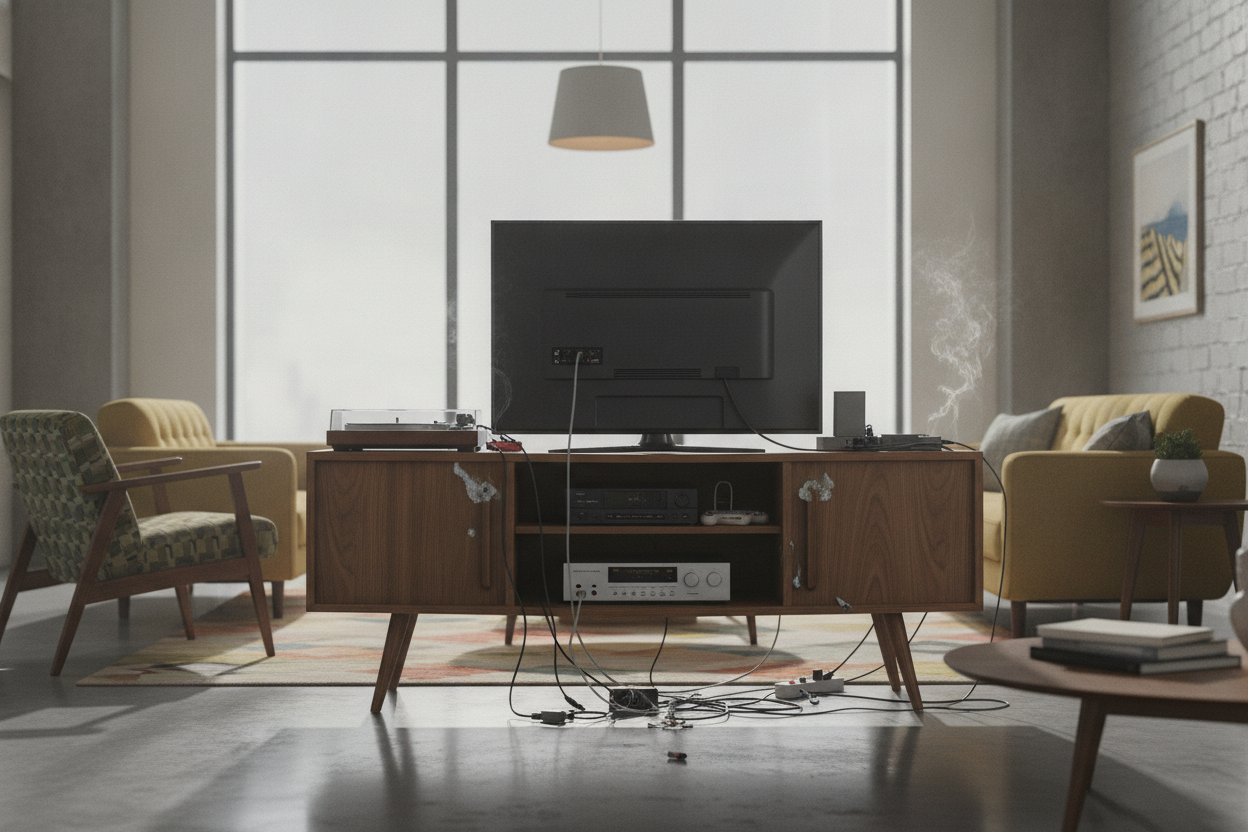
I remember the day I brought home a gorgeous, authentic 1960s teak sideboard from a local estate sale. It had those iconic tapered legs and a rich honey-gold patina that made my living room look like a set from Mad Men. I felt like I had won the furniture lottery until I tried to hook up my gear. My 65-inch television looked like a giant black monolith perched on a toothpick, and my PlayStation 5 sounded like a jet engine taking off within twenty minutes of playing a game.
The hard truth is that while we all love the look of a mid-century modern tv stand, most vintage pieces were never designed to house equipment that generates as much heat as a small space heater. We are trying to shove 2024 technology into 1955 storage solutions, and our expensive electronics are paying the price.
Quick Takeaways
- Vintage dressers lack the depth and airflow required for modern gaming consoles and receivers.
- Solid wood doors act as insulators, trapping heat and shortening the lifespan of your tech.
- Slatted door designs are the gold standard for balancing MCM aesthetics with ventilation.
- Always measure your largest component (usually the receiver or center speaker) before buying a console with fixed shelves.
- Pre-drilled cable management is a non-negotiable for a clean, cord-free look.
The Vintage Dresser Trap (And Why We All Fall for It)
We've all scrolled through those Pinterest boards where someone uses a mid century dresser as tv stand. It looks clever and soulful in a photo. In reality, it is a logistical nightmare. Most vintage dressers are about 30 to 34 inches high. Once you put a large screen on top, you are staring upward at an angle that will have you booking a chiropractor appointment by the end of the month.
Then there is the structural issue. A heavy 75-inch TV can put immense pressure on the center of a vintage piece not designed for top-heavy loads. I have seen beautiful mcm tv stand wood tops start to bow because they lacked a center support leg. Plus, unless you are handy with a hole saw, you will end up with a spaghetti-mess of wires spilling out the side because there is no path for cords to reach the outlet.
Why Solid Wood Doors Are a Literal Oven for Your Tech
If you are using a vintage mid century tv console or a reproduction with solid doors, you are essentially slow-cooking your router and gaming systems. Modern tech needs to breathe. When you tuck a high-end media server into a mid century modern tv cabinet with heavy wooden doors, the internal temperature can spike by 30 degrees in under an hour.
Wood is a fantastic insulator. That is great for a coffee table, but terrible for a media center mid century setup. I once lost a high-end mesh router because I kept it inside a solid-door mid century modern media cabinet. The plastic casing actually discolored from the constant heat. If you can smell 'hot electronics' when you open your cabinet doors, you are already in the danger zone.
The Slatted Door Compromise I Finally Made
After frying my second router, I realized I needed a wood mid century modern tv stand that actually understood physics. The solution is the slatted front. It provides that continuous horizontal line that makes mid-century furniture so appealing, but it functions like a vent. I eventually upgraded to a mid century modern tv stand with slatted doors, and the difference was immediate.
Not only did the fans on my console stop screaming, but my remote control signals actually passed through the gaps. No more standing up and pointing the remote at a specific angle just to pause a movie. Whether you are looking for a small mid century tv stand or a massive mid century modern tv stand 65 inch model, prioritize those slats. It is the only way to get the vintage vibe without the technical headaches.
Other Non-Negotiables for a Retro-Style Media Center
Before you drop a grand on a new mcm entertainment center, look at the back panel. If it is solid plywood with no holes, keep looking. You want a mid century modern entertainment center with pre-cut circular grommets. Trying to DIY these holes often leads to splintered veneer and a piece of furniture that looks like it was attacked by a beaver.
Also, check the shelf adjustability. Many mid century modern media cabinets have fixed internal shelves to maintain structural integrity. I once bought a beautiful 48 inch mid century modern tv stand only to realize my receiver was exactly a quarter-inch too tall for the opening. I ended up having to leave the receiver on the floor for months. If you want a setup that works, browse for functional TV stands that offer at least three height levels for internal shelving.
When to Ditch the Mid-Century Look Altogether
I love the MCM aesthetic, but I'll be the first to admit it isn't for everyone. If you have a massive home theater setup with a dedicated center-channel speaker and four different consoles, a dainty mid century media stand might look cluttered and overwhelmed. The thin legs and low profiles can sometimes look 'lost' against a massive 85-inch screen.
There came a point in my basement setup where I realized the retro look was fighting the room's purpose. I actually traded my mid century console for a post modern tv stand because I needed the extra depth and a more industrial build. Don't let a commitment to a specific era ruin your enjoyment of your home. If the tech is the priority, choose the furniture that supports it, not the furniture that suffocates it.
FAQ
Can I just leave the cabinet doors open while using my TV?
You can, but it defeats the purpose of having a beautiful mid century tv stand with storage. It also becomes a trip hazard and a dust magnet. Slatted doors are a much more permanent and attractive solution.
What is the ideal height for a mid-century TV console?
For most living rooms, you want the center of your TV at eye level when seated. This usually means a console height of 18 to 24 inches. Most mid century modern low tv stand options fall perfectly into this range.
Is solid wood better than MDF for a TV stand?
Solid wood like walnut or acorn is more durable and can be refinished, but high-quality MDF with a real wood veneer is often more stable in temperature-controlled homes. Avoid the cheap 'paper' veneers that peel at the corners after six months.


Laisser un commentaire
Ce site est protégé par hCaptcha, et la Politique de confidentialité et les Conditions de service de hCaptcha s’appliquent.