


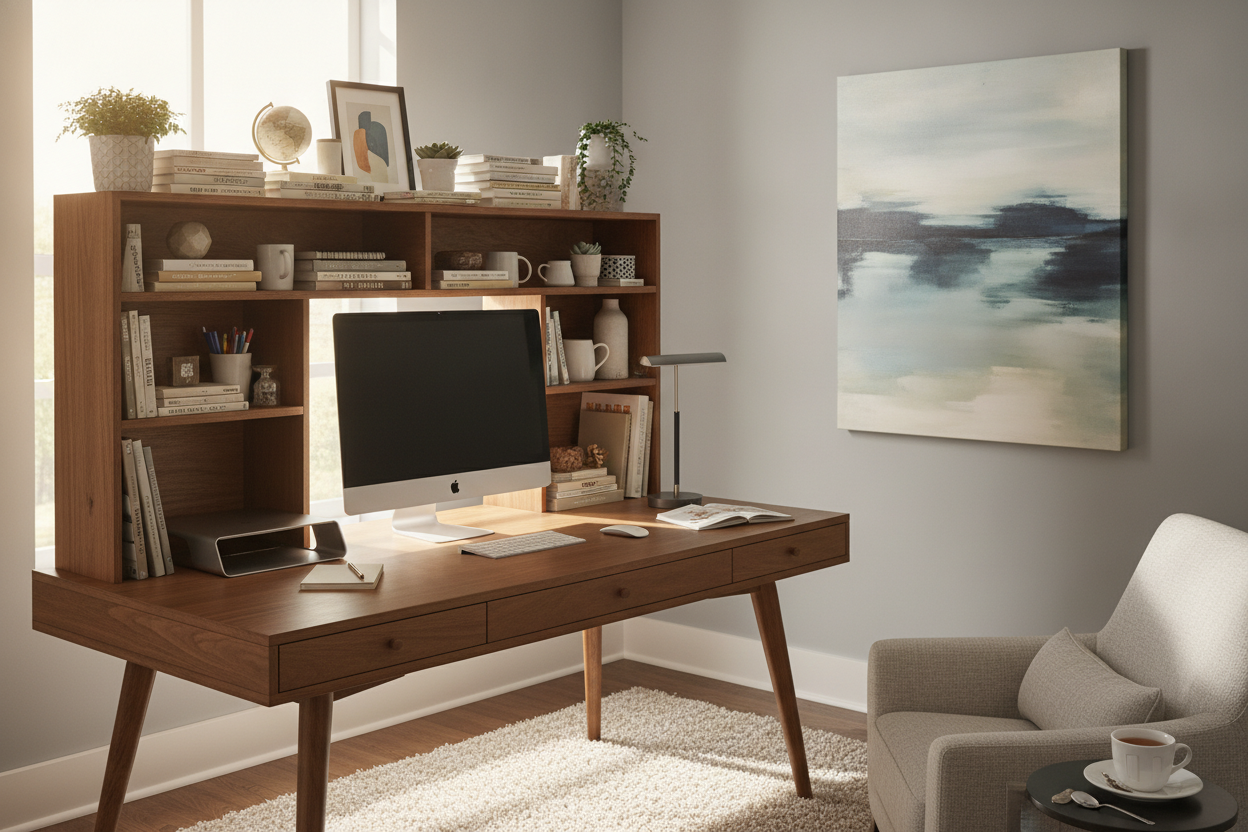
I used to think my productivity was tied directly to my available surface area. I bought a massive desk shelf organizer thinking I’d finally have a place for my pens, my sticky notes, and that one smooth rock I found on a hike in 2019. Instead, I just created a two-story parking garage for trash. My mess didn't go away; it just got a better view of my face.
Quick Takeaways
- Vertical space is a trap if you don't declutter your actual desktop first.
- The 'Arm's Reach' rule is the only thing standing between you and a chaotic workspace.
- Clamp-on shelves are almost always superior to free-standing units for stability.
- Cable management becomes 10x more visible once you add a shelf, so plan for it.
The Trap of the Elevated Junk Drawer
Buying a desktop shelving organizer is the office equivalent of shoving everything under the bed and calling the room clean. You feel better for exactly five minutes. Then, you realize your stapler, three half-empty Chapsticks, and a stack of 'to-do' mail are now staring you in the face at eye level. It’s distracting, it’s ugly, and it’s a total productivity killer.
An over the desk shelf organizer is meant to give your monitor some height and your keyboard a home. It is not a display case for things you’re too lazy to file away. When I first set mine up, I treated it like a trophy rack for my clutter. If you aren't careful, you’re just building a monument to your own procrastination.
Why You Need to Audit Before You Elevate
Before you even think about adding an office desk shelf organizer to your cart, you have to do the brutal work of a purge. If you haven't touched a piece of equipment or a notebook in three weeks, it doesn't deserve a spot on your desk. It belongs in a drawer, a closet, or the bin. Period.
The goal of desk shelf storage is to create a 'cockpit' feel where everything you need is accessible but out of the way. I had to read through this expert guide to office desk shelf design to realize I was treating my workspace like a warehouse rather than a workstation. You need clear zones, not just more levels of stuff.
The 'Arm's Reach' Rule for Desktop Storage
Here is my personal framework: if I have to stand up or lean significantly to grab it, it shouldn't be on my shelf organizer for desk. Daily use items—my DAC, my main notebook, my glasses—stay on the top tier. Everything else gets hidden. If you use that heavy-duty stapler twice a year, why is it taking up prime real estate on your desk? Hide it.
How to Style It So It Doesn't Look Like a Hoarder's Rack
A desk organizer rack shouldn't look like the clearance aisle of a big-box office store. To keep it from feeling heavy, I follow a 60/40 rule: 60% utility, 40% aesthetics. Put your monitor on one side, a small Pothos plant on the other, and maybe one—just one—decorative object in the middle. This breaks up the visual weight of the desk shelves organiser.
Texture matters too. If your desk is white laminate, don't buy a cheap white wire rack. Go for wood or felt to add some warmth. If you want a setup that actually looks intentional, take some notes on office desk and shelf layout to avoid the 'cubicle' aesthetic. Use trays to corral small items like paperclips so they don't migrate across the shelf like tiny metal ants.
The Best Types of Shelves for Tiny Desktops
If you're working on a 40-inch slab from a Swedish flat-pack giant, you don't have room for a bulky computer desk shelf organizer with four legs. It will eat your mouse space. Instead, look for a desktop storage rack that clamps to the back edge of your desk. This keeps the surface clear for your actual work.
For those with weird setups, a small desk organizer shelf that is modular is the way to go. I personally prefer adjustable shelf storage because my needs change. One month I’m using a massive 32-inch monitor, the next I’m back to a laptop and a secondary screen. Your furniture should be as flexible as your workflow.
The Cord Management Reality Check
Here is the brutal truth: an organizer shelf for desk acts like a spotlight for your cable spaghetti. Because the shelf is raised, all those wires running to your monitor, keyboard, and speakers are now perfectly framed for the world to see. It looks terrible. I spent three hours last Saturday with Velcro ties and adhesive clips just to hide the mess my new shelf exposed. If you aren't prepared to cable manage, don't buy the shelf.
Personal Experience: The Great Topple of 2022
I once bought a cheap, particle-board shelf that claimed to hold 50 pounds. I put my ultra-wide monitor on it and within two days, the center started to bow like a sad smile. Always check the material. If it’s half-inch MDF, skip it. You want solid wood, heavy-duty aluminum, or steel. My current setup is a solid walnut plank on steel risers. It doesn't wobble when I type, and it doesn't look like it belongs in a dorm room.
FAQ
Do desk shelves cause neck pain?
Only if they are too high. Your eyes should be level with the top third of your monitor screen. If you're looking up, you're going to end up at the chiropractor.
Are wood or metal organizers better?
Metal is thinner and usually more 'industrial,' which is great for small spaces. Wood feels premium and dampens sound better, but it usually has a thicker profile that can feel bulky on a small desk.
Can I put a printer on a desk shelf?
Only if the shelf is bolted or clamped. Most 'sit-on-top' organizers will vibrate like crazy when the printer starts moving, which makes for a very annoying work environment.



Laisser un commentaire
Ce site est protégé par hCaptcha, et la Politique de confidentialité et les Conditions de service de hCaptcha s’appliquent.